Casco Viejo: The Second Season
Chapter Ten
Almost forgotten in the aftermath of Beth’s murder was the scheduled visit of Barb’s best friend from high school Jackie and her husband Hank, all the way from Saginaw, Michigan. Even though they didn’t socialize much with the Hanners back in Saginaw—Barb would meet Jackie once or twice a year for lunch—they were the first and so far only people who showed any interest in visiting Panama. “Their visit will give us a chance to become acquainted,” Mitch pointed out. It mystified the Multuskys that so few of their friends, family, colleagues and acquaintances seemed to consider Panama a desirable place to visit. “Maybe they don’t know what’s here,” Mitch reasoned. “I mean how interesting can a canal be?” When Barb raised an eyebrow, “I know, an engineering wonder of the world; but I don’t think people realize how big and impressive the city is or that the entire country is two beautiful coast lines with a mountain range in the middle or …”
“A banana republic with dictators like Noriega running around having machine gun battles with drug cartels,” Barb giggled. “You know when we left, people kept saying how brave we were; like we were hiking into the rainforest with nothing but a water bottle and a machete. If not being able to speak Spanish stops people then no one would go to Miami. I think they’re ignorant of where or what Panama is. All they know is that Carter should have never let Panama have control over the canal.”
“Another real possibility is that the people back in Michigan don’t miss us that much,” Mitch said, as he popped open a can of Atlas beer.
“And vice versa,” Barb said, which was true. She had expected to feel more sentimental about leaving a place where she had spent most of her life, but she didn’t. Before she left, at her school’s end- of-the-year party for example, she got the impression that some of her fellow faculty felt that they were somehow being abandoned—that Barb was turning her back on them, or on America or home or something that comprised all of that. Why would anyone want to live anywhere other than in the good old United States of America?
Mitch and Barb never had kids and there was always a mixture of resentment, disapproval and pity about that, but it also gave the Multuskys the freedom to live wherever they wanted, without worrying about being there for their children and grandchildren and birthdays, graduations, weddings and Christmas. Barb always wondered why her biological alarm clock never went off. Mitch and she never considered themselves particularly selfish or ungenerous, after all they ended up working with thousands of other people’s kids, but the urge to procreate seldom if never came about for them. It wasn’t a problem, except in other people’s minds, some of whom had even inquired over the years if “everything was working properly.” To be honest, they never checked medically, but had always been very careful. When Barb reached menopause, Mitch claimed to “miss a good ol’ cum shot every once in a while.”
With their parents deceased (Mitch noted once that “we’re orphans living in a strange land,” while Barb thought the term orphans seemed inappropriate for two old fart retirees.), and a brother here and a cousin there, family wasn’t as strong a force as it seemed to plenty of folks Barb knew. Again it wasn’t rejection. As far as Barb was concerned they weren’t rejecting family or America. Once when they were discussing what they left behind—partisan politics; real estate tax coupled with a rising cost of living; eight-lane highways; and reality TV; both were quick to admit that there was much they missed including smooth roads; postal service; the local evening news on TV; corn-fed Angus beef; and long summer nights. “I do miss apple pie,” Mitch admitted, “but we have baseball down here and they’re pretty good, so there’s pluses and minuses.” Yes, when they watched CNN International they were informed that other things were happening to people in the world other than U.S. politicians and celebrities. They voted absentee in the federal election (Obama—both wanted Hilary, but never voted for “that idiot Bush” and certainly not McCain), and still paid income tax and worried about the recession and the oil spill. “Okay,” Mitch said when Barb kept fretting, “we’re retired, which means we’re on permanent vacation and we picked some place exotic, instead of some god-awful retirement community outside of Orlando or Tampa or wherever. Not that there’s anything wrong with that (with a wink), but we took the path less travelled and that’s made all the difference.”
“Not an exact quote, but close enough.” Barb loved her husband and appreciated his attempts at humor and/or wisdom and knew there was nothing she could do about the perception of others. Maybe in a busy world, they hadn’t really been gone long enough yet to be missed. And Jackie and her husband were coming in, soon in fact, so Barb washed a couple of glasses in the sink and asked Mitch if he was ready to go to the airport.
At Tocumen Airport, Barb and Mitch waited for nearly an hour after the flight landed for their friends to finally emerge through the door from customs. Many, many people had come out that particular sliding glass door in the past forty-five minutes and were greeted by huggers or guys with signs with names printed in marker, but never the Hanners. There was even a lull, when no one existed for what seemed like five minutes. Then when the Hanners did show, Barb and Mitch failed to immediately recognize them. It might have been the sun glasses (“Why would they need sun glasses inside the terminal?” Mitch wondered later, in private. To which Barb replied “maybe they were ready for the tropic sun.”); or maybe it was that Jackie’s long brown dyed hair was pulled back in a ponytail; or maybe it was because neither one of them knew Hank that well. Then too Jackie and Hank peered past and beyond their hosts before finally focusing on the Multuskys looking around anxiously.
“Can you imagine,” Jackie said as she ducked away from Mitch’s attempt at an air kiss, “the people in customs didn’t even speak English.”
“It’s a Spanish speaking country,” Mitch said.
“At the airport?” Hank was in full eyebrows up; head back; well-I-don’t-think-so attitude that immediately, irrevocably pissed Mitch off.
“Actually, everywhere. Here let me help you with that.” Hank handed over his suitcase happily and allowed Mitch to hoist both his and his wife’s luggage, while he pulled a small carry-on bag on squeaky wheels, while Barb took control of Jackie’s carry-on.
For the next four days, Mitch had to bite his tongue and ignore the urge to grab the much shorter but pudgier man and shake him by the lapels, actually by a fist full of polo shirt. While Barb and Jackie seemed to have plenty to talk about, Hank kept hitting Mitch with statements like:
“I thought they drove on the left in Panama.”
“No that’s the Bahamas and I think maybe Bermuda—nowhere near here.”
“I’m going to need to exchange some money.”
“It’s the U.S. dollar down here.”
“You’re kidding. So I guess we’re still in charge.”
“Not really.”
“So I need to change the time on my watch.”
“Actually, we’re in the same time zone, so your watch is correct.”
“No way. How can that be? You know that was the announcement on the plane when we landed, but I didn’t believe it.”
“Panama is directly south of New York or Miami in the Eastern Time Zone, but we don’t have day-light-savings time, so we match the Midwest.”
“No way. How can that be? Panama’s way over in Central America. Am I right?”
“Well yeah, but its longitude, not latitude. Anyway, your watch is correct.”
“So who is the dictator now?”
“Actually, they have an elected president, a fella by the name of Martinelli, and a vice president, and a democratic legislature and democratically elected representatives and mayor of the city.”
“You’re kidding. So where’s, you know, what’s his name?”
“Noriega?”
“Yeah, that guy.”
“Well, for the past 17 years he’s been in prison in Florida and just recently he was extradited to France for money laundering charges.”
“You must be kidding. That long ago?”
“I kid you not.”
And so it went. When Carmen jumped up to say hello, Jackie acted as if she were being attacked by a giant scorpion. Hank would push down at Carmen and fervently say “Bad dog, bad dog,” until the free-range pet would take the hint and escape through the window grate. Jackie was allergic to seafood in a country of coastline. Hank wasn’t but wanted oysters and something “light and white like haddock”—neither available. Jackie, who was shaped like her husband, kinda round in a not very tall way, seemed to talk constantly, but never directed a single utterance at Mitch, who they both treated like a hired driver, with perpetual requests to turn up or turn down the air conditioner or radio combined with exhortations to “Slow down” or “Look out!”; or concierge with unending requests for different soap, fresh towels, tissues, toilet paper that turned out to be under the bathroom sink and to make fine adjustments to the air conditioning or fan speeds; or bartender, with requests for diet cokes, sparkling water, Corona beers with limes inserted in the bottle, vodka tonics that were too weak more than once, but never too strong and unpredictable switches from white to red or red to white wine almost always when a new bottle needed to be opened. Barb tried to help, but most requests, demands and comments were directed directly at Mitch, who made a point of springing into action like a well trained domestic, after his suggestions that “please feel free to help yourself” went unheeded.
More than once, twice in fact, Hank got up to go to the men’s room just in time to avoid being present when a dinner check arrived. Needless to say, he never inquired about the bill or even offered Mitch the pleasure of receiving a thank you. Hank was quick on the draw for lunch and made a point of saying “My turn,” strongly implying that the next meal—dinner with cocktails, appetizers, dessert and at least two bottles of wine—would be someone else’s turn.
Were they impressed by the locks on the Panama Canal? Not really. “It takes a mighty long time for a boat to get through.” They did think the skyline of Panama City reminded them of Miami Beach, which turned out to be a place they had never been. Too much horn honking, too many pedestrians and way too many tall buildings as far as they were concerned in Panama City.
Ah, but what about Casco Viejo? “Well, it certainly is no New Orleans.” Another place they had never actually visited. Too much construction. Too many tourists. “So what are they?” Mitch wondered under his breath. And the sidewalks. Both Hank and particularly Jackie walked the sidewalks of Casco Antiguo as if they were crossing a lunar minefield. Hank actually said “I can’t look at the architecture because I have to watch my every step.” No doubt there are too many cracks, holes and uneven places, but the Hanners were so not making a go of it, that Mitch was tempted to push Hank off the curb into an oncoming taxi and simply claim that Hank fell. When they saw the cranes, stately exotic birds that had been part of the scene since the 1920s, in the lobby of the presidential palace, they thought it was “weird.” And the views of the Pacific Ocean from the walls of Las Bovedas. “Nice.” For once Mitch did not think that the ancient practice of chaining prisoners to the outside walls during low tide as too cruel. “It would be nice, when high tide came and Hank was chained at rock level.” Mitch smiled at his fantasy. Overall impression of Casco Viejo—“kinda run down, but could be nice (Nice again. Mitch’s nostrils flared.) with a whole lot of elbow grease.” Mitch thought of greasing his elbows. Then in one of Hank’s most gracious moments, “…an interesting place to visit, but I wouldn’t want to live here.” A two or three beat pause, then a nervous little smirk and a lame “I was only kidding. It’s all very nice.” Jackie slapped his arm and said, “They might not believe you’re kidding.” They didn’t. After five days of “getting handled by the Hanners,” as Mitch would remember it, Multusky drove them to the small local airport at Albrook for their flight to David and their stay in a small boutique hotel in the mountains near the town of Bouquete. Since Barb stayed back so she could get back to her private investigation, Mitch saw no reason to do anything other than simply stop at the main entrance of the airport and pull the lever that unlocked the back door of the SUV. Hank struggled some but got the baggage to the curb. When the door was closed, Mitch needed all his self control, developed through years of being the vice principal in charge of discipline at a junior high school, to not burn rubber. Instead, he lowered the passenger side window half way and said “Good bye.” He then pulled off slowly, but without waiting for anything more to be said by his guests.
Barb really had no idea how to conduct an investigation, especially since she did not have any authority to do so. Benito Cortez, her young Panamanian lawyer and guardian angel, tried to get information from the police, who were not very forthcoming. Since Beni was unwilling to misrepresent himself as anything other than a concerned citizen, all he was really able to do is translate the official police report—estimated time of death: sometime between 11:00 p.m. and 7:30 a.m. / cause of death: strangulation / suspect: Horace Gomez, aka Jamon / motive: attempted robbery / evidence: Gomez had an unspecified amount of cash on his person / victim’s purse and wallet were missing / items of value such as a cell phone; wide-screen TV; art work; jewelry including a diamond ring on victim’s small finger were still on the premises / other details: no evidence of forced entry; cat’s bowl was empty and cat had not appeared; front door and back gate locked, while door to back porch left ajar.
Beni was allowed to speak with Jamon, even though he had no intension of representing the street person. Cortez did not do criminal law and couldn’t see how becoming officially involved would benefit his career or reputation. Barb was so anxious to do something that Beni went along but wasn’t very convinced by what he learned during his interview with Jamon. For the most part, Jamon didn’t know what was happening or what happened. He was very sorry, but he didn’t hurt Senora Beth. He had no idea who did, and did not remember seeing anyone. He was around like always, but couldn’t remember exactly where or when. He looked up at the handsome young lawyer with a bewildered expression on his sad face.
Did he have an alibi? No. / Did he go to Senora Beth’s house? Yes, but she was not there. How did he know she wasn’t there? She didn’t answer when he knocked on the front door, looking for a donation. (That answer won’t help him Beni thought.) / Was he with anyone? Sure. Juan, Billy and Carmen. Did he mean the dog? Yes. Was he with them at any particular time? Yes. When? During the night…and so it went. Beni was fairly confident that Jamon had not committed murder, but was also sure that the poor little dumpy helpless man would not be an easy client to defend.
The only method that Barb could come up with was to visit with people who she thought might have done it. In other words involve the suspects themselves in her informal inquiry. For a variety of reasons, not the least of which was that she was a bit afraid of Jerry Cole’s temper herself, she skipped him and went on to Allen Myers, the closest thing she had to someone who would be grieving and maybe who would share her ardor to find the true perpetrator.
She had never been in Allen’s apartment before and was surprised at how much it struck her as a so-called bachelor pad. It was done up in what she considered “retro Playboy Mansion,” even though Barb really had no experience in any such place. There was actually a painting of a busty Nubian princess on black velvet, hung directly above a sectional couch upholstered in a leopard print. A single black-leather Lazyboy-style lounge chair was stationed in front of a huge flat-screen TV hung on a wall that was painted fire-engine red. A three-stool curvy bar with gold studs in red leather stood in one corner. The dining area with an over-formal chandelier seemed neglected with papers, envelopes and magazines scattered on the table surrounded by four chairs, all pushed in. When Barb used the powder room she noted two rather tasteful pen-and-ink drawings of nude women on the wall.
After Barb expressed her concerns about Beth’s killer getting off, while poor Jamon was taking the rap, she asked Allen if he had any idea who might have actually committed the crime.
“Well, it wasn’t me,” Allen said as he pulled out one of the dining set chairs and pushed a couple of old newspapers out of the way. One was a La Penza that had the front-page story of Beth’s death. “Of course you know the husband is always the first and primary suspect, but since Beth’s husband is dead, the boyfriend is the most likely and that was me. To be quite frank, I expected a lot more attention from the police. After all, I was the last person to see her alive.” When Allen saw the surprised look on Barb’s small alert face, he shrugged. “We even had sex, so there should be a boatload of DNA evidence if they even checked. Anyway, I told them I left around 11 and they duly noted that and apparently went out and arrested the bum on the corner.” Barb did not know how to respond to Allen’s incriminating evidence. “Here’s my point,” he said in response to the fact that Barb did not display a poker face. “I know I did not kill Beth. Shit, I liked her, a lot. I mean what would my motive be? End the best chances for a real relationship in years. We were perfect for each other. To be totally honest, I was more than a little put off by how casual or off-handed or however you want to put it that the cops were. Now, I do have a witness, who saw me arrive home at a little after 11, but that still doesn’t mean I shouldn’t be a suspect, if you know what I mean.”
Barb nodded. “Who’s your witness?”
“Jack, Jack Smith. He often sits out on a bench in the square outside our building. I even said ‘hello’ to him.”
Barb’s hands were fluttering like sparrows. She had decided not to take notes, until after she left because she wanted to appear like a concerned friend, rather than a nosey private eye. However, Allen was hitting her with more info than she knew what to do with. Why hadn’t Jack mentioned that he had seen a or the prime suspect that night? Why was Allen being so darn forthcoming? Was he trying to disarm her with candor? What would be a plausible motive for Allen to do Beth wrong? And what am I getting myself into? “So, who do you think did it?”
“I have to admit, I don’t think that worthless homeless guy had anything to do with it. So I agree with you that Beth’s murderer is still at large.”
“So?”
“So I don’t know; but if I had to guess I’d say it could very well be that creep Joe Berger. Beth told me that he had been lurking around her house for days and I actually caught him once on her door step.”
“Why Joe?”
“You’re kidding right? The stupid shit, excuse me, was jealous. I mean you’re not going to broadcast this around, because if it’s not true it’s slander.” Beth gave a wave of her jittery hands to indicate no problem. “But the guy was literally stalking her. Beth told me that she might have encouraged him at first, whatever that meant, but that he kicked her dog or something and she decided he wasn’t her type and that she had trouble getting rid of him.”
“I don’t believe that Beth had a dog,” Barb pointed out patiently. “Maybe it was a cat.”
“No, no, it was that little black and white mutt, that hung around her place.”
“You don’t mean Carmen?” Barb was reeling from too much information, much of which was a total surprise. So, she tried to get back to Berger, since he was in fact near the top of her list of suspects.
“I really don’t know the dog’s name. I mean I think it’s a stray.” Apparently Allen had never encountered Barb or more likely Mitch when Carmen was on a leash. “What I do know, was that Berger lost what chance he had, when he kicked that dog; and then I came into the picture and he wasn’t happy. So much so that the jerk started going out with that bimbo, I was dating before.”
“I believe I met her on at least one occasion,” Barb offered.
“Yeh, the Columbian hooker I forced on you folks a couple of times. I’m sorry about that, but I guess I was showing off or something. I’ll tell you I was thankful that Beth didn’t hold it against me.”
Again Barb was stunned by Allen’s candor, so much so that she found it made her suspicious. “Why are you telling me all this?”
Allen paused, and looked the little woman at his table straight in her eyes. “Am I telling you anything really that you haven’t at least suspected? I mean, you’re the first person that came around, except the police, who has even bothered to ask how I’m doing. Well, I’m fucking upset, if you really want to know. I meet somebody pretty darn cool and we start like dating, really dating and I have sex with her and later that same night, she’s murdered. And you ask me who I think might have done it and so I tell you. What do you want me to say? I think it was that Berger character.”
“Do you think he’s capable of murder?”
“How the shit should I know. Does anybody know anything about the guy?”
Monday, July 5, 2010

Wednesday, May 26, 2010
Casco Viejo: The Second Season
Chapter Nine
For a moment, Jack did not realize that the faint buzzing sound was actually coming from the buzzer to his door. It had been weeks, months maybe, since anyone had come to visit and pushed 3B. He was both surprised and irritated. Why was he being bothered? His cell phone seldom rang. Jack Smith had gotten used to being by himself. Sure his name was recognized as the restaurant critic for The Visitor, but that required a certain degree of professional anonymity, so he often flew solo. Every once in a while he brought the editor Edward Jacobs along because the young American, who had learned Spanish while his parents were missionaries in Bolivia, always seemed to appreciate a free meal. Jack had gotten used to his loneliness. In a way, he romanticized his isolation as a tribute to his dead wife. Nobody could take Patricia’s place. She had been his best friend; his lover; the mother of his children ; his confidant. It was disturbing, almost scary to have his solitude interrupted. The buzzer sounded again. Reluctantly, Jack stepped over to the intercom and enquired “Who is it?” Nobody answered. The buzzer sounded again. “I hope this isn’t kids pulling a prank,” Jack thought, because he had heard it happened to other people, though never to him before. So again, “Who is it?” This time he heard a voice, cut off at the first syllable when he released the button. “Oh, shit,” and then with the button held down, “I’m sorry. Who is it please?”
“It’s me, Barb. I need to talk to you. Can I come up for a minute?”
The feeling Jack had at that moment could only be explained as panic. Brief, fleeting, illogical but that is what he felt, and not just because he was seated in his parlor in his boxer shorts and a woman was trying to gain entry. It must have been something in her voice. Why would she need to talk to him?
“Okay,” he said. “Give me a minute. Is Mitch with you?” Jack wasn’t sure why that mattered, but he wanted to know. He grabbed an old pair of khaki shorts and tucked in his tee shirt.
“Just me,” Barb Multusky said.
“Oh, oh,” Jack thought. Even over the static of the intercom, Barb’s cheerful-enough tone sounded forced, excited maybe or anxious. “What is this about? I hope Mitch is okay,” he wondered wringing his hands in a worried way. “This is silly. It’s Barb for Christ sake.” Sometimes Jack did speak out loud to himself, and this was such an occasion. “Come on up,” he said and this time he held down the release button that unlocked the exterior door, with a jailhouse clank.
When he opened the door, Barb darted into the room, strafed him with a quick air kiss and positioned herself in the middle of his living room. “I’m sorry to burst in on you like this,” Barb said. Burst was exactly what she had done. Had she looked around, Barb would have noticed a rather old fashioned, very tidy apartment decorated in what would have to be called Spanish Colonial style. There was actually a faux painting of a bullfighter with his red cape swirling as a hefty bull reared its horns. The coffee table, side tables and dining room set were all done in thick dark wood and the soft couch was upholstered in shiny green and gold brocade. The place had been decorated by Jack’s late wife and he saw no reason to change anything. He motioned toward a chair with his hand, but Barb acted puzzled by the gesture. Her agitated movements did nothing to quell the feeling of dread that Jack felt when the buzzer first sounded.
“My god, Barb, what’s going on? Is Mitch okay? Please, please have a seat and tell me what exactly is going on.”
“Oh, Mitch is fine,” Barb said, with a dismissive wave of her hand. “He’s at practice with his little team, trying to figure out if they’ll ever win a game. Don’t worry, it’s nothing like that.”
“Then what is it?” Jack was in no mood to be patient.
“Well, you know about poor Beth…”
“Of course—it was on the front page of La Penza. Terrible, absolutely terrible,” Jack said, and he meant it. Nobody deserves to be murdered, but he, like many people, was shocked and troubled by the fact that it was somebody he knew and liked.
“So,” Barb said as she slid to the edge of her chair, “who do you think did it?”
“Well, I’m sure I don’t know,” Jack said, even though the first person he thought of when he saw the newspaper was Jerry Cole. After all, Cole had made no secret of the fact that he was furious with poor Beth and railed against her at every opportunity. Even though he hadn’t read many mysteries as an English professor, sticking more to serious fiction, he had read enough and seen plenty of movies, where the perpetrator of the crime was never the most obvious candidate, so he wasn’t about to speculate.
“But you must have some suspicions,” Barb persisted.
Jack was not a big man, at 5’8” a little below average, thin but not fit, with a short gray haircut, with a sloppy part, but he looked even smaller to Barb as he leaned back into the cushions of his couch.
“I’m afraid with our friend Beth there might be quite a list of suspects, to be honest,” Jack said with shrug. “Being unhappy or jealous or whatever is one thing; but being capable of murder and motivated enough to do such a thing is quite a different proposition. And then of course, it could be somebody we’re not even aware of; a burglar for example; or a rapist; or somebody from a part of Beth’s life we know nothing about.” Jack hadn’t realized until that moment, but he had done some thinking on the subject of who just might be capable of strangling Beth, which was the reported cause of death.
“Exactly,” Barb said waving her right index finger in the air. In some ways, Barb reminded Jack of his mother, who died at the age of 86, small, frail but energetic, with an intelligent glint in her blue eyes. “I don’t suppose you heard,” Beth continued, “but the police arrested that poor street person Horace and charged him with Beth’s murder for goodness sake.”
“Who?” Jack had no idea. “But there you have it. Case closed without slandering anyone.”
“You know, Jamon, Ham, that’s what they call him, the street guy…” At that Barb rose to her entire 5’3” height, “but I don’t for a minute believe it was him. He’s harmless and helpless and he’s no bigger than Beth. To be honest in a fight, I think she would kick that poor drunk’s butt and definitely not allow him to choke her much less to death. It’s ridiculous and just too easy. Poor old Horace or Jamon was passed out in an alley when they picked him up. Mitch was out walking Carmen and watched as the cops had trouble waking the guy up, for goodness sake. Not much of a getaway; and of course no alibi; but I just can’t believe it. You said there would probably be quite a long list of suspects; but I bet Jamon wasn’t on the one you came up with, was he?” In a pair of skinny pedal pushers and a white blousy top, Barb paced back and forth across the worn oriental carpet as Jack watched like a spectator at a tennis match.
“Of course because first I don’t think I know the fella and secondly, I don’t have an actual list.” Jack leaned back into the sofa.
“Oh please Jack, don’t be obstinate.” Barb flopped back into her chair and her feet actually came off the ground. “I need your help. Obviously the wrong person is being accused, while the real murderer is out there and for all we know could be somebody we know. We can’t let the real murderer get away with it, can we?”
“Now wait a minute, will you,” Jack said trying to sound calm and firm as if he were attempting to cool down an argument at a faculty meeting or a confrontation in a classroom. “You keep saying we and that you need my help; but to be quite honest, I don’t see how I’m involved at all. Or you, for that matter. It’s none of our business.”
“She was a friend of ours—one of us, a member of our little community. There’s nobody else—no husband; no children; I don’t know if there’s even a next of kin. She died alone, like a lot of us will down here, since we’ve made a clean break with back home; this is home, our home. At least we should challenge the police to make sure they’ve got the right person.”
Jack sat up straight in his chair. He didn’t like hearing about dying alone. Little Barb sat across from him making him feel very uncomfortable and guilty and alone. “Why are you saying these things to me? I knew Beth, sure; I even liked her; but we were far from fast friends. She has never been in my apartment, for example. What am I supposed to do? Why are you here?”
“Because, you’re a journalist, you know how to investigate things, you know, like crimes.”
“I’m a fucking restaurant critic,” Jack said throwing up his arms. “Excuse my French, but the only thing I investigate is the dessert trolley.”
“Jack, you taught journalism for years, I know that, and I’m sure you know how to be an investigative journalist.”
“No never,” Jack said. “Theory sure, and a couple of my students investigated crimes on campus or misappropriations of funds or something like that but not often and nothing like this. Who do you think you are Agatha Christie or Miss Marple or somebody?”
“Oh, don’t be silly. This is serious and I’m serious. You know more about conducting an investigation than I do…”
“Don’t be so sure,” Jack interjected.
“…and there is nobody else; nobody else. If it had happened to me, Mitch would have tried to find out the truth, but I sincerely feel that the poor dear wouldn’t get very far. How about if you got mugged or murdered? Who would look after your interests?”
“That’s just my point,” Jack said and surprised himself with the bitterness he felt. “Nobody. Nobody in the world would bother to investigate as you suggest. Why would they? Nobody cares. They would tisk, tisk, tisk over white wine at happy hour and go about their business. I would be surprised if you would be out tracking down my killer, to be quite honest, my dear.”
“Maybe so, maybe so, I don’t know,” Beth said with a sincerely sad look on her face. “I would like to think I would do what I could; to do the right thing. That’s what I want to do, the right thing by Beth, by myself by all us lost souls looking for a home in somebody else’s country. I’m sorry Jack; it’s not your problem, but who else is there? And excuse me, what else is going on in your life? Or mine? Why can’t we stick our nose in and see if we can do our part to make sure this horrible business turns out correctly?”
“I write my restaurant reviews.” Jack tried to look indignant.
“That takes three hours, four hours max and two of those hours are spent eating the dinner. You’re a professional. I read your reviews. They’re fine and informative, but you’ve got it down to a pattern and then what?”
Jack was pleased that Barb actually read his stuff and at the same time upset that she felt she had detected a formula. Of course there was a formula, especially when writing to certain space limitations, but it was his job to hide that from his readers. “I’m sorry, you find my reviews tedious,” Jack said.
“Oh, stop it,” Beth said. She looked cross and exasperated. “I find your reviews very entertaining, but that’s not what we’re talking about. I’m here because a woman we knew was killed, before her time, by somebody who is still walking around; and laughing; and having a life; and eating in nice restaurants that you recommended while some poor jerk takes the fall and nobody cares. So I say, let’s care. Why not?”
“Well, the murderer could get you or me next especially if he finds out we’re playing Sherlock Holmes. That’s why not.”
“Only if it’s not Jamon. We’ll be discreet. I’ve asked our friend Beni, you know Benito, my lawyer to help out with the Spanish speaking police and all; and when I told Bobby Boar, Beth’s attorney, that they arrested a bum off the streets, he laughed. He promised me he’ll look into some things too. So we’re not alone. Please Jack, help me out. I need somebody to brain storm with and snoop around and, you know, work with me. It might even be rewarding; but I can’t do it without help.”
“And, it’s me, not Mitch because?”
“Because Mitch would never do it and he’s not up to it, to be honest. And it’s you; because I did work up a list of possible suspects and Mitch and you are the only men I know who are not on the list, if you really want to know. You didn’t murder Beth, did you?”
“No, I didn’t,” Jack said. “By the way, why are you sure it’s a man?”
“I’m not. I don’t know who did it. But I will tell you that Allen’s hooker ex-girlfriend is on my list.”
“Tell me,” Jack said. “Was, as far as you know, anything stolen from her house?”
“I have no idea. That’s something I hope Beni finds out from the cops,” Barb said, then, she smiled.
“Well, that’s important,” Jack said. He sat straight up. “If nothing’s missing that means it was probably a crime of passion.”
“So do you want to compare lists?”
* * *
Since she read in Panama News, an English-language news website, that Beth Page had been murdered, Madge had a knot in the pit of her stomach. The thought “stupid Jerry, stupid Jerry” played over and over like a refrain in her brain. When she read the first paragraph of the article and realized that the “Prominent Real Estate Developer…” in the headline was Beth, the first person Madge thought of was Jerry. After all, her husband, more than anyone else, had gone out of his way to establish a motive. He told people that he “hates that bitch.” He cussed her and yelled at her and made angry faces at her at parties and even on the street. Madge was sure that there were dozens of hateful e-mails on Beth’s computer from her bitterly angry, often distraught husband. How difficult would it be for an investigating detective to find that incriminating paper trail, or electronic trail or whatever it’s called?
When her husband would come home frustrated and angry, it seemed like he was letting off steam by describing the method he would use to “get rid of that Beth bitch.” That’s what he called her, never simply Beth or that Page woman or anything like that but always “that Beth bitch.” He would often go into detail, about the creative ways he would wreak his revenge—a briefcase that supposedly contained the last payment which he never intended to make but was stuffed with explosives instead; a poisoned wedding cake “if she ever married that jerk Allen”; a Fer-de-Lance tucked under her pillow; and the not so creative methods involving aluminum baseball bats; chainsaws; shotguns and machine guns; steak knives or machetes; or his favorite, his bare hands. Oh, oh, that’s a little too close to what reportedly happened. Madge had taken out a tissue and wiped her glasses when she read that Beth had been choked to death. Jerry had told her repeatedly that he “would love to wring her neck.” That’s what he said. Most of the time, Madge would laugh off the threats as silly fantasies and Jerry would make it seem comic with exaggerated gestures and a deep announcer’s voice as he described lighting the fuse to the stick of dynamite or running her over with a bulldozer from the construction site.
Of course, he was joking. Where was Jerry going get his hands or grenades or a Glock. But his bare hands, there was the rub. As was often the case lately, Madge had had her first vodka tonic around noon and usually switched to Absolute on the rocks with a twist by cocktail hour. As a nurse, she knew she was self medicating and as Jerry’s wife she felt she needed to tranquilize herself. Jerry never hit her. That’s what she always told herself. However, if the truth be told, he had shoved her a couple of times and grabbed her arms and left bruises that she had so far successfully hidden from friends and colleagues with long sleeves or makeup. So was that enough to mean that he was prone to violence? Even though they weighed about the same, not always but lately, Madge was in fact afraid of her husband, because there was no way she could match his intensity. She tried to tell herself that it didn’t happen often, but sometimes he would yell loud and rage at her and call her fat, which was true and stupid which wasn’t true at all. His small pinched face would contort into an ugly grimace, while his words would be cruel and direct without sarcasm, simply mean—fat pig; four-eyed sow; stupid cow; stupid hippo; stupid mutt…One time, it finally struck her as so ridiculous that she laughed and said that “you’ve called me every animal name under the sun.” To which he responded, “you’re right, you stupid pile of shit.” No more laughing it off.
Of course, he almost always apologized and said that he regretted losing his temper and would even show up occasionally with the cliché flowers or champagne and always with a promise to do better. He didn’t mean what he said. He was out of control. If anything, he needed her help and was so, so very sorry. He never actually promised that it would not happen again, but did say that he would try, whatever that meant. Marge was embarrassed that as a medical professional she couldn’t get herself out of the cycle.
Moving to Panama was supposed to help. Now that he was retired—forced out was the not-for-public-consumption story—building their dream house on the beach was supposed to keep Jerry occupied and stimulated. He was an engineer, after all, who for most of his life had specialized in oil rig construction; so how hard could it be to build a house. It was supposed to be their latest adventure. Really, they had moved around enough that Marge assumed that settling in Panama on a pensioner’s visa would not be that much of a challenge. The main reason they had chosen Panama was that even expats on a pension were exonerated from property tax for 20 years. Jerry loved the idea of not having to pay taxes. An unforeseen consequence was that Madge could no longer work locally because that was prohibited because she was the spouse of someone with pensioner’s status. There was no home base. They didn’t own a house anywhere else like in Houston or Curacao. So she could say she was on leave, since she had kept her certification up to date, but the reality was that no particular hospital had her on its books. Nobody was anticipating her return. Madge was trapped. She felt trapped. Sure she considered leaving Jerry, though she still felt loyal and responsible some times, but she had no particular place to go—by herself; all alone; a fat four-eyed cow with no prospects. It was Jerry, with all his faults and most of the money, or nobody.
Then Madge had the extra worry that her stupid misguided husband may have actually gone too far. The main reason that Madge found it difficult to sleep at night was that she could not provide an adequate alibi for her husband’s whereabouts the night of the crime. He wasn’t home at their apartment in the Columbus House until almost midnight. Plenty of time to do poor Beth in. Supposedly he was out at a bar along the highway socializing with his architect and one of the sub-contractors, trying a new approach of getting along with the people he was working with. However, it was an hour-and-a-half drive back to the city from Gorgona, so lots of unaccounted-for time even if he had someone who could corroborate his story. Then he was up and out by a bit after 6 a.m. and on his way back to the construction site. Again he had time to pay Beth an early unwelcome visit and still be on the Pan American highway before rush hour. Such thoughts filled Marge’s head with dread and her heart with a sadness that she couldn’t express to anyone, least of all her number one suspect, her own husband.
Another notion added guilt to the mix of feelings that made Madge ill. If Jerry had in fact done it; and she certainly didn’t have any proof he did, then that might be the last nail in the coffin and she could, would be forced to crawl out from under his thumb. Was Madge hoping that her own husband of 25 years was a murderer? In a way, yes—that would be an undeniable last straw; uncontestable grounds for divorce, with Madge getting most of the money. The beach house would eventually be completed and she could live there; get a dog; and be free; free of abuse; free to leave if she wanted. However, there was also the possibility that he had nothing to do with Beth’s death. In fact, when she told him the news, Jerry had appeared to be sincerely surprised and more than a bit bewildered. As far as Madge could observe he didn’t act guilty, though she also wasn’t very sure how guilt would be displayed. What he said was “So, the bitch is dead. How about that?”
To say that Madge’s nerves were on edge, jangled even, was an understatement. During the past couple of days, she couldn’t sleep, had trouble concentrating on the book she was trying to read and went on long walks around Casco Viejo, just to use up some of her nervous energy. Pacing the hallway of her small apartment made her feel like a crazy woman.
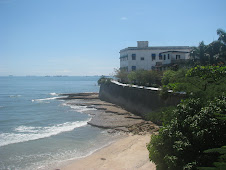
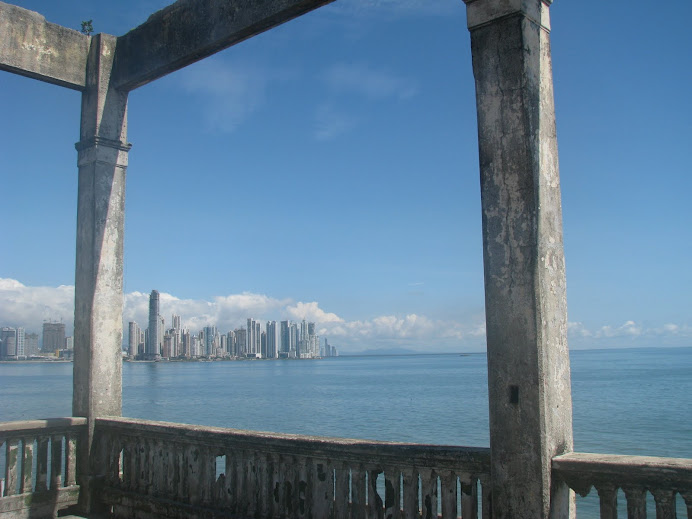
So there she was walking along the sea wall with the Gulf of Panama stretched out to the horizon. The tide was out and what waves there were in the hot afternoon calm broke some 300 yards away. Somebody had told her that the Pacific tides could run as much as 17 feet from low to high. Indeed there were times when waves splashed over the wall, but at that time long, flat brownish rock formations and sandy patches stretched out for what seemed like a couple of city blocks. At one point, a flock of 30 or 40 pelicans sat and rested on a rock formation that would be totally submerged at high tide.
Madge was at loose ends. She was on more of a wander than a stroll. There was no destination. Her only goal was to get out of the apartment. Not a smoker, she didn’t need cigarettes. Without a car, she couldn’t drive into the city and pretend to go shopping or out to lunch. A taxi was too much trouble. Even before she had the worry that her husband may have done a very bad thing, she sometimes thought of their apartment, with its rented furniture and a big screen TV that she didn’t watch very often, as a jail cell. She still wanted to visit the site where their dream beach house was being built, but Jerry often made her feel unwanted; not needed; in the way. How could she be a third wheel in a partnership of two? Without being able to escape to a job at a hospital, where she was treated with respect as a professional, because that’s what she was, she felt useless without an outlet.
At first, she was able to express some creativity by helping with the design of the house. Jerry seemed quite open, even welcoming to her suggestions. The upstairs balcony off the master bedroom; the wide doors that opened onto the terrace from the dining room as well as off the living room; the skylight over the stairwell; the way that the built-in flower beds curved around the terrace and the stairs down to the swimming pool were all her ideas. However, when construction actually began, Jerry suggested that she would be bored or even in the way. So, she was left back at the apartment and only visited the beach once or twice a week, most of the time on the weekend when the workers weren’t even there. The house was taking shape and Madge could see that it was going to be quite spectacular, when it was completed with an expansive view of the Pacific and Toboga Island out near the horizon.
However, progress did seem to be very slow. At times she couldn’t see much difference from one visit to the next. Costs also seemed to continually escalate. That was what angered Jerry the most. The contract that he signed that was brokered by Beth Page through the real estate agency with the contractor wasn’t as binding as Madge and Jerry had expected. At juncture after juncture, prices for materials seemed to go up and needed to be renegotiated and then paid up front. Permits took weeks to be approved instead of days. Bribes were offered, but then ignored; or accepted with no tangible speedup to the process. The specified windows were unavailable, even though the holes were already cut in place. Eight-inch tiles turned into six-inch. Twelve-inch tiles didn’t look right either. There was no drain hole for a sink in one of the bathrooms. Openings for light switches were behind doors. The guy who was supposed to do the very attractive blue-on-blue tile work in the pool got started right on time and then never showed up again. Plus Jerry didn’t handle the contractors and workers that well. Not only did he speak in pigeon Spanish, but he was too quick to yell. Whole crews quit and walked off the job because he disrespected them and made it clear because as Jerry said more than once “I don’t respect these guys. They’re useless at best and dishonest at worst.”
Jerry had never been known as a patient person and Madge had always had to deal with his quick temper and biting tongue. However, Jerry was no fool at his job and conducted himself in what could only be called a professional manner. That was until he had a “falling out” with his superiors and been forced into early retirement. At least that was Jerry’s side of the story and Madge really never had a chance to find out what exactly happened. Then when they decided on Panama and committed to the beach house, the trend continued. Things seemed to consistently go wrong and Jerry seemed constantly unhappy. Jerry had so many fallings out that Madge had joked to herself that her poor husband was in free fall.
Madge simply stood along the seawall and stared out at the distant ships anchored off the end of the Amador Causeway waiting their turn to pass through the canal. Mitch, with Carmen on a leash, was almost right next to her before she noticed her friend and his dog.
“Hola Senora. So what are you up to?” Mitch said. Tail wagging, Carmen jumped up and Madge caught the little dog’s front paws in her hands. “Down you bad dog,” Mitch said with a smile and a tug on the leash.
“Oh, nothing.” Madge shrugged. “I just had to get out of the apartment. How about you—what’s up?”
“Well, I know it’s silly but I like taking Carmen for a walk, every morning and afternoon. She even usually takes a pee and sometimes both.”
“Why’s that silly?” Madge patted the dog and gently pushed her away from her white peasant skirt.
A brief look of mild surprise passed over Mitch broad friendly face. “Well, she’s actually a street dog and really doesn’t need my help or permission to do her duty. She’s free to wander the neighborhood and poop where ever she sees fit.”
“Oh, I know,” Madge said. “I saw her once all the way up by the fish market. But, I guess she always comes home, huh?”
“So far.” Mitch said and nodded. “I guess you could say we’re out role playing as owner and loyal pup.” It was obvious to Madge that the big burly man in front of her loved the dog, that in no way appeared uncomfortable in its role as pampered pet. “I think the secret is that we feed her.”
“And love her,” Madge said. At that moment Madge felt more than a tinge of jealousy and wanted a dog of her own. The problem was that Jerry was dead set against owning a dog. Madge figured that he wanted all her attention for himself.
“So what do you think of this Beth business?” Mitch enquired while Carmen placed both paws on the edge of the wall and peered out to sea. “Carmen loves a good view,” Mitch would say when ever Carmen did that or stopped and looked around.
Meanwhile Madge knew exactly what she thought of the Beth business but had no idea what to say about it, so she came up with “Terrible, simply terrible,” then a bit more candidly, “I just don’t know what to say or think for that matter.”
“Any way, did you hear they arrested poor ol’Jamon for Beth’s murder?”
Genuinely surprised and relieved Madge said “No I hadn’t. So it’s solved then.”
“Hardly,” Mitch said and shook his head as if considering a bad play on the basketball court. “The guy’s tiny. Smaller than Beth and I’m sure she’s tougher. Both Barb and I agree that there is no way that sickly, usually drunk or stoned street guy had enough gumption or strength to overpower much less strangle to death a healthy, determined woman like Beth. No way.”
“Oh, dear,” Madge said, sincerely concerned. “Then who do you think did such a thing?”
It was at that moment that Mitch realized that not only was he talking to an acquaintance and fellow expat in the neighborhood, who would be properly concerned, but that he was also speaking with the wife of a leading suspect in the case. “Me and my big mouth,” Mitch thought as he sputtered “Oh, I have no idea.” Mitch was sure he saw worry in Madge’s expression and also strongly suspected that she sensed that he had grown nervous about the subject they were discussing, which he brought up. The two stood in awkward silence for a long moment as Carmen wrapped the leash around Mitch’s leg. “Oh no, you don’t,” Mitch said to Carmen, in a sincere effort to change the subject. “You’re not going to pee on my shoe.” The remark did make Madge giggle and at that Mitch said, maybe rather too briskly, “We’re off, take care.”
Madge wasn’t fooled. As she watched the tall guy hustle off with the small black and white dog, she realized that at least some of the people around Casco Viejo probably suspected her husband; and why wouldn’t they? She did.
Chapter Nine
For a moment, Jack did not realize that the faint buzzing sound was actually coming from the buzzer to his door. It had been weeks, months maybe, since anyone had come to visit and pushed 3B. He was both surprised and irritated. Why was he being bothered? His cell phone seldom rang. Jack Smith had gotten used to being by himself. Sure his name was recognized as the restaurant critic for The Visitor, but that required a certain degree of professional anonymity, so he often flew solo. Every once in a while he brought the editor Edward Jacobs along because the young American, who had learned Spanish while his parents were missionaries in Bolivia, always seemed to appreciate a free meal. Jack had gotten used to his loneliness. In a way, he romanticized his isolation as a tribute to his dead wife. Nobody could take Patricia’s place. She had been his best friend; his lover; the mother of his children ; his confidant. It was disturbing, almost scary to have his solitude interrupted. The buzzer sounded again. Reluctantly, Jack stepped over to the intercom and enquired “Who is it?” Nobody answered. The buzzer sounded again. “I hope this isn’t kids pulling a prank,” Jack thought, because he had heard it happened to other people, though never to him before. So again, “Who is it?” This time he heard a voice, cut off at the first syllable when he released the button. “Oh, shit,” and then with the button held down, “I’m sorry. Who is it please?”
“It’s me, Barb. I need to talk to you. Can I come up for a minute?”
The feeling Jack had at that moment could only be explained as panic. Brief, fleeting, illogical but that is what he felt, and not just because he was seated in his parlor in his boxer shorts and a woman was trying to gain entry. It must have been something in her voice. Why would she need to talk to him?
“Okay,” he said. “Give me a minute. Is Mitch with you?” Jack wasn’t sure why that mattered, but he wanted to know. He grabbed an old pair of khaki shorts and tucked in his tee shirt.
“Just me,” Barb Multusky said.
“Oh, oh,” Jack thought. Even over the static of the intercom, Barb’s cheerful-enough tone sounded forced, excited maybe or anxious. “What is this about? I hope Mitch is okay,” he wondered wringing his hands in a worried way. “This is silly. It’s Barb for Christ sake.” Sometimes Jack did speak out loud to himself, and this was such an occasion. “Come on up,” he said and this time he held down the release button that unlocked the exterior door, with a jailhouse clank.
When he opened the door, Barb darted into the room, strafed him with a quick air kiss and positioned herself in the middle of his living room. “I’m sorry to burst in on you like this,” Barb said. Burst was exactly what she had done. Had she looked around, Barb would have noticed a rather old fashioned, very tidy apartment decorated in what would have to be called Spanish Colonial style. There was actually a faux painting of a bullfighter with his red cape swirling as a hefty bull reared its horns. The coffee table, side tables and dining room set were all done in thick dark wood and the soft couch was upholstered in shiny green and gold brocade. The place had been decorated by Jack’s late wife and he saw no reason to change anything. He motioned toward a chair with his hand, but Barb acted puzzled by the gesture. Her agitated movements did nothing to quell the feeling of dread that Jack felt when the buzzer first sounded.
“My god, Barb, what’s going on? Is Mitch okay? Please, please have a seat and tell me what exactly is going on.”
“Oh, Mitch is fine,” Barb said, with a dismissive wave of her hand. “He’s at practice with his little team, trying to figure out if they’ll ever win a game. Don’t worry, it’s nothing like that.”
“Then what is it?” Jack was in no mood to be patient.
“Well, you know about poor Beth…”
“Of course—it was on the front page of La Penza. Terrible, absolutely terrible,” Jack said, and he meant it. Nobody deserves to be murdered, but he, like many people, was shocked and troubled by the fact that it was somebody he knew and liked.
“So,” Barb said as she slid to the edge of her chair, “who do you think did it?”
“Well, I’m sure I don’t know,” Jack said, even though the first person he thought of when he saw the newspaper was Jerry Cole. After all, Cole had made no secret of the fact that he was furious with poor Beth and railed against her at every opportunity. Even though he hadn’t read many mysteries as an English professor, sticking more to serious fiction, he had read enough and seen plenty of movies, where the perpetrator of the crime was never the most obvious candidate, so he wasn’t about to speculate.
“But you must have some suspicions,” Barb persisted.
Jack was not a big man, at 5’8” a little below average, thin but not fit, with a short gray haircut, with a sloppy part, but he looked even smaller to Barb as he leaned back into the cushions of his couch.
“I’m afraid with our friend Beth there might be quite a list of suspects, to be honest,” Jack said with shrug. “Being unhappy or jealous or whatever is one thing; but being capable of murder and motivated enough to do such a thing is quite a different proposition. And then of course, it could be somebody we’re not even aware of; a burglar for example; or a rapist; or somebody from a part of Beth’s life we know nothing about.” Jack hadn’t realized until that moment, but he had done some thinking on the subject of who just might be capable of strangling Beth, which was the reported cause of death.
“Exactly,” Barb said waving her right index finger in the air. In some ways, Barb reminded Jack of his mother, who died at the age of 86, small, frail but energetic, with an intelligent glint in her blue eyes. “I don’t suppose you heard,” Beth continued, “but the police arrested that poor street person Horace and charged him with Beth’s murder for goodness sake.”
“Who?” Jack had no idea. “But there you have it. Case closed without slandering anyone.”
“You know, Jamon, Ham, that’s what they call him, the street guy…” At that Barb rose to her entire 5’3” height, “but I don’t for a minute believe it was him. He’s harmless and helpless and he’s no bigger than Beth. To be honest in a fight, I think she would kick that poor drunk’s butt and definitely not allow him to choke her much less to death. It’s ridiculous and just too easy. Poor old Horace or Jamon was passed out in an alley when they picked him up. Mitch was out walking Carmen and watched as the cops had trouble waking the guy up, for goodness sake. Not much of a getaway; and of course no alibi; but I just can’t believe it. You said there would probably be quite a long list of suspects; but I bet Jamon wasn’t on the one you came up with, was he?” In a pair of skinny pedal pushers and a white blousy top, Barb paced back and forth across the worn oriental carpet as Jack watched like a spectator at a tennis match.
“Of course because first I don’t think I know the fella and secondly, I don’t have an actual list.” Jack leaned back into the sofa.
“Oh please Jack, don’t be obstinate.” Barb flopped back into her chair and her feet actually came off the ground. “I need your help. Obviously the wrong person is being accused, while the real murderer is out there and for all we know could be somebody we know. We can’t let the real murderer get away with it, can we?”
“Now wait a minute, will you,” Jack said trying to sound calm and firm as if he were attempting to cool down an argument at a faculty meeting or a confrontation in a classroom. “You keep saying we and that you need my help; but to be quite honest, I don’t see how I’m involved at all. Or you, for that matter. It’s none of our business.”
“She was a friend of ours—one of us, a member of our little community. There’s nobody else—no husband; no children; I don’t know if there’s even a next of kin. She died alone, like a lot of us will down here, since we’ve made a clean break with back home; this is home, our home. At least we should challenge the police to make sure they’ve got the right person.”
Jack sat up straight in his chair. He didn’t like hearing about dying alone. Little Barb sat across from him making him feel very uncomfortable and guilty and alone. “Why are you saying these things to me? I knew Beth, sure; I even liked her; but we were far from fast friends. She has never been in my apartment, for example. What am I supposed to do? Why are you here?”
“Because, you’re a journalist, you know how to investigate things, you know, like crimes.”
“I’m a fucking restaurant critic,” Jack said throwing up his arms. “Excuse my French, but the only thing I investigate is the dessert trolley.”
“Jack, you taught journalism for years, I know that, and I’m sure you know how to be an investigative journalist.”
“No never,” Jack said. “Theory sure, and a couple of my students investigated crimes on campus or misappropriations of funds or something like that but not often and nothing like this. Who do you think you are Agatha Christie or Miss Marple or somebody?”
“Oh, don’t be silly. This is serious and I’m serious. You know more about conducting an investigation than I do…”
“Don’t be so sure,” Jack interjected.
“…and there is nobody else; nobody else. If it had happened to me, Mitch would have tried to find out the truth, but I sincerely feel that the poor dear wouldn’t get very far. How about if you got mugged or murdered? Who would look after your interests?”
“That’s just my point,” Jack said and surprised himself with the bitterness he felt. “Nobody. Nobody in the world would bother to investigate as you suggest. Why would they? Nobody cares. They would tisk, tisk, tisk over white wine at happy hour and go about their business. I would be surprised if you would be out tracking down my killer, to be quite honest, my dear.”
“Maybe so, maybe so, I don’t know,” Beth said with a sincerely sad look on her face. “I would like to think I would do what I could; to do the right thing. That’s what I want to do, the right thing by Beth, by myself by all us lost souls looking for a home in somebody else’s country. I’m sorry Jack; it’s not your problem, but who else is there? And excuse me, what else is going on in your life? Or mine? Why can’t we stick our nose in and see if we can do our part to make sure this horrible business turns out correctly?”
“I write my restaurant reviews.” Jack tried to look indignant.
“That takes three hours, four hours max and two of those hours are spent eating the dinner. You’re a professional. I read your reviews. They’re fine and informative, but you’ve got it down to a pattern and then what?”
Jack was pleased that Barb actually read his stuff and at the same time upset that she felt she had detected a formula. Of course there was a formula, especially when writing to certain space limitations, but it was his job to hide that from his readers. “I’m sorry, you find my reviews tedious,” Jack said.
“Oh, stop it,” Beth said. She looked cross and exasperated. “I find your reviews very entertaining, but that’s not what we’re talking about. I’m here because a woman we knew was killed, before her time, by somebody who is still walking around; and laughing; and having a life; and eating in nice restaurants that you recommended while some poor jerk takes the fall and nobody cares. So I say, let’s care. Why not?”
“Well, the murderer could get you or me next especially if he finds out we’re playing Sherlock Holmes. That’s why not.”
“Only if it’s not Jamon. We’ll be discreet. I’ve asked our friend Beni, you know Benito, my lawyer to help out with the Spanish speaking police and all; and when I told Bobby Boar, Beth’s attorney, that they arrested a bum off the streets, he laughed. He promised me he’ll look into some things too. So we’re not alone. Please Jack, help me out. I need somebody to brain storm with and snoop around and, you know, work with me. It might even be rewarding; but I can’t do it without help.”
“And, it’s me, not Mitch because?”
“Because Mitch would never do it and he’s not up to it, to be honest. And it’s you; because I did work up a list of possible suspects and Mitch and you are the only men I know who are not on the list, if you really want to know. You didn’t murder Beth, did you?”
“No, I didn’t,” Jack said. “By the way, why are you sure it’s a man?”
“I’m not. I don’t know who did it. But I will tell you that Allen’s hooker ex-girlfriend is on my list.”
“Tell me,” Jack said. “Was, as far as you know, anything stolen from her house?”
“I have no idea. That’s something I hope Beni finds out from the cops,” Barb said, then, she smiled.
“Well, that’s important,” Jack said. He sat straight up. “If nothing’s missing that means it was probably a crime of passion.”
“So do you want to compare lists?”
* * *
Since she read in Panama News, an English-language news website, that Beth Page had been murdered, Madge had a knot in the pit of her stomach. The thought “stupid Jerry, stupid Jerry” played over and over like a refrain in her brain. When she read the first paragraph of the article and realized that the “Prominent Real Estate Developer…” in the headline was Beth, the first person Madge thought of was Jerry. After all, her husband, more than anyone else, had gone out of his way to establish a motive. He told people that he “hates that bitch.” He cussed her and yelled at her and made angry faces at her at parties and even on the street. Madge was sure that there were dozens of hateful e-mails on Beth’s computer from her bitterly angry, often distraught husband. How difficult would it be for an investigating detective to find that incriminating paper trail, or electronic trail or whatever it’s called?
When her husband would come home frustrated and angry, it seemed like he was letting off steam by describing the method he would use to “get rid of that Beth bitch.” That’s what he called her, never simply Beth or that Page woman or anything like that but always “that Beth bitch.” He would often go into detail, about the creative ways he would wreak his revenge—a briefcase that supposedly contained the last payment which he never intended to make but was stuffed with explosives instead; a poisoned wedding cake “if she ever married that jerk Allen”; a Fer-de-Lance tucked under her pillow; and the not so creative methods involving aluminum baseball bats; chainsaws; shotguns and machine guns; steak knives or machetes; or his favorite, his bare hands. Oh, oh, that’s a little too close to what reportedly happened. Madge had taken out a tissue and wiped her glasses when she read that Beth had been choked to death. Jerry had told her repeatedly that he “would love to wring her neck.” That’s what he said. Most of the time, Madge would laugh off the threats as silly fantasies and Jerry would make it seem comic with exaggerated gestures and a deep announcer’s voice as he described lighting the fuse to the stick of dynamite or running her over with a bulldozer from the construction site.
Of course, he was joking. Where was Jerry going get his hands or grenades or a Glock. But his bare hands, there was the rub. As was often the case lately, Madge had had her first vodka tonic around noon and usually switched to Absolute on the rocks with a twist by cocktail hour. As a nurse, she knew she was self medicating and as Jerry’s wife she felt she needed to tranquilize herself. Jerry never hit her. That’s what she always told herself. However, if the truth be told, he had shoved her a couple of times and grabbed her arms and left bruises that she had so far successfully hidden from friends and colleagues with long sleeves or makeup. So was that enough to mean that he was prone to violence? Even though they weighed about the same, not always but lately, Madge was in fact afraid of her husband, because there was no way she could match his intensity. She tried to tell herself that it didn’t happen often, but sometimes he would yell loud and rage at her and call her fat, which was true and stupid which wasn’t true at all. His small pinched face would contort into an ugly grimace, while his words would be cruel and direct without sarcasm, simply mean—fat pig; four-eyed sow; stupid cow; stupid hippo; stupid mutt…One time, it finally struck her as so ridiculous that she laughed and said that “you’ve called me every animal name under the sun.” To which he responded, “you’re right, you stupid pile of shit.” No more laughing it off.
Of course, he almost always apologized and said that he regretted losing his temper and would even show up occasionally with the cliché flowers or champagne and always with a promise to do better. He didn’t mean what he said. He was out of control. If anything, he needed her help and was so, so very sorry. He never actually promised that it would not happen again, but did say that he would try, whatever that meant. Marge was embarrassed that as a medical professional she couldn’t get herself out of the cycle.
Moving to Panama was supposed to help. Now that he was retired—forced out was the not-for-public-consumption story—building their dream house on the beach was supposed to keep Jerry occupied and stimulated. He was an engineer, after all, who for most of his life had specialized in oil rig construction; so how hard could it be to build a house. It was supposed to be their latest adventure. Really, they had moved around enough that Marge assumed that settling in Panama on a pensioner’s visa would not be that much of a challenge. The main reason they had chosen Panama was that even expats on a pension were exonerated from property tax for 20 years. Jerry loved the idea of not having to pay taxes. An unforeseen consequence was that Madge could no longer work locally because that was prohibited because she was the spouse of someone with pensioner’s status. There was no home base. They didn’t own a house anywhere else like in Houston or Curacao. So she could say she was on leave, since she had kept her certification up to date, but the reality was that no particular hospital had her on its books. Nobody was anticipating her return. Madge was trapped. She felt trapped. Sure she considered leaving Jerry, though she still felt loyal and responsible some times, but she had no particular place to go—by herself; all alone; a fat four-eyed cow with no prospects. It was Jerry, with all his faults and most of the money, or nobody.
Then Madge had the extra worry that her stupid misguided husband may have actually gone too far. The main reason that Madge found it difficult to sleep at night was that she could not provide an adequate alibi for her husband’s whereabouts the night of the crime. He wasn’t home at their apartment in the Columbus House until almost midnight. Plenty of time to do poor Beth in. Supposedly he was out at a bar along the highway socializing with his architect and one of the sub-contractors, trying a new approach of getting along with the people he was working with. However, it was an hour-and-a-half drive back to the city from Gorgona, so lots of unaccounted-for time even if he had someone who could corroborate his story. Then he was up and out by a bit after 6 a.m. and on his way back to the construction site. Again he had time to pay Beth an early unwelcome visit and still be on the Pan American highway before rush hour. Such thoughts filled Marge’s head with dread and her heart with a sadness that she couldn’t express to anyone, least of all her number one suspect, her own husband.
Another notion added guilt to the mix of feelings that made Madge ill. If Jerry had in fact done it; and she certainly didn’t have any proof he did, then that might be the last nail in the coffin and she could, would be forced to crawl out from under his thumb. Was Madge hoping that her own husband of 25 years was a murderer? In a way, yes—that would be an undeniable last straw; uncontestable grounds for divorce, with Madge getting most of the money. The beach house would eventually be completed and she could live there; get a dog; and be free; free of abuse; free to leave if she wanted. However, there was also the possibility that he had nothing to do with Beth’s death. In fact, when she told him the news, Jerry had appeared to be sincerely surprised and more than a bit bewildered. As far as Madge could observe he didn’t act guilty, though she also wasn’t very sure how guilt would be displayed. What he said was “So, the bitch is dead. How about that?”
To say that Madge’s nerves were on edge, jangled even, was an understatement. During the past couple of days, she couldn’t sleep, had trouble concentrating on the book she was trying to read and went on long walks around Casco Viejo, just to use up some of her nervous energy. Pacing the hallway of her small apartment made her feel like a crazy woman.
So there she was walking along the sea wall with the Gulf of Panama stretched out to the horizon. The tide was out and what waves there were in the hot afternoon calm broke some 300 yards away. Somebody had told her that the Pacific tides could run as much as 17 feet from low to high. Indeed there were times when waves splashed over the wall, but at that time long, flat brownish rock formations and sandy patches stretched out for what seemed like a couple of city blocks. At one point, a flock of 30 or 40 pelicans sat and rested on a rock formation that would be totally submerged at high tide.
Madge was at loose ends. She was on more of a wander than a stroll. There was no destination. Her only goal was to get out of the apartment. Not a smoker, she didn’t need cigarettes. Without a car, she couldn’t drive into the city and pretend to go shopping or out to lunch. A taxi was too much trouble. Even before she had the worry that her husband may have done a very bad thing, she sometimes thought of their apartment, with its rented furniture and a big screen TV that she didn’t watch very often, as a jail cell. She still wanted to visit the site where their dream beach house was being built, but Jerry often made her feel unwanted; not needed; in the way. How could she be a third wheel in a partnership of two? Without being able to escape to a job at a hospital, where she was treated with respect as a professional, because that’s what she was, she felt useless without an outlet.
At first, she was able to express some creativity by helping with the design of the house. Jerry seemed quite open, even welcoming to her suggestions. The upstairs balcony off the master bedroom; the wide doors that opened onto the terrace from the dining room as well as off the living room; the skylight over the stairwell; the way that the built-in flower beds curved around the terrace and the stairs down to the swimming pool were all her ideas. However, when construction actually began, Jerry suggested that she would be bored or even in the way. So, she was left back at the apartment and only visited the beach once or twice a week, most of the time on the weekend when the workers weren’t even there. The house was taking shape and Madge could see that it was going to be quite spectacular, when it was completed with an expansive view of the Pacific and Toboga Island out near the horizon.
However, progress did seem to be very slow. At times she couldn’t see much difference from one visit to the next. Costs also seemed to continually escalate. That was what angered Jerry the most. The contract that he signed that was brokered by Beth Page through the real estate agency with the contractor wasn’t as binding as Madge and Jerry had expected. At juncture after juncture, prices for materials seemed to go up and needed to be renegotiated and then paid up front. Permits took weeks to be approved instead of days. Bribes were offered, but then ignored; or accepted with no tangible speedup to the process. The specified windows were unavailable, even though the holes were already cut in place. Eight-inch tiles turned into six-inch. Twelve-inch tiles didn’t look right either. There was no drain hole for a sink in one of the bathrooms. Openings for light switches were behind doors. The guy who was supposed to do the very attractive blue-on-blue tile work in the pool got started right on time and then never showed up again. Plus Jerry didn’t handle the contractors and workers that well. Not only did he speak in pigeon Spanish, but he was too quick to yell. Whole crews quit and walked off the job because he disrespected them and made it clear because as Jerry said more than once “I don’t respect these guys. They’re useless at best and dishonest at worst.”
Jerry had never been known as a patient person and Madge had always had to deal with his quick temper and biting tongue. However, Jerry was no fool at his job and conducted himself in what could only be called a professional manner. That was until he had a “falling out” with his superiors and been forced into early retirement. At least that was Jerry’s side of the story and Madge really never had a chance to find out what exactly happened. Then when they decided on Panama and committed to the beach house, the trend continued. Things seemed to consistently go wrong and Jerry seemed constantly unhappy. Jerry had so many fallings out that Madge had joked to herself that her poor husband was in free fall.
Madge simply stood along the seawall and stared out at the distant ships anchored off the end of the Amador Causeway waiting their turn to pass through the canal. Mitch, with Carmen on a leash, was almost right next to her before she noticed her friend and his dog.
“Hola Senora. So what are you up to?” Mitch said. Tail wagging, Carmen jumped up and Madge caught the little dog’s front paws in her hands. “Down you bad dog,” Mitch said with a smile and a tug on the leash.
“Oh, nothing.” Madge shrugged. “I just had to get out of the apartment. How about you—what’s up?”
“Well, I know it’s silly but I like taking Carmen for a walk, every morning and afternoon. She even usually takes a pee and sometimes both.”
“Why’s that silly?” Madge patted the dog and gently pushed her away from her white peasant skirt.
A brief look of mild surprise passed over Mitch broad friendly face. “Well, she’s actually a street dog and really doesn’t need my help or permission to do her duty. She’s free to wander the neighborhood and poop where ever she sees fit.”
“Oh, I know,” Madge said. “I saw her once all the way up by the fish market. But, I guess she always comes home, huh?”
“So far.” Mitch said and nodded. “I guess you could say we’re out role playing as owner and loyal pup.” It was obvious to Madge that the big burly man in front of her loved the dog, that in no way appeared uncomfortable in its role as pampered pet. “I think the secret is that we feed her.”
“And love her,” Madge said. At that moment Madge felt more than a tinge of jealousy and wanted a dog of her own. The problem was that Jerry was dead set against owning a dog. Madge figured that he wanted all her attention for himself.
“So what do you think of this Beth business?” Mitch enquired while Carmen placed both paws on the edge of the wall and peered out to sea. “Carmen loves a good view,” Mitch would say when ever Carmen did that or stopped and looked around.
Meanwhile Madge knew exactly what she thought of the Beth business but had no idea what to say about it, so she came up with “Terrible, simply terrible,” then a bit more candidly, “I just don’t know what to say or think for that matter.”
“Any way, did you hear they arrested poor ol’Jamon for Beth’s murder?”
Genuinely surprised and relieved Madge said “No I hadn’t. So it’s solved then.”
“Hardly,” Mitch said and shook his head as if considering a bad play on the basketball court. “The guy’s tiny. Smaller than Beth and I’m sure she’s tougher. Both Barb and I agree that there is no way that sickly, usually drunk or stoned street guy had enough gumption or strength to overpower much less strangle to death a healthy, determined woman like Beth. No way.”
“Oh, dear,” Madge said, sincerely concerned. “Then who do you think did such a thing?”
It was at that moment that Mitch realized that not only was he talking to an acquaintance and fellow expat in the neighborhood, who would be properly concerned, but that he was also speaking with the wife of a leading suspect in the case. “Me and my big mouth,” Mitch thought as he sputtered “Oh, I have no idea.” Mitch was sure he saw worry in Madge’s expression and also strongly suspected that she sensed that he had grown nervous about the subject they were discussing, which he brought up. The two stood in awkward silence for a long moment as Carmen wrapped the leash around Mitch’s leg. “Oh no, you don’t,” Mitch said to Carmen, in a sincere effort to change the subject. “You’re not going to pee on my shoe.” The remark did make Madge giggle and at that Mitch said, maybe rather too briskly, “We’re off, take care.”
Madge wasn’t fooled. As she watched the tall guy hustle off with the small black and white dog, she realized that at least some of the people around Casco Viejo probably suspected her husband; and why wouldn’t they? She did.
Monday, May 3, 2010
Casco Viejo: the Second Season
Chapter Eight
The sun rose over the Pacific. It took Mitch Multusky a while to get used to the idea, but that’s what happens in a country that basically runs from west to east, with two coastlines along the north and south. Casco Viejo is on the western side of the Gulf of Panama, so the view of the rising sun was obviously due east but the bright line of morning glitter sparkled the Pacific defying a lifetime of logic. The Caribbean, with much less severe tides and often calmer seas, runs along the northern coast and leads to the Atlantic. Mitch remembered the time Barb and he were walking along the Amador Causeway, when they first visited Panama, and the sun set behind their view of the city. It was disorientating because the Pacific was at their backs. It was like his compass had gone haywire. “Hey, wait a minute,” Mitch had said. “How is this possible?” Had the world tilted in a different direction on its axis? No, but coming from the US, with an East Coast—Atlantic sunrise and a West Coast—Pacific sunset, it did feel as if his gyroscope was out of kilter. “Stop the presses,” Barb joked. “I think we have a scoop. Sun sets in the North.” Sometimes it still felt odd, another element that gave Panama an exotic feel.
A few fishing boats were silhouetted against the glare as they sped into port with that day’s catch. First one flock of pelicans, then another soared smoothly, effortlessly, just inches above the morning-calm water. Mitch never tired of calling them “the Panamanian air force,” because they usually flew in graceful line or “V” formations.
It was difficult getting up before seven every morning to take the dog for her walk, but after he was actually up and out, Mitch appreciated the beauty of a new day. Panama is near enough to the equator that there is basically the same amount of daylight and night, year-round, with the sun coming up around 6:30 every morning and setting every evening at about 6:30 p.m. There was no need for daylight-savings time because there was no more or less daylight to save. None of this seemed to affect Carmen, who pulled on her leash just a bit as she appeared to always enjoy being out and about sniffing the cellophane wrappers and Styrofoam cups that had collected along the promenade during the previous cool, breezy evening.
Most Panamanians were not careful where they threw their trash, so the streets, gutters, sidewalks and grassy patches were usually strewn with a plethora of Styrofoam cups, plates and boxes, with the added chance of chicken parts, which made such items irresistible to Carmen who loved pollo. Looking over the railing at the small beach, which was already strewn with tires that had floated in on high tide (“from I wonder where,” Mitch thought); the sandy area looked as if it had been decorated by a number of red, green and blue balloons, maybe two dozen that had blown in from a party somewhere across the bay. These colors mixed with the ubiquitous plastic bags, mostly white, shocking pink or lime green that littered much of the Panamanian landscape.
Every morning, Mitch and Carmen would encounter a crew of workers, mostly hefty women, in bright yellow tee shirts with “Aseo” printed in bold red lettering across their backs. When Mitch looked aseo up in his Spanish/English dictionary it translated to cleanliness and most of the gals seemed determined to scoop up as much debris as possible with their ragged brooms and rusty dust pans. The clean-up crews apparently did not appreciate dog doo, because, more than half the time, Mitch and Carmen not only were greeted with dirty looks, but often one of the gals would say something to Mitch in a peeved voice. Even though he didn’t know exactly what she was saying, Mitch got the drift and made an educated guess and pulled out the plastic bag he always carried to show that his intentions were honorable. Seeing a plastic bag clutched in one of Mitch’s big hands usually placated the workers. A garbage truck also came by almost every day to unload the bulging dumpsters that were scattered around the neighborhood. The result was that the town was both clean and filthy depending on the time of day in a before-and-after sequence that was repeated on a daily basis.
Mitch wondered which came first—the routine street sweepers, who might be even considered enablers of the litterbugs; or vice versa, the propensity of the average Panamanian to simply discard their trash, sometimes even just steps away from a rare, but not unheard of, can that necessitated daily cleanups. Most evidence led Mitch to believe that the latter was the case since he had numerous opportunities to observe people tossing cigarette packs off balconies and virtually anything and everything from condoms to beer cans from the windows of their cars. Cigarette butts formed rings around park benches and outside of restaurants, since a new law didn’t allow smoking inside. Some of those butts even probably belonged to his wife, Mitch figured. He had never smoked, but couldn’t give Barb a hard time about “her one vice” as he referred to her smoking habit. Mitch concluded that there was no Suzy Spotless, no Susanna Inmaculado in Panamanian culture to caution folks with the admonition “Don’t be a litterbug.”
While the little dog and her owner circled the block, government employees who worked at either the presidential compound or the ministries of Justice or Culture began taking all the available parking places, something that never failed to irritate Mitch. Many seemed to arrive even before breakfast, because parking along the narrow cobblestone streets was limited, which was Mitch’s point exactly. Soon, Mitch’s thoughts left the parking problem and went back to the day before and the first game of the season for the youth basketball team he coached.
The Casco Cougars, as they were called, lost their opening game in the 12-13-year-old league to a team from nearby Calidonia, by the score of 36 to 12. Mitch knew his boys weren’t very good and wondered what the rest of the league was like. “Maybe the kids weren’t much worse than the rest of ‘em,” Mitch had hoped. Now he had a suspicion that he had his work cut out for him. The game, which was played on a smallish court in an old church that was converted into a community center and gymnasium, was refereed in Spanish and Mitch suspected he wasn’t getting any breaks either. Even with some old ceiling fans rattling in the rafters, the gym was stifling hot and Mitch’s old coaching shirt from West Saginaw High was soaked in sweat. In a funny way he was relieved that the other team seemed competently coached with a couple of kids who looked like they had some ability. Mitch had been afraid (based on the lack of knowledge and experience of his players) that the whole operation might be too rinky-dink to tolerate. Now, he simply knew he had plenty of work to do to “coach ‘em up” to a standard where they might be competitive. Thank goodness for Tito Romero, who helped with translating the coach for the kids or it probably would be impossible. Actually, Mitch was learning a bit more Spanish and that was certainly a plus. So, if Tito and he could get the boys to show up regularly and take their very tall gringo coach seriously and stop laughing at his Spanish, maybe, just maybe there’s another bad team out there they could beat.
Finally, Carmen squatted and took a dump on the parking lot next to the National Theatre. Mitch looked around to see if anybody had noticed. This was the same lot where he couldn’t procure a parking pass because all the spots were taken up by those pesky government workers. “Well, fuck it,” Mitch thought as he spared himself the sensation of grabbing several steaming turds in his plastic covered hand and left the bag in his pocket. “Good pup,” Mitch said, “good pup.” Especially out on the concrete parking lot, the morning was already getting steamy hot.
When they got back to the apartment, and the report of “number three” was given, Barb handed Carmen a doggie treat and reiterated “Good pup, you’re such a good pup.” Carmen had a few slurps of water and hung around for a while and then casually sauntered over to the window which was open. The security grate on the outside was wet since the maintenance guy had watered the plants out in the small courtyard, but that didn’t stop Carmen from squeezing through.
“There she goes,” Barb said with a smile. Most everything her small, fragile looking black and white dog did, Barb considered cute.
“Write when you find work,” Mitch said.
Carmen was lucky because she had four legs instead of only two, like her people, because this meant that she had no trouble making her way along the sidewalks in Casco Viejo. The dog also didn’t know any better and so it didn’t bother her that the sidewalks were broken up to gravel in places where construction trucks had crushed the curbs. She simply wandered along, stepping over holes in the sidewalk that used to be covered with utility plates, long lost or stolen. Even when the plates were in place, they were sometimes loose and seldom reliable. Mitch had a rule, which Barb followed, to never step on plates or grates. “Watch your step” was a good policy. Cracks in places had widened to fissures. Halfway down a block, a sidewalk might change levels with a small step up or down. Curbs, with no disability access anywhere were never at a standard height. The curb in front of the Super Deli, a popular local sandwich shop, was over two-foot high, for example. At that point, Barb would have to go around, because the step up hurt her knee. Mitch often pretended to be surprised that the streets weren’t littered with the bodies of drunks from the night before who failed to negotiate the sidewalks that reminded him of “a moonscape.”
Often, Carmen simply walked in the street; and she wasn’t alone. The sidewalks were also quite narrow in most places, so the streets, which weren’t that much smoother, at least meant there was no place farther to fall. Okay, there were missing manholes, but these never bothered Carmen either. Some residents would hose off their balconies in the morning with no regard to the fact that the water dripped onto the sidewalk below. So many pedestrians also seemed to feel safer or more comfortable walking in the roadways. For some reason, most tourists sweating under their newly purchased Panama hats treated the streets as if they were on an esplanade and greeted oncoming cars with dumfounded surprise. The locals, children in particular, acted as if there were no cars at all. Mitch figured there had to be a number of pedestrian accidents, but was also fairly certain that the word had not gotten out. It dawned on Mitch that he never realized how trained he was as a child back in the States—look both ways before crossing; always walk facing traffic; always cross at intersections; wear white at night—these were rules he and most other folks followed routinely; but seemed unheard of in Panama.
School children hurried by in uniform white shirts and navy blue trousers or white blouses and blue jumpers. Men in short sleeves and ties sat on stools in front of storefront counters and sipped their coffee and chewed a bit of fried beef or crunched patacones, crispy fried plantains. Shop owners rolled up the corrugated steel shutters that protected their windows and doors, while various concierges swept the foyers and hosed down the steps of the buildings they tended. Carmen’s black and white ears were tuned to the constant murmur of automobile tires. Many horns honked, but mostly in a friendly greeting of two short bumps of the driver’s fist. Red Devil buses would stop at intersections and add more pedestrians to the uneven cobblestone thoroughfares and side streets and then rumble off in a cloud of dark grey diesel exhaust. Carmen’s black tail curved up behind in a crescent moon shape that made her appear alert and perky.
Carmen’s first regular stop was the Central Hotel construction site. This was the place that was supposed to revitalize Casco Viejo, by giving tourists some place to stay within the old city. There were a couple of bed and breakfast places and two or three hostels, but most of the time, tourists were bused in and led around in groups of 12 to 20. Often they left after bumping around the streets and stalling traffic, without buying anything and not stopping for lunch. The Hotel Central would change all that was the hope. Guests of the hotel would provide a more meaningful type of foot traffic—the type that stuck around for more than a couple of hours; browsed the gifts shops and actually purchased a souvenir or two; and whose plans included lunch at a sidewalk café; dinner at a restaurant and a few drinks at a bar. Until then, the bars, cafes and restaurants had to count on Panamanians coming in from other parts of the city on Friday and Saturday nights and the relatively few expat residents who did their best to patronize the local spots.
At that point in time the Hotel Central was a big dusty promise. When most of the interior was demolished, some of the unsupported exterior walls collapsed, leaving an incomplete shell of what was once one of Panama City’s best hotels. One whole corner of the façade was gone. Crews spent endless days (at least that’s how it seemed to nearby residents) pouring new concrete floors from an ingenious but noisy spout held by a boom that loomed over the steel girders. One after another wide cement mixer trucks would back up to the site, and the concrete would be emptied into a pipe that led to a pump. The workers in their Red hard hats and heavy boots were Carmen’s buddies. Before the first truck arrived, the men, mostly young Indians or blacks, would sit on the curb or park benches in the park across the street and toss crusts of bread to Carmen, who always acted grateful. Barb would have been mortified since it looked as if Carmen had not eaten in days, rather than less than a half hour. Some of the guys called her “Periodico,” because she was black on white like a newspaper. The rest called her simply perra, which was what she was. Nobody seemed to mind that she was around and to Carmen’s credit; she didn’t over stay her welcome and kept moving.
Soon, she found Horace aka Jamon sitting with his head in his hands in a back doorway not far from the gate to Beth’s backyard and Carmen’s ultimate destination. Jamon smelled of puke, and stale whiskey and regular old body odor, but Carmen didn’t seem to mind even after a sniff. “Buenas dias, Carmelita,” Jamon said with a weak but sincere smile. Carmen leaned her shoulder into Jamon’s damp shin in what Mitch called a “dog hug,” and accepted a friendly almost grateful pat from a man at the bottom. It is doubtful if the guy could give a name to it, but what Carmen provided instinctively was unconditional love. All the dog expected in return was a bit of affection, which was just about all Jamon had to offer. “Ciao, mi amiga,” Jamon said, when Carmen headed off toward Beth’s gate at the other end of the alley. When Jamon looked away for a moment, Carmen was gone under the gate. There was no way for the dog to know that the gate was locked tight. The normal smells of bacon and eggs were not present, but Carmen climbed the steps anyway. There was something there. One chair was knocked over and blocked the top of the stairs. Carmen paused for a moment and sniffed the air. In a quick vertical leap, she cleared the chair and landed next to Beth, who was sprawled on the deck. Beth Page was motionless, with her chest on the floor, with one arm beneath her and the other, elbow out and awkward to the side. Her left cheek was flat against a floorboard, and a trickle of blood dripped from her nose. Carmen licked some of the blood and also licked Beth’s pale cheek and closed eyelids.
Outside the locked gate, somebody called “Senora Beth, Senora Beth,” in a somewhat insistent, somewhat worried tone of voice. Carmen stood still and listened. It was Tica the maid, not in her usual spot. “Senora. Senora!” Carmen could not possibly understand, but might have sensed something was wrong. With her paw, she ever so gently nudged the breakfast lady on her shoulder, but Beth did not move. Twice more “Senora Beth! Senora,” and then Tica was gone.
Chapter Eight
The sun rose over the Pacific. It took Mitch Multusky a while to get used to the idea, but that’s what happens in a country that basically runs from west to east, with two coastlines along the north and south. Casco Viejo is on the western side of the Gulf of Panama, so the view of the rising sun was obviously due east but the bright line of morning glitter sparkled the Pacific defying a lifetime of logic. The Caribbean, with much less severe tides and often calmer seas, runs along the northern coast and leads to the Atlantic. Mitch remembered the time Barb and he were walking along the Amador Causeway, when they first visited Panama, and the sun set behind their view of the city. It was disorientating because the Pacific was at their backs. It was like his compass had gone haywire. “Hey, wait a minute,” Mitch had said. “How is this possible?” Had the world tilted in a different direction on its axis? No, but coming from the US, with an East Coast—Atlantic sunrise and a West Coast—Pacific sunset, it did feel as if his gyroscope was out of kilter. “Stop the presses,” Barb joked. “I think we have a scoop. Sun sets in the North.” Sometimes it still felt odd, another element that gave Panama an exotic feel.
A few fishing boats were silhouetted against the glare as they sped into port with that day’s catch. First one flock of pelicans, then another soared smoothly, effortlessly, just inches above the morning-calm water. Mitch never tired of calling them “the Panamanian air force,” because they usually flew in graceful line or “V” formations.
It was difficult getting up before seven every morning to take the dog for her walk, but after he was actually up and out, Mitch appreciated the beauty of a new day. Panama is near enough to the equator that there is basically the same amount of daylight and night, year-round, with the sun coming up around 6:30 every morning and setting every evening at about 6:30 p.m. There was no need for daylight-savings time because there was no more or less daylight to save. None of this seemed to affect Carmen, who pulled on her leash just a bit as she appeared to always enjoy being out and about sniffing the cellophane wrappers and Styrofoam cups that had collected along the promenade during the previous cool, breezy evening.
Most Panamanians were not careful where they threw their trash, so the streets, gutters, sidewalks and grassy patches were usually strewn with a plethora of Styrofoam cups, plates and boxes, with the added chance of chicken parts, which made such items irresistible to Carmen who loved pollo. Looking over the railing at the small beach, which was already strewn with tires that had floated in on high tide (“from I wonder where,” Mitch thought); the sandy area looked as if it had been decorated by a number of red, green and blue balloons, maybe two dozen that had blown in from a party somewhere across the bay. These colors mixed with the ubiquitous plastic bags, mostly white, shocking pink or lime green that littered much of the Panamanian landscape.
Every morning, Mitch and Carmen would encounter a crew of workers, mostly hefty women, in bright yellow tee shirts with “Aseo” printed in bold red lettering across their backs. When Mitch looked aseo up in his Spanish/English dictionary it translated to cleanliness and most of the gals seemed determined to scoop up as much debris as possible with their ragged brooms and rusty dust pans. The clean-up crews apparently did not appreciate dog doo, because, more than half the time, Mitch and Carmen not only were greeted with dirty looks, but often one of the gals would say something to Mitch in a peeved voice. Even though he didn’t know exactly what she was saying, Mitch got the drift and made an educated guess and pulled out the plastic bag he always carried to show that his intentions were honorable. Seeing a plastic bag clutched in one of Mitch’s big hands usually placated the workers. A garbage truck also came by almost every day to unload the bulging dumpsters that were scattered around the neighborhood. The result was that the town was both clean and filthy depending on the time of day in a before-and-after sequence that was repeated on a daily basis.
Mitch wondered which came first—the routine street sweepers, who might be even considered enablers of the litterbugs; or vice versa, the propensity of the average Panamanian to simply discard their trash, sometimes even just steps away from a rare, but not unheard of, can that necessitated daily cleanups. Most evidence led Mitch to believe that the latter was the case since he had numerous opportunities to observe people tossing cigarette packs off balconies and virtually anything and everything from condoms to beer cans from the windows of their cars. Cigarette butts formed rings around park benches and outside of restaurants, since a new law didn’t allow smoking inside. Some of those butts even probably belonged to his wife, Mitch figured. He had never smoked, but couldn’t give Barb a hard time about “her one vice” as he referred to her smoking habit. Mitch concluded that there was no Suzy Spotless, no Susanna Inmaculado in Panamanian culture to caution folks with the admonition “Don’t be a litterbug.”
While the little dog and her owner circled the block, government employees who worked at either the presidential compound or the ministries of Justice or Culture began taking all the available parking places, something that never failed to irritate Mitch. Many seemed to arrive even before breakfast, because parking along the narrow cobblestone streets was limited, which was Mitch’s point exactly. Soon, Mitch’s thoughts left the parking problem and went back to the day before and the first game of the season for the youth basketball team he coached.
The Casco Cougars, as they were called, lost their opening game in the 12-13-year-old league to a team from nearby Calidonia, by the score of 36 to 12. Mitch knew his boys weren’t very good and wondered what the rest of the league was like. “Maybe the kids weren’t much worse than the rest of ‘em,” Mitch had hoped. Now he had a suspicion that he had his work cut out for him. The game, which was played on a smallish court in an old church that was converted into a community center and gymnasium, was refereed in Spanish and Mitch suspected he wasn’t getting any breaks either. Even with some old ceiling fans rattling in the rafters, the gym was stifling hot and Mitch’s old coaching shirt from West Saginaw High was soaked in sweat. In a funny way he was relieved that the other team seemed competently coached with a couple of kids who looked like they had some ability. Mitch had been afraid (based on the lack of knowledge and experience of his players) that the whole operation might be too rinky-dink to tolerate. Now, he simply knew he had plenty of work to do to “coach ‘em up” to a standard where they might be competitive. Thank goodness for Tito Romero, who helped with translating the coach for the kids or it probably would be impossible. Actually, Mitch was learning a bit more Spanish and that was certainly a plus. So, if Tito and he could get the boys to show up regularly and take their very tall gringo coach seriously and stop laughing at his Spanish, maybe, just maybe there’s another bad team out there they could beat.
Finally, Carmen squatted and took a dump on the parking lot next to the National Theatre. Mitch looked around to see if anybody had noticed. This was the same lot where he couldn’t procure a parking pass because all the spots were taken up by those pesky government workers. “Well, fuck it,” Mitch thought as he spared himself the sensation of grabbing several steaming turds in his plastic covered hand and left the bag in his pocket. “Good pup,” Mitch said, “good pup.” Especially out on the concrete parking lot, the morning was already getting steamy hot.
When they got back to the apartment, and the report of “number three” was given, Barb handed Carmen a doggie treat and reiterated “Good pup, you’re such a good pup.” Carmen had a few slurps of water and hung around for a while and then casually sauntered over to the window which was open. The security grate on the outside was wet since the maintenance guy had watered the plants out in the small courtyard, but that didn’t stop Carmen from squeezing through.
“There she goes,” Barb said with a smile. Most everything her small, fragile looking black and white dog did, Barb considered cute.
“Write when you find work,” Mitch said.
Carmen was lucky because she had four legs instead of only two, like her people, because this meant that she had no trouble making her way along the sidewalks in Casco Viejo. The dog also didn’t know any better and so it didn’t bother her that the sidewalks were broken up to gravel in places where construction trucks had crushed the curbs. She simply wandered along, stepping over holes in the sidewalk that used to be covered with utility plates, long lost or stolen. Even when the plates were in place, they were sometimes loose and seldom reliable. Mitch had a rule, which Barb followed, to never step on plates or grates. “Watch your step” was a good policy. Cracks in places had widened to fissures. Halfway down a block, a sidewalk might change levels with a small step up or down. Curbs, with no disability access anywhere were never at a standard height. The curb in front of the Super Deli, a popular local sandwich shop, was over two-foot high, for example. At that point, Barb would have to go around, because the step up hurt her knee. Mitch often pretended to be surprised that the streets weren’t littered with the bodies of drunks from the night before who failed to negotiate the sidewalks that reminded him of “a moonscape.”
Often, Carmen simply walked in the street; and she wasn’t alone. The sidewalks were also quite narrow in most places, so the streets, which weren’t that much smoother, at least meant there was no place farther to fall. Okay, there were missing manholes, but these never bothered Carmen either. Some residents would hose off their balconies in the morning with no regard to the fact that the water dripped onto the sidewalk below. So many pedestrians also seemed to feel safer or more comfortable walking in the roadways. For some reason, most tourists sweating under their newly purchased Panama hats treated the streets as if they were on an esplanade and greeted oncoming cars with dumfounded surprise. The locals, children in particular, acted as if there were no cars at all. Mitch figured there had to be a number of pedestrian accidents, but was also fairly certain that the word had not gotten out. It dawned on Mitch that he never realized how trained he was as a child back in the States—look both ways before crossing; always walk facing traffic; always cross at intersections; wear white at night—these were rules he and most other folks followed routinely; but seemed unheard of in Panama.
School children hurried by in uniform white shirts and navy blue trousers or white blouses and blue jumpers. Men in short sleeves and ties sat on stools in front of storefront counters and sipped their coffee and chewed a bit of fried beef or crunched patacones, crispy fried plantains. Shop owners rolled up the corrugated steel shutters that protected their windows and doors, while various concierges swept the foyers and hosed down the steps of the buildings they tended. Carmen’s black and white ears were tuned to the constant murmur of automobile tires. Many horns honked, but mostly in a friendly greeting of two short bumps of the driver’s fist. Red Devil buses would stop at intersections and add more pedestrians to the uneven cobblestone thoroughfares and side streets and then rumble off in a cloud of dark grey diesel exhaust. Carmen’s black tail curved up behind in a crescent moon shape that made her appear alert and perky.
Carmen’s first regular stop was the Central Hotel construction site. This was the place that was supposed to revitalize Casco Viejo, by giving tourists some place to stay within the old city. There were a couple of bed and breakfast places and two or three hostels, but most of the time, tourists were bused in and led around in groups of 12 to 20. Often they left after bumping around the streets and stalling traffic, without buying anything and not stopping for lunch. The Hotel Central would change all that was the hope. Guests of the hotel would provide a more meaningful type of foot traffic—the type that stuck around for more than a couple of hours; browsed the gifts shops and actually purchased a souvenir or two; and whose plans included lunch at a sidewalk café; dinner at a restaurant and a few drinks at a bar. Until then, the bars, cafes and restaurants had to count on Panamanians coming in from other parts of the city on Friday and Saturday nights and the relatively few expat residents who did their best to patronize the local spots.
At that point in time the Hotel Central was a big dusty promise. When most of the interior was demolished, some of the unsupported exterior walls collapsed, leaving an incomplete shell of what was once one of Panama City’s best hotels. One whole corner of the façade was gone. Crews spent endless days (at least that’s how it seemed to nearby residents) pouring new concrete floors from an ingenious but noisy spout held by a boom that loomed over the steel girders. One after another wide cement mixer trucks would back up to the site, and the concrete would be emptied into a pipe that led to a pump. The workers in their Red hard hats and heavy boots were Carmen’s buddies. Before the first truck arrived, the men, mostly young Indians or blacks, would sit on the curb or park benches in the park across the street and toss crusts of bread to Carmen, who always acted grateful. Barb would have been mortified since it looked as if Carmen had not eaten in days, rather than less than a half hour. Some of the guys called her “Periodico,” because she was black on white like a newspaper. The rest called her simply perra, which was what she was. Nobody seemed to mind that she was around and to Carmen’s credit; she didn’t over stay her welcome and kept moving.
Soon, she found Horace aka Jamon sitting with his head in his hands in a back doorway not far from the gate to Beth’s backyard and Carmen’s ultimate destination. Jamon smelled of puke, and stale whiskey and regular old body odor, but Carmen didn’t seem to mind even after a sniff. “Buenas dias, Carmelita,” Jamon said with a weak but sincere smile. Carmen leaned her shoulder into Jamon’s damp shin in what Mitch called a “dog hug,” and accepted a friendly almost grateful pat from a man at the bottom. It is doubtful if the guy could give a name to it, but what Carmen provided instinctively was unconditional love. All the dog expected in return was a bit of affection, which was just about all Jamon had to offer. “Ciao, mi amiga,” Jamon said, when Carmen headed off toward Beth’s gate at the other end of the alley. When Jamon looked away for a moment, Carmen was gone under the gate. There was no way for the dog to know that the gate was locked tight. The normal smells of bacon and eggs were not present, but Carmen climbed the steps anyway. There was something there. One chair was knocked over and blocked the top of the stairs. Carmen paused for a moment and sniffed the air. In a quick vertical leap, she cleared the chair and landed next to Beth, who was sprawled on the deck. Beth Page was motionless, with her chest on the floor, with one arm beneath her and the other, elbow out and awkward to the side. Her left cheek was flat against a floorboard, and a trickle of blood dripped from her nose. Carmen licked some of the blood and also licked Beth’s pale cheek and closed eyelids.
Outside the locked gate, somebody called “Senora Beth, Senora Beth,” in a somewhat insistent, somewhat worried tone of voice. Carmen stood still and listened. It was Tica the maid, not in her usual spot. “Senora. Senora!” Carmen could not possibly understand, but might have sensed something was wrong. With her paw, she ever so gently nudged the breakfast lady on her shoulder, but Beth did not move. Twice more “Senora Beth! Senora,” and then Tica was gone.
Sunday, April 18, 2010
Casco Viejo: the Second Season
Chapter Seven
Joe Berger wasn’t happy. In fact, he was miserable. He had just eaten a hamburger at Mojito’s, an inexpensive but trendy open air bar on a corner of Plaza Herrera—by himself. “Geesus,” he thought, “I’ll never, ever kick a dog again.” Indeed, since he had been sent off in disgrace by Beth Page, he felt like he was not back to square one but somehow strangely further behind the curve than when he first arrived and knew no one. It wasn’t like everybody was aware of the story. For some reason, maybe “because she’s a classy gal,” Joe was pretty sure that Beth had not made him the butt of gossip as a notorious dog kicker. Yet, he had to believe that some of the folks knew something was up or more correctly down in his case. His e-mail account wasn’t exactly burning up with invitations (none in fact). A couple of chance encounters, once with two Panamanian women in their thirties, who seemed to be on a girl’s day out, and an older woman in a broad-brimmed sun hat, out walking her dog Oh, oh, turned out awkwardly.
Joe had lost his confidence, again, not without reason. If you go up to the plate and strike out every time, then there’s no reason to expect to get a hit. Berger never got beyond Little League and that was sometimes a painful experience, stuck out in right field hoping that no speeding baseballs would come his way. If you usually get knocked out, after a while you’re reluctant to climb back in the ring. Face facts, you’ve got a glass jaw. Enough with the metaphors, the reality was that Joe was in a new slump in a new land.
It was only about 9:00, so Berger wandered up to check out a popular night spot called the Relic, which he heard about but never visited. “Who knows?” he thought, I might get lucky.” Luck had nothing to do with it. As Joe descended the long stairway down to a courtyard with palms shielding the soft lightning, he noticed that the crowd was about evenly split between male and female. At least there weren’t more guys. The only problem, that Joe became aware of as he made his way around and through several talkative groups, was that everyone in the place appeared to be under 35 and most looked to be under 30. What also surprised him was how many kids seemed to be expats, or tourists, but definitely speaking English. Kids Not one young lady, and there were many, many of whom looked bright and sexy, with nice long hair, blonde, brunette and lots of black, short skirts and high heels; not one made eye contact with Joe. Against his better judgment, Joe elbowed his way onto a stool at the bar and ordered a rum and coke. It didn’t help that the bartender called him “jefe.” As he looked around expectantly, he soon realized that he was virtually invisible. To be seen, the person in question has to come into focus, and not a single young woman even bothered to allow him into her depth of field. “They must all consider me a dirty old man, and I’m not that old.” Even at 50, Berger realized that if he stayed until closing time, which he was sure was way past his bedtime, that the ugliest girl in the place would simply give up, find her purse and head out the door. When a young fellow accidently bumped into him while carrying a couple of drinks, and the guy said, “Excuse me, Sir,” Joe thought, “I’m outta here,” and paid up; climbed the stairs as if he were headed to a hanging, his own; stopped in the men’s room for what was becoming an all-too-frequent pee; and found himself back out on the street. Sir
At that moment, no kidding, coming up the street, illuminated by a streetlight, was Carmen. Without hesitation, she pranced up to Joe, and was the first being to actually make eye contact in the past half hour. “Well, well,” Berger said as he bent over and gave Carmen the pet that was expected. “At least, you don’t hold a grudge.” He played with the one white and one black ear for a moment and then patted the dog on her fuzzy white side. Carmen gave a quick little shake that made Joe think, “Oh shit, she shook it off,” and then continued her jaunt down the street, stopping once at a streetlamp for a sniff.
Joe had become used to facing defeat and decided he might as well go back to his apartment and see if he could get interested in a porn site on his computer. As he came around the corner of his building he spotted a young woman pacing back and forth in front of the Columbus House. Not skinny, but curvy rather than pudgy, she was wearing a strapless, leopard-print, what could only be called a party dress, sandals with a short heel and an angry expression on her face.
In fact Bebe Castro was pissed off. Not only had Allan Myers not called her for three days, he had not returned her calls and then that day apparently changed his phone number. This was a guy she had allowed to fuck her in her ass. Of course he paid the first time they had sex, but after that she gave it away. Allan was her boyfriend and he seemed to like to take advantage of her willingness to suck his cock any time and any where. He bought her sexy underwear, which he expected her to wear when they were alone in his apartment and nothing else. Okay, they didn’t talk much. Allan didn’t seem that interested in learning Spanish, but she tried a few words in English; and “oh baby, yeh baby,” was a kind of universal language. The problem was that she really thought he liked her, beyond the good sex. Maybe she hoped too much that he liked her. If she gave him what he wanted, then he would appreciate it and make it worth her while. Marriage, sure, why not? Instead, he dumped her, like a discarded candy wrapper, without a word, without a gesture of good will, without a cent. Bebe truly believed that Allan owed her something; and her plan was that she wasn’t going to leave until he took her back or until she got paid.
Berger recognized her as Allan’s girlfriend, if that’s what you want to call her. He also recognized an opportunity for a bit of revenge. How’s it hangin’? So he tried to push his casual button and nonchalantly strolled up and said “Hey, what’s up Babe?” To which, the woman, who had her hair pulled over to a ponytail on the side of her round face, said “Be Be,” emphasizing each syllable. This caught Joe off guard for a moment and he repeated “Bay Bay?” in the tone of a question. “Si,” she said, “Bebe.” The fact that was her name finally dawned on Joe and he said “Oh, si, Bebe,” as he shook her right hand and leaned over and kissed her left cheek. “Mi llamo Joe. Como esta usted?”
“Bien,” she said. Since, Joe couldn’t think of how to say “How about a drink?” He countered with “Habla, usted, inglais?”
“A pequeno,” she said with a shrug of her bare shoulders that glistened with a sheen of perspiration.
“Okay, how about a drink?” Joe held out his elbow for the girl to take and she did.
“Okay,” she said, and for the first time since he arrived she smiled. Bebe couldn’t exactly remember where she had seen this gringo, but she was pretty sure he was a friend or at least an acquaintance of Allan’s. “Vive aqui?” she asked pointing to the front door.
“Si,” Joe said. He was pleased and surprised he understood. Then a bit too formally “Yo vivo aqui.” He pointed actually at a window of his apartment instead at the entrance.
“Muy bien,” Bebe thought. She too recognized an opportunity for revenge.
* * *
When Beth and Allan entered Indigo’s they immediately came upon Jack Smith sitting at the bar. In fact he was the only person seated on a stool along the front side wall.
“So are you reviewing this place, old buddy?” Allan gave him a friendly faux slap on the back.
“No, not tonight,” Jack said, looking up from his vodka on the rocks with a twist. “Actually, I’ve already written up this place, when it first opened.”
“So what did you think?” Allan persisted.
“Four out of five stars.” Jack shrugged. “So Beth, I saw an article in the paper about whatshisname Feliz, the happy-go-lucky developer. I’m pretty sure though I didn’t spot your name. Isn’t the building in question right next to your much more legitimate development project? I’m surprised the reporter didn’t try to get a nice scathing quote out of you.”
“Oh, shit,” Beth said with just the hint of a forced smile, “I’m glad they didn’t. I would have probably stuck my foot in my mouth.”
“I doubt that,” Jack said, and he did too. Beth was becoming a major player in Casco Viejo, and he was still enough of a newspaper man (retired) to wonder why she wouldn’t have been the first person a reporter would have gone to for a statement about that Feliz character.
“I’m not the only one who is trying to save Casco,” Beth pointed out. “I’m glad that other property owners and developers and residents even are concerned about preserving our heritage.”
“And our property values,” Allan said. It was pretty obvious that Allan wanted to move Beth on to a table and back to him as the center of attention.
“Indeed,” Jack said. Beth’s response sounded to him like a prepared statement, with no high-heeled foot in her mouth. As the newest couple on the social scene moved away, Jack figured Beth knew more than she was saying about her involvement in “saving Casco Viejo.”
What did that mean exactly? Save what from what? Obviously, Casco Viejo, which was also known as Casco Antiquo, is a place, but somebody, even a greedy bastard like Feliz, would not change that by putting up a brand new building. In many places that would be considered urban renewal. Certainly, there were plenty of buildings in Casco Viejo and the greater San Felipe district that were run-down or worse to fallen down. Those old structures had not been saved—not in time. The deal is that the whole peninsula was declared a World Heritage site back in 1997 apparently because of its rich historical and cultural importance and is supposedly protected by the National Historical Heritage Office. There is a finite number of a bit over 800 buildings; and every one of them are supposed to remain true to their original architectural plan. In fact, a few years ago Jack climbed nearby Ancon Hill and took a panoramic photo of the whole area. When he compared it to an antique photograph taken in the 1890s the view was remarkably similar.
After all, neighborhoods even cities decline then decay and sometimes are abandoned but often replaced with newer, not necessarily better or more charming, but practical and improved buildings where people live, work and have families. Jack had lived in Casco longer than most expats or gringos or whatever including the many younger Panamanians who worked in the modern high-rise city and wound their way through the narrow streets of the old section, back to their small apartments in renovated buildings and out to sidewalk cafes like the Casa Blanca or Ego’s or restaurants like Cedro’s or Indigo’s. As far as Jack could tell, the vague hoped-for plans for the area didn't really include family life. The parks or squares were sites for cathedrals and/or sidewalk cafes. The streets and sidewalks were narrow and not stroller friendly.
If Casco Viejo was being saved it seemed like it was being saved for a future group of residents, people who weren't there yet, but who would purchase the renovated buildings and condos and apartments for more than they cost to restore. It was being saved for baby boomers, who had not yet retired; for Venezuelans who had not yet gotten their money out from under Chavez's thumb; for Columbians, who needed a place to invest their drug money; and for Panamanians who needed some place to reinvest. Most importantly, with about a half dozen hotels in the works, including the renovations (or more correctly the rebuilding) of the old Union Club and the Hotel Central; Casco Viejo was being saved so tourists would have a place to visit. It is doubtful that as many tourists would go to San Juan if there wasn't a fully restored, heavy on the charm and safe Old San Juan to tour. The streets of the modern Panama City were like anywhere; but the streets of Casco Antiquo reminded some of the French quarter in New Orleans with wrought-iron balconies and jazz music coming from a club nearby.
Of course, Panama as a nation needs to remember its history from Simon Bolivar and the founding fathers; through first the French and then the Americans and their involvement in the canal and up to Torrijos and Noriega. Even the fact that Casco Viejo exists on the peninsula it does is because the true original town was burned to the ground by Henry Morgan and his private army of pirates. High walls on a peninsula made the town easier to defend. Yes, that history too of exploitation goes back to the early days of the Spanish conquest and it too was based on greed, the greed for gold.
Now what is either being exploited or saved is because of greed for profits made from history and old -time architecture. Jack felt cynical when he had these thoughts, as he stared at the prism of melting ice floating in vodka. The great old days of Casco Viejo, were when it wasn't called that; when it was simply Panama, the capital and a town that bordered on the American territory known as the Canal Zone. Come to think of it, that wasn't that great either—the capital of an occupied country.
What Jack knew was that the place wasn't being saved at all. Not restored, not renewed, but replaced. When many or most of the buildings are finally renovated, most of the people, not all squatters, by the way, would be moved out; either relocated by the government to huge developments of tiny houses out along the Pan American Highway; or priced out with pretty much the same destination—those ticky-tacky little boxes out on tracks of land stripped of trees and character. Probably, many also would end up occupying the smaller, older high-rise apartment buildings, whose views have been blocked by the newer, taller towers along Balboa Avenue.
The people who would move in, who already started and lived in buildings like the Columbus House and the old Hotel Columbia and the Art Nuevo Building or their own three story mansions on cobblestone streets, would not share the heritage that was preserved. Being well-off, they might be able to appreciate it, but relocating for maybe six months a year or retired from Spain, Canada, Russia or the States, meant that the Canal Museum was something to show visitors from back home. The history of daring splits from Columbia or the fall of a two-bit dictator were stories to be told; value added to the setting. If people like Beth and that Feliz character had their way, Casco wouldn't be Viejo at all, but Nuevo, with new buildings that looked old. And the native people who remained would have plenty of opportunities selling handicrafts and souvenirs on the streets; or as waiters, cooks, and bartenders; maids, superintendents, store clerks; and yes some would own the shops that catered to the new clientele and probably a new generation of Panamanians would join the mix, but most of them would speak English and tip badly, like the expats and retirees who seem determined to take over.
So Jack at least, who had embraced yet a different Panama, the land of his deceased wife, a place cut in half by an American-built waterway, couldn't really go along with the idea of anyone, not the government, not the developers and certainly not future residents saving Casco Viejo. Yes, there were good strong even worthwhile reasons to protect the concept of a quaint quarter, filled with historical landmarks and tourist attractions. Definitely, it would be a shame if the old places were bulldozed away and even more towers scraped the sky—that would be a total loss. However, Jack couldn't help seeing self interest in any notion of saving Casco Viejo, not for posterity as much for economic potential; not for the people as much as for personal gain; not for the soul of a nation as much as for the bank accounts of the few who dared to invest. It was probably true that people like Beth and Allan saw it as a win-win situation, where a unique place is not destroyed, and because it isn't, they double their money. What could be wrong with that? Nothing was wrong with that, Jack knew, but he also wished that the section of the city, now known as Old/Viejo, would have stayed nice and really true with Panamanians living and working and governing from a neighborhood that didn't need to be renovated, because it had always been kept up and lived in and maintained as a place worth saving.
* * *
When Beth Page and Allan Myers followed the waiter out to the back open-air courtyard (so Beth could smoke), they immediately noticed Barb and Mitch Multusky sitting with Madge and Jerry Cole at a table along the wall. Even though she wondered if Cole would be civil, Beth led Allan across the small space and greeted the other two couples with the required hugs and air kisses. Along with Mitch, who towered over the group, Jerry stood up and shook Allan’s hand with both his eyebrows arched high on his forehead. He nodded toward Beth, in an I-know-you’re-here kind of way. Without much chitchat, Beth and Allan retreated to the relative safety of their candle-lit table. Both exchanged smirks.
“Well, had we announced our date on CascoViejo.org, I’m not sure any more people would know about it,” Allan, who really didn’t mind, said as he lit Beth’s cigarette. “Not that there’s anything to be ashamed of or secretive about. In fact, I’m proud to be seen out with such an attractive woman,” Allan asserted as he signaled the waiter, who had not bothered to take their drink orders when he seated them.
“You’re such a flatterer,” Beth said, “and don’t stop for a minute. I just hate the tension that is caused by just having Jerry Cole in the room.” It occurred to Beth that she had never before had such a long list of enemies—probably the price of being an independent woman in a macho land, a concept even the gringos seemed to embrace the minute they landed at Tocumen Airport. Maybe not so much with Mitch, who simply let Barb do most of the errands; but definitely Cole who seldom missed an opportunity to brow beat his wife. That’s why she liked the idea of Allan. He was a bullshitter, for sure, but he was also apparently independently wealthy and had been accomplished, so not likely to feel jealous or threatened or uncomfortable when dealing with a woman as strong and capable as Beth hoped she actually was.
“I think Jerry was so surprised to see us together, that he forgot to hit you over the head with a chair,” Allan said as they clicked their glasses, each a Mojito.
For the next hour or so, one couple at one table and two couples at another in a pleasant courtyard surrounded by a stone wall bordered by leafy trees that only allowed a glimpse of a half moon, tried to speak in hushed tones so the other table wouldn’t be aware that they were talking about them. Everybody agreed that Beth looked good in what Mitch called “yet another strapless dress,” this time white on white lace. Nobody at the couples table knew what had happened to “that Joe fella” but they weren’t surprised that Beth had apparently moved on rather quickly. They agreed that they were a bit more surprised by Allan being added to the equation since “he seemed to be into las chicas,” as Mitch put it.
“I just hope Allan doesn’t invest any money with her,” Jerry said.
“Oh, Jerry, give it a rest,” Madge said. She hoped to get away with the rebuke because they were with another couple. Further, she hoped that after some more red wine that Jerry would forget the putdown. Probably not, but she was having a hard time putting up with his tirades. Also, since she was the only one who would listen, she often found herself in the position of surrogate object of his wrath. Beth for example had not replied to any e-mails sent by Jerry in months, and she wasn’t the only one. No doubt about it, Madge was tired of being her husband’s scapegoat, most probably because no one else would listen to his invective, particularly not most of the contractors, foremen and laborers responsible. She was sick of being his whipping boy or girl or whatever and wasn’t willing to take the rap any more. No wonder Madge felt the need to reply in kind on occasion, when she had a chance.
* * *
When Beth spotted Berger walking from the other direction toward the door of Columbus House with Allan’s puta on his arm, she laughed out loud. “This is unbelievable,” she said. Actually, it wasn’t that surprising since the expat community was small and concentrated within a few blocks. Beth, way more often than not, saw people she knew out and about town. Heck, the question back at Indigo’s was who didn’t she know. Plus Berger did live in the same building as Allan, but the timing seemed ridiculous. It also seemed to her that the other couple, who were closing quickly, were somehow pleased by and welcomed the opportunity to confront the two of them.
As Joe said “Good evening,” in a very hearty almost boisterous manner, Bebe slipped her hand from Berger’s elbow, stepped forward, with her shoulders back (which meant that her breasts were thrust forward), her chin up and her eyes big, and said “Hello, Allan.” The way she said his name was all so very formal—Al and lan being two distinct and overdone syllables—that Beth laughed again. It was like getting the giggles during a funeral or in court. Everybody seemed to be taking things so seriously and at least as far as Beth was concerned it was pretty darn silly.
“I woulda like to speak you, uno momento,” Bebe said as she glared at Beth, who was failing in her attempt to stifle her laughter.
“Sorry, that ain’t gonna happen,” Allan said with a sneer that could have almost passed as a smile.
“That was a good try, but no cigar, Baby,” Beth said, as she tried to catch her breath. Sure she had what three, maybe four Mojitos, but this was just too funny.
“What so funny, bitch?” Bebe said, with her hands on her hips.
At that another laugh burst from Beth. “Oh, please,” she sputtered.
“Say, look here,” Berger said, as he put a foot on the step as Allan worked his key in the lock.
“Oh, this is too much,” Beth gasped. At that, the mechanical lock clicked loudly and the door swung open. Allan smoothly swung Beth, unsteady on her high heels, through the entrance and turned to the other two. After he gently shoved his giddy school-girlish date toward the elevator, he held the door partly open and snarled “listen you two losers—get the fuck out of our face.”
“Hey, wait a minute. I live in this building too,” Joe said.
“Yeh, I know. So, fuck off,” Allan said as he shut the door which locked automatically. Since Berger did not have his key out, that was that as the elevator door could be seen closing behind the barred windows. That was certainly that as Bebe turned and walked away at a quick and determined pace.
Unseen by the two couples, Jack Smith sat on a park bench, and watched life unfold on the front steps of his building across the street. From his point of view not hidden really but not under a street light, Jack found that he was able to appreciate the comic element of what he had just witnessed. Jack often sat on a bench in one of the squares “playing the role of an old geezer” as Mitch suggested one evening when he came by walking Carmen. “Takes one to know one,” Jack said and Mitch readily agreed. “You betcha,” Mitch said “I’m an authority on geezer behavior.” He was too and hit Jack with a series of one liners.
“You know you’re a geezer when you try to get your jubilado discount on a hot dog from a sidewalk vendor. “You know you’re a geezer if you can remember when Noriega was in power. …when the US of A owned the Panama Canal. …when real estate was cheap in Panama. “
Jack had laughed, but it wasn’t because he was old exactly, but because sometimes sitting by himself in his apartment made him feel extra lonely. Out on the squares, there was life, even if it turned out to be screwballs like Berger, who chased after a young woman, half his age, who looked vulnerable rather than sexy in that little bit of a leopard-print dress; or couples still lucky enough to have each other, walking by; or groups of young guys out on a toot; or even a Presidential police officer riding by on a noisy ATV. It was somebody to think about and observe for a moment. It was seldom as diverting as watching the local soap opera play out on the steps to Columbus House, but it was better than focusing on himself and the empty space in his world.
Chapter Seven
Joe Berger wasn’t happy. In fact, he was miserable. He had just eaten a hamburger at Mojito’s, an inexpensive but trendy open air bar on a corner of Plaza Herrera—by himself. “Geesus,” he thought, “I’ll never, ever kick a dog again.” Indeed, since he had been sent off in disgrace by Beth Page, he felt like he was not back to square one but somehow strangely further behind the curve than when he first arrived and knew no one. It wasn’t like everybody was aware of the story. For some reason, maybe “because she’s a classy gal,” Joe was pretty sure that Beth had not made him the butt of gossip as a notorious dog kicker. Yet, he had to believe that some of the folks knew something was up or more correctly down in his case. His e-mail account wasn’t exactly burning up with invitations (none in fact). A couple of chance encounters, once with two Panamanian women in their thirties, who seemed to be on a girl’s day out, and an older woman in a broad-brimmed sun hat, out walking her dog Oh, oh, turned out awkwardly.
Joe had lost his confidence, again, not without reason. If you go up to the plate and strike out every time, then there’s no reason to expect to get a hit. Berger never got beyond Little League and that was sometimes a painful experience, stuck out in right field hoping that no speeding baseballs would come his way. If you usually get knocked out, after a while you’re reluctant to climb back in the ring. Face facts, you’ve got a glass jaw. Enough with the metaphors, the reality was that Joe was in a new slump in a new land.
It was only about 9:00, so Berger wandered up to check out a popular night spot called the Relic, which he heard about but never visited. “Who knows?” he thought, I might get lucky.” Luck had nothing to do with it. As Joe descended the long stairway down to a courtyard with palms shielding the soft lightning, he noticed that the crowd was about evenly split between male and female. At least there weren’t more guys. The only problem, that Joe became aware of as he made his way around and through several talkative groups, was that everyone in the place appeared to be under 35 and most looked to be under 30. What also surprised him was how many kids seemed to be expats, or tourists, but definitely speaking English. Kids Not one young lady, and there were many, many of whom looked bright and sexy, with nice long hair, blonde, brunette and lots of black, short skirts and high heels; not one made eye contact with Joe. Against his better judgment, Joe elbowed his way onto a stool at the bar and ordered a rum and coke. It didn’t help that the bartender called him “jefe.” As he looked around expectantly, he soon realized that he was virtually invisible. To be seen, the person in question has to come into focus, and not a single young woman even bothered to allow him into her depth of field. “They must all consider me a dirty old man, and I’m not that old.” Even at 50, Berger realized that if he stayed until closing time, which he was sure was way past his bedtime, that the ugliest girl in the place would simply give up, find her purse and head out the door. When a young fellow accidently bumped into him while carrying a couple of drinks, and the guy said, “Excuse me, Sir,” Joe thought, “I’m outta here,” and paid up; climbed the stairs as if he were headed to a hanging, his own; stopped in the men’s room for what was becoming an all-too-frequent pee; and found himself back out on the street. Sir
At that moment, no kidding, coming up the street, illuminated by a streetlight, was Carmen. Without hesitation, she pranced up to Joe, and was the first being to actually make eye contact in the past half hour. “Well, well,” Berger said as he bent over and gave Carmen the pet that was expected. “At least, you don’t hold a grudge.” He played with the one white and one black ear for a moment and then patted the dog on her fuzzy white side. Carmen gave a quick little shake that made Joe think, “Oh shit, she shook it off,” and then continued her jaunt down the street, stopping once at a streetlamp for a sniff.
Joe had become used to facing defeat and decided he might as well go back to his apartment and see if he could get interested in a porn site on his computer. As he came around the corner of his building he spotted a young woman pacing back and forth in front of the Columbus House. Not skinny, but curvy rather than pudgy, she was wearing a strapless, leopard-print, what could only be called a party dress, sandals with a short heel and an angry expression on her face.
In fact Bebe Castro was pissed off. Not only had Allan Myers not called her for three days, he had not returned her calls and then that day apparently changed his phone number. This was a guy she had allowed to fuck her in her ass. Of course he paid the first time they had sex, but after that she gave it away. Allan was her boyfriend and he seemed to like to take advantage of her willingness to suck his cock any time and any where. He bought her sexy underwear, which he expected her to wear when they were alone in his apartment and nothing else. Okay, they didn’t talk much. Allan didn’t seem that interested in learning Spanish, but she tried a few words in English; and “oh baby, yeh baby,” was a kind of universal language. The problem was that she really thought he liked her, beyond the good sex. Maybe she hoped too much that he liked her. If she gave him what he wanted, then he would appreciate it and make it worth her while. Marriage, sure, why not? Instead, he dumped her, like a discarded candy wrapper, without a word, without a gesture of good will, without a cent. Bebe truly believed that Allan owed her something; and her plan was that she wasn’t going to leave until he took her back or until she got paid.
Berger recognized her as Allan’s girlfriend, if that’s what you want to call her. He also recognized an opportunity for a bit of revenge. How’s it hangin’? So he tried to push his casual button and nonchalantly strolled up and said “Hey, what’s up Babe?” To which, the woman, who had her hair pulled over to a ponytail on the side of her round face, said “Be Be,” emphasizing each syllable. This caught Joe off guard for a moment and he repeated “Bay Bay?” in the tone of a question. “Si,” she said, “Bebe.” The fact that was her name finally dawned on Joe and he said “Oh, si, Bebe,” as he shook her right hand and leaned over and kissed her left cheek. “Mi llamo Joe. Como esta usted?”
“Bien,” she said. Since, Joe couldn’t think of how to say “How about a drink?” He countered with “Habla, usted, inglais?”
“A pequeno,” she said with a shrug of her bare shoulders that glistened with a sheen of perspiration.
“Okay, how about a drink?” Joe held out his elbow for the girl to take and she did.
“Okay,” she said, and for the first time since he arrived she smiled. Bebe couldn’t exactly remember where she had seen this gringo, but she was pretty sure he was a friend or at least an acquaintance of Allan’s. “Vive aqui?” she asked pointing to the front door.
“Si,” Joe said. He was pleased and surprised he understood. Then a bit too formally “Yo vivo aqui.” He pointed actually at a window of his apartment instead at the entrance.
“Muy bien,” Bebe thought. She too recognized an opportunity for revenge.
* * *
When Beth and Allan entered Indigo’s they immediately came upon Jack Smith sitting at the bar. In fact he was the only person seated on a stool along the front side wall.
“So are you reviewing this place, old buddy?” Allan gave him a friendly faux slap on the back.
“No, not tonight,” Jack said, looking up from his vodka on the rocks with a twist. “Actually, I’ve already written up this place, when it first opened.”
“So what did you think?” Allan persisted.
“Four out of five stars.” Jack shrugged. “So Beth, I saw an article in the paper about whatshisname Feliz, the happy-go-lucky developer. I’m pretty sure though I didn’t spot your name. Isn’t the building in question right next to your much more legitimate development project? I’m surprised the reporter didn’t try to get a nice scathing quote out of you.”
“Oh, shit,” Beth said with just the hint of a forced smile, “I’m glad they didn’t. I would have probably stuck my foot in my mouth.”
“I doubt that,” Jack said, and he did too. Beth was becoming a major player in Casco Viejo, and he was still enough of a newspaper man (retired) to wonder why she wouldn’t have been the first person a reporter would have gone to for a statement about that Feliz character.
“I’m not the only one who is trying to save Casco,” Beth pointed out. “I’m glad that other property owners and developers and residents even are concerned about preserving our heritage.”
“And our property values,” Allan said. It was pretty obvious that Allan wanted to move Beth on to a table and back to him as the center of attention.
“Indeed,” Jack said. Beth’s response sounded to him like a prepared statement, with no high-heeled foot in her mouth. As the newest couple on the social scene moved away, Jack figured Beth knew more than she was saying about her involvement in “saving Casco Viejo.”
What did that mean exactly? Save what from what? Obviously, Casco Viejo, which was also known as Casco Antiquo, is a place, but somebody, even a greedy bastard like Feliz, would not change that by putting up a brand new building. In many places that would be considered urban renewal. Certainly, there were plenty of buildings in Casco Viejo and the greater San Felipe district that were run-down or worse to fallen down. Those old structures had not been saved—not in time. The deal is that the whole peninsula was declared a World Heritage site back in 1997 apparently because of its rich historical and cultural importance and is supposedly protected by the National Historical Heritage Office. There is a finite number of a bit over 800 buildings; and every one of them are supposed to remain true to their original architectural plan. In fact, a few years ago Jack climbed nearby Ancon Hill and took a panoramic photo of the whole area. When he compared it to an antique photograph taken in the 1890s the view was remarkably similar.
After all, neighborhoods even cities decline then decay and sometimes are abandoned but often replaced with newer, not necessarily better or more charming, but practical and improved buildings where people live, work and have families. Jack had lived in Casco longer than most expats or gringos or whatever including the many younger Panamanians who worked in the modern high-rise city and wound their way through the narrow streets of the old section, back to their small apartments in renovated buildings and out to sidewalk cafes like the Casa Blanca or Ego’s or restaurants like Cedro’s or Indigo’s. As far as Jack could tell, the vague hoped-for plans for the area didn't really include family life. The parks or squares were sites for cathedrals and/or sidewalk cafes. The streets and sidewalks were narrow and not stroller friendly.
If Casco Viejo was being saved it seemed like it was being saved for a future group of residents, people who weren't there yet, but who would purchase the renovated buildings and condos and apartments for more than they cost to restore. It was being saved for baby boomers, who had not yet retired; for Venezuelans who had not yet gotten their money out from under Chavez's thumb; for Columbians, who needed a place to invest their drug money; and for Panamanians who needed some place to reinvest. Most importantly, with about a half dozen hotels in the works, including the renovations (or more correctly the rebuilding) of the old Union Club and the Hotel Central; Casco Viejo was being saved so tourists would have a place to visit. It is doubtful that as many tourists would go to San Juan if there wasn't a fully restored, heavy on the charm and safe Old San Juan to tour. The streets of the modern Panama City were like anywhere; but the streets of Casco Antiquo reminded some of the French quarter in New Orleans with wrought-iron balconies and jazz music coming from a club nearby.
Of course, Panama as a nation needs to remember its history from Simon Bolivar and the founding fathers; through first the French and then the Americans and their involvement in the canal and up to Torrijos and Noriega. Even the fact that Casco Viejo exists on the peninsula it does is because the true original town was burned to the ground by Henry Morgan and his private army of pirates. High walls on a peninsula made the town easier to defend. Yes, that history too of exploitation goes back to the early days of the Spanish conquest and it too was based on greed, the greed for gold.
Now what is either being exploited or saved is because of greed for profits made from history and old -time architecture. Jack felt cynical when he had these thoughts, as he stared at the prism of melting ice floating in vodka. The great old days of Casco Viejo, were when it wasn't called that; when it was simply Panama, the capital and a town that bordered on the American territory known as the Canal Zone. Come to think of it, that wasn't that great either—the capital of an occupied country.
What Jack knew was that the place wasn't being saved at all. Not restored, not renewed, but replaced. When many or most of the buildings are finally renovated, most of the people, not all squatters, by the way, would be moved out; either relocated by the government to huge developments of tiny houses out along the Pan American Highway; or priced out with pretty much the same destination—those ticky-tacky little boxes out on tracks of land stripped of trees and character. Probably, many also would end up occupying the smaller, older high-rise apartment buildings, whose views have been blocked by the newer, taller towers along Balboa Avenue.
The people who would move in, who already started and lived in buildings like the Columbus House and the old Hotel Columbia and the Art Nuevo Building or their own three story mansions on cobblestone streets, would not share the heritage that was preserved. Being well-off, they might be able to appreciate it, but relocating for maybe six months a year or retired from Spain, Canada, Russia or the States, meant that the Canal Museum was something to show visitors from back home. The history of daring splits from Columbia or the fall of a two-bit dictator were stories to be told; value added to the setting. If people like Beth and that Feliz character had their way, Casco wouldn't be Viejo at all, but Nuevo, with new buildings that looked old. And the native people who remained would have plenty of opportunities selling handicrafts and souvenirs on the streets; or as waiters, cooks, and bartenders; maids, superintendents, store clerks; and yes some would own the shops that catered to the new clientele and probably a new generation of Panamanians would join the mix, but most of them would speak English and tip badly, like the expats and retirees who seem determined to take over.
So Jack at least, who had embraced yet a different Panama, the land of his deceased wife, a place cut in half by an American-built waterway, couldn't really go along with the idea of anyone, not the government, not the developers and certainly not future residents saving Casco Viejo. Yes, there were good strong even worthwhile reasons to protect the concept of a quaint quarter, filled with historical landmarks and tourist attractions. Definitely, it would be a shame if the old places were bulldozed away and even more towers scraped the sky—that would be a total loss. However, Jack couldn't help seeing self interest in any notion of saving Casco Viejo, not for posterity as much for economic potential; not for the people as much as for personal gain; not for the soul of a nation as much as for the bank accounts of the few who dared to invest. It was probably true that people like Beth and Allan saw it as a win-win situation, where a unique place is not destroyed, and because it isn't, they double their money. What could be wrong with that? Nothing was wrong with that, Jack knew, but he also wished that the section of the city, now known as Old/Viejo, would have stayed nice and really true with Panamanians living and working and governing from a neighborhood that didn't need to be renovated, because it had always been kept up and lived in and maintained as a place worth saving.
* * *
When Beth Page and Allan Myers followed the waiter out to the back open-air courtyard (so Beth could smoke), they immediately noticed Barb and Mitch Multusky sitting with Madge and Jerry Cole at a table along the wall. Even though she wondered if Cole would be civil, Beth led Allan across the small space and greeted the other two couples with the required hugs and air kisses. Along with Mitch, who towered over the group, Jerry stood up and shook Allan’s hand with both his eyebrows arched high on his forehead. He nodded toward Beth, in an I-know-you’re-here kind of way. Without much chitchat, Beth and Allan retreated to the relative safety of their candle-lit table. Both exchanged smirks.
“Well, had we announced our date on CascoViejo.org, I’m not sure any more people would know about it,” Allan, who really didn’t mind, said as he lit Beth’s cigarette. “Not that there’s anything to be ashamed of or secretive about. In fact, I’m proud to be seen out with such an attractive woman,” Allan asserted as he signaled the waiter, who had not bothered to take their drink orders when he seated them.
“You’re such a flatterer,” Beth said, “and don’t stop for a minute. I just hate the tension that is caused by just having Jerry Cole in the room.” It occurred to Beth that she had never before had such a long list of enemies—probably the price of being an independent woman in a macho land, a concept even the gringos seemed to embrace the minute they landed at Tocumen Airport. Maybe not so much with Mitch, who simply let Barb do most of the errands; but definitely Cole who seldom missed an opportunity to brow beat his wife. That’s why she liked the idea of Allan. He was a bullshitter, for sure, but he was also apparently independently wealthy and had been accomplished, so not likely to feel jealous or threatened or uncomfortable when dealing with a woman as strong and capable as Beth hoped she actually was.
“I think Jerry was so surprised to see us together, that he forgot to hit you over the head with a chair,” Allan said as they clicked their glasses, each a Mojito.
For the next hour or so, one couple at one table and two couples at another in a pleasant courtyard surrounded by a stone wall bordered by leafy trees that only allowed a glimpse of a half moon, tried to speak in hushed tones so the other table wouldn’t be aware that they were talking about them. Everybody agreed that Beth looked good in what Mitch called “yet another strapless dress,” this time white on white lace. Nobody at the couples table knew what had happened to “that Joe fella” but they weren’t surprised that Beth had apparently moved on rather quickly. They agreed that they were a bit more surprised by Allan being added to the equation since “he seemed to be into las chicas,” as Mitch put it.
“I just hope Allan doesn’t invest any money with her,” Jerry said.
“Oh, Jerry, give it a rest,” Madge said. She hoped to get away with the rebuke because they were with another couple. Further, she hoped that after some more red wine that Jerry would forget the putdown. Probably not, but she was having a hard time putting up with his tirades. Also, since she was the only one who would listen, she often found herself in the position of surrogate object of his wrath. Beth for example had not replied to any e-mails sent by Jerry in months, and she wasn’t the only one. No doubt about it, Madge was tired of being her husband’s scapegoat, most probably because no one else would listen to his invective, particularly not most of the contractors, foremen and laborers responsible. She was sick of being his whipping boy or girl or whatever and wasn’t willing to take the rap any more. No wonder Madge felt the need to reply in kind on occasion, when she had a chance.
* * *
When Beth spotted Berger walking from the other direction toward the door of Columbus House with Allan’s puta on his arm, she laughed out loud. “This is unbelievable,” she said. Actually, it wasn’t that surprising since the expat community was small and concentrated within a few blocks. Beth, way more often than not, saw people she knew out and about town. Heck, the question back at Indigo’s was who didn’t she know. Plus Berger did live in the same building as Allan, but the timing seemed ridiculous. It also seemed to her that the other couple, who were closing quickly, were somehow pleased by and welcomed the opportunity to confront the two of them.
As Joe said “Good evening,” in a very hearty almost boisterous manner, Bebe slipped her hand from Berger’s elbow, stepped forward, with her shoulders back (which meant that her breasts were thrust forward), her chin up and her eyes big, and said “Hello, Allan.” The way she said his name was all so very formal—Al and lan being two distinct and overdone syllables—that Beth laughed again. It was like getting the giggles during a funeral or in court. Everybody seemed to be taking things so seriously and at least as far as Beth was concerned it was pretty darn silly.
“I woulda like to speak you, uno momento,” Bebe said as she glared at Beth, who was failing in her attempt to stifle her laughter.
“Sorry, that ain’t gonna happen,” Allan said with a sneer that could have almost passed as a smile.
“That was a good try, but no cigar, Baby,” Beth said, as she tried to catch her breath. Sure she had what three, maybe four Mojitos, but this was just too funny.
“What so funny, bitch?” Bebe said, with her hands on her hips.
At that another laugh burst from Beth. “Oh, please,” she sputtered.
“Say, look here,” Berger said, as he put a foot on the step as Allan worked his key in the lock.
“Oh, this is too much,” Beth gasped. At that, the mechanical lock clicked loudly and the door swung open. Allan smoothly swung Beth, unsteady on her high heels, through the entrance and turned to the other two. After he gently shoved his giddy school-girlish date toward the elevator, he held the door partly open and snarled “listen you two losers—get the fuck out of our face.”
“Hey, wait a minute. I live in this building too,” Joe said.
“Yeh, I know. So, fuck off,” Allan said as he shut the door which locked automatically. Since Berger did not have his key out, that was that as the elevator door could be seen closing behind the barred windows. That was certainly that as Bebe turned and walked away at a quick and determined pace.
Unseen by the two couples, Jack Smith sat on a park bench, and watched life unfold on the front steps of his building across the street. From his point of view not hidden really but not under a street light, Jack found that he was able to appreciate the comic element of what he had just witnessed. Jack often sat on a bench in one of the squares “playing the role of an old geezer” as Mitch suggested one evening when he came by walking Carmen. “Takes one to know one,” Jack said and Mitch readily agreed. “You betcha,” Mitch said “I’m an authority on geezer behavior.” He was too and hit Jack with a series of one liners.
“You know you’re a geezer when you try to get your jubilado discount on a hot dog from a sidewalk vendor. “You know you’re a geezer if you can remember when Noriega was in power. …when the US of A owned the Panama Canal. …when real estate was cheap in Panama. “
Jack had laughed, but it wasn’t because he was old exactly, but because sometimes sitting by himself in his apartment made him feel extra lonely. Out on the squares, there was life, even if it turned out to be screwballs like Berger, who chased after a young woman, half his age, who looked vulnerable rather than sexy in that little bit of a leopard-print dress; or couples still lucky enough to have each other, walking by; or groups of young guys out on a toot; or even a Presidential police officer riding by on a noisy ATV. It was somebody to think about and observe for a moment. It was seldom as diverting as watching the local soap opera play out on the steps to Columbus House, but it was better than focusing on himself and the empty space in his world.
Wednesday, March 24, 2010
Casco Viejo: The Second Season
Chapter Six
For the past few weeks, Terry Perdu held her yoga classes out on the terrace of the old Union Club. Decades ago, the exclusive, old-family members of the club abandoned the building and relocated directly across Panama Bay, not unlike most of the gentry, who moved away from Casco Viejo during the ‘70s to newer, more modern houses and apartments in Marbella, El Congrejo or the condo canyon of Paitilla. For a while, Manuel Noriega had taken over the club, which previously denied him membership (A sign of a powerful, established club is when the dictator of the country cannot gain admittance.), and reportedly made it one of his favorite hangouts which he renamed Club de Clases y Tropas, even though there were many more military than working class in attendance. That was until the U.S. invasion of 1989 put Noriega out of business and in a Miami jail. The once elegant, neo-classical building, which was built in 1917, looks like it must have been bombed out, during operation “Just Cause,” but apparently simply collapsed from neglect into a roofless ruin, with vultures lounging on a railing around the empty trash-strewn swimming pool, and a tree growing out of a chimney.
What remains is a wide terrace, perched out over the waves of the Pacific, with a skyline view that stretches around the entire bay past the ocean’s horizon and over to where ships, lighted at night, wait at the entrance of the canal for their turn to pass through. Attempts to keep the entrance blocked and locked seemed half-hearted and futile as skateboarders often found a way out on to the terrace, which Mitch Multusky claimed “had to be one of the most gorgeous skate parks in the world,” especially in the pink of evening. There were occasionally art shows and/or discotheques staged on the premises and scenes from the James Bond movie The Quantum of Solace were shot there, but for the most part the structure stood in magnificent decay with a front door latched by a broken chain and a padlock cut with bolt cutters.
So why not hold yoga class out on the sunny, mostly breezy terrace (it did get hot and glary sometimes), with pelicans flying by and the sound of waves washing below. Then one day, the door had been reinforced and locked, but even more meaningful to Perdu’s class was that an eight-foot wall of corrugated steel had been constructed over night around the building. Actually, it took the workers the full previous day, into the evening to complete the barricade, but that was still lightning quick by local standards. Those members of the class, principally, Barb Multusky, who lived down the block and even Beth Page, who made a point to know about such things, noticed the wall go up, but still figured that they could gain access. The rest of Tony’s students were surprised to discover that construction was indeed beginning on what had been rumored for years to be a new boutique hotel. A sign depicting an artist’s conception of what the totally renovated building would look like, was even tacked up at the front of what used to be the second story. Allan Myers, Perdu’s only male client, pointed out that a corner of the grand terrace was represented in the picture, so “at least, that is a good thing;” to which the ladies standing around in loose-fitting tee shirts and draw-string pants, with plastic mats tucked under their arms, readily agreed.
“Okay,” Tony Perdu announced, “we’ll have to walk over to Columbus House. Sorry for the delay.” Perdu, all in white, leotard, short shorts and sneakers, with her brown hair in her usual ponytail, looked peeved, even though her dozen devotees didn’t seem to mind at all. Probably only Beth Page knew that Tony’s seldom-seen husband was interested in developing the old Union Club, which was rumored to be for sale but Beth couldn’t identify the owners, so was unable to represent Mr. Perdu’s Polish money in obtaining the potentially lucrative property. “Please follow me,” Tony said with a raised hand, as her twelve followers walked in double file like a school field trip.
“Welcome, to Casco,” Madge Cole smiled. It was a statement, a version of which was repeated often among the expat community. “Welcome to Panama” or “Welcome to Casco” or “Welcome to Bocas Del Toro” or “…to Boquete.” So what does it mean? Since most of the misplaced yoga enthusiasts nodded knowingly in agreement, the attitude represented by the statement had to do, at least in part, with a kind of agreed-to Murphy’s Law approach to the way things were in Panama. Things never quite worked out smoothly. Plans were often changed; or sabotaged by forces uniquely Panamanian and out of the control of the gringo making the statement. The electricity would go out for three hours after a spectacular thunder storm—Welcome to Panama. An Atlas beer truck would get wedged in between a balcony and Toyota Prada parked on a narrow street—Welcome to Casco. The entire city would close down for Carnival week—Welcome to Panama. The third restaurant at the same location over the past two years would close—Welcome to Casco. A fellow pushing a shaved-ice cart, would be run over by a Diablo Rojo, one of the colorful busses (often painted red—that’s why they’re called Red Devils), that jam the city’s streets—Welcome to Panama. A real estate agent could not ascertain the names of the owners of a desirable property, which, in fact, had a “Se Vende” sign out front--Welcome to Casco. The mountain streams and rivers would flood the town and ruin the annual flower festival—Welcome to Boquete. A tourist would hand his camera to a passerby, who would then run off with it instead of taking a picture—Welcome to Panama. A retired expat couple’s beach cottage would finally be ready for occupancy, nearly a year and a half late—Welcome to Panama. (Just ask Madge’s husband Jerry about that.) Even though the statement was most often used in a negative, what-can-go-wrong-will-go-wrong manner it also was used to refer to other more positive things that seemed inevitable about Panama. Many new faces at an expat mixer—Welcome to Panama. Nearly two dozen cats being fed nightly around the kiosk at the public parking lot—Welcome to Casco. Very hot, humid bright sunny days fading into cool, breezy, star-lit nights—Welcome to Panama.
The group did not march in silence. All Tony Peru needed was to be in a nun’s costume with a clicker and Barb Multusky’s memory of Catholic school would have been complete. She walked next to Madge Cole, whose constant smile seemed more nervous than usual. “So, how’s it goin’?” Barb inquired routinely. Madge pushed up her big white-framed glasses with a finger between her eyes, and sighed. Her hair was bleach blonde, but so light it didn’t make her look any younger than if she had allowed her natural gray to show.
“Sometimes, I feel so guilty,” Madge said. “Here I am off to find inter-peace, while Jerry’s out there at the beach descending further into a hell of his own design.”
Barb laughed. She couldn’t help herself. “Don’t be silly,” she said. “You have every right to relax every once in a while.” Even though their little group seemed agitated in talkative two by twos, Barb persisted. “Yoga class is supposed be to where you learn to relax and reflect, so instead of feeling guilty that you’re here and he’s not, you should get him to come along. It would probably do him a world of good.”
“Oh, yeh, I can see that…” Madge seldom stopped with the smile. Often sincere, it was almost always plastered on her round face, which Barb described as cute, a term that Madge would probably interpret as a euphemism for chubby. “Jerry sitting in the lotus position, while gritting his teeth—he’s wound too tight.”
“That’s just my point—it might loosen him up.”
“Hardly.”
“So what’s happened now?” Barb asked, even though she didn’t really want to know any details.
“Sometimes, I think he’s like a Job character,” Madge said, warming to the subject, just as Barb had feared she would. “It’s like the gods are torturing him for the fun of it.”
“What’s happened now?” Barb was resigned.
“Oh, I don’t know. You mean like having the floor tile in the upstairs bathroom come out three tiles short, after they’ve laid ‘em. Or the fact that he was careful and hired a new plumber before he fired the old plumber; but then the new guy didn’t show up and didn’t call or answer his cell phone.”
“Well, welcome to Panama.” Barb provided the standard response.
“Oh, I almost forgot. Last Saturday, Jerry was cleaning up the area, you know, picking up loose concrete bags so they wouldn’t blow into our neighbor’s garden, stuff like that. He had all the trash in a big barrel on the site, so he splashes a little bit of gasoline on the pile and throws a match on. Well, it explodes and knocks Jerry off his feet into a hedge bordering our neighbors’ driveway about fifteen feet away.”
“Geeeezus, Madge. Is he all right?”
“He says he wasn’t hurt.” Madge shrugged, and her smile looked wistful. “Someone must have thrown away a container of gasoline is all we can figure. Jerry’s gas can didn’t explode; and he says he was careful; and he usually is; but he coulda been burnt, or hurt or killed for Christ sake.”
“That’s scary.” Barb had to admit that Madge’s latest tale of woe exceeded the normal level of griping—and oh yeh, my husband was almost killed or maimed at our construction site last week. “Things are just going to have to get better,” Barb said. “They can’t get any worse.” Barb heard her own cliché, but continued, “things are bound to improve.”
“Don’t be so sure,” Madge countered. “Jerry’s ordered a stun gun over the internet. Apparently, it’s legal down here. Guns are hard to get a license for if you’re not a citizen, we’ve been told, so he’s getting a stun gun instead.”
“Guns, are you kidding me?” Barb was surprised. “What do you need a stun gun for?”
“I don’t know; protection, I guess. Jerry says he needs one, so that’s it.”
“Protection from what? Who?”
* * *
“So, you still seein’ that Berger guy?” Allan Myers enquired as casually as he could. He and Beth were the last two in line.
“I was never seeing him,” Beth said with added emphasis; “and excuse me, why is that any concern of yours?”
“Now, don’t get bent out of shape, I’m just making conversation.” Allan made an exaggerated move to back off with his hands at shoulder height and his open palms facing Beth. What Beth didn’t know was that Allan already had a pretty good idea about Berger’s status with her.
The evening before, Beth arrived home from grocery shopping at Riba Smith’s and got Jamon to carry the bags into her kitchen through the front door. As she handed Jamon, who was showing his crooked smile and dirty finger nails, two quarters, Joe Berger’s head appeared over the street guy’s shoulder. He said, “Hi, Beth” in a sudden, high pitched, kinda loud voice. Jamon almost jumped out of his beat-up Crocks, as Beth bleated “Oh, shit!” Jamon spun off the stoop and down the steps in a rather graceful stumble, leaving Berger facing Beth with a surprised look on both their faces. Damn.
“I was hoping to get a chance to talk, you know. It was a big misunderstanding. I didn’t know about the dog and that it was like your pet or whatever.”
“Oh stop. That doesn’t matter. This has nothing to do with the stupid dog; and she’s not my pet.” Beth backed into her open doorway.
“Okay, okay. I was just waiting for you, so we could clear things up, you know, straighten everything out, so we could, you know, get back together.”
“Are you stalking me, you son of a bitch? What do you mean ‘waiting’? You nearly scared Jamon to death, sneaking around…”
“I wasn’t sneaking and I’m not stalking anybody, I was simply in your area and saw that guy at your door, so I figured you were home and so I waited a minute and then I came up to talk.” It was all true, but Joe knew he wasn’t getting anywhere (his explanation sounded contrived to him), and that his timing turned out as bad as always. “Can’t we just sit down and talk for a while. This is all a big mistake.”
“You’re right about that Buster,” Beth said; and closed the door firmly just short of a slam.
Buster ? Berger stood staring at the closed door for a moment and then turned to go. It was his turn to be caught by surprise. What the hell. Walking by slowly, just then at the foot of the three steps, Allan Myers smiled up at Joe and said, “Hey, Berger, how’s it hangin’?”
Before he could compose himself, Berger came out with, “Huh? Okay, I guess.” To Joe, it looked more like a smirk than a smile on Myer’s always confident, smooth face. After a moment, he wished he had said “None of your business, you bald bastard,” but the moment had passed. Dressed in one of his many flower-print Hawaiian shirts, this time green with yellow and white blossoms, chino shorts and flip flops, Myers didn’t stop to talk. He had all the information he needed. He left Berger to linger at the foot of the stairs, befuddled and embarrassed.
“Okay, if you’re not dating anybody, how about me? I would really like to take you out to dinner; how about tonight?
That was not what Beth was expecting, so she came up with a rather weak, “are you kidding?”
“No. I couldn’t be more serious. It occurred to me that we’re perfect for each other.”
Beth quickly regained her footing and countered with “Oh, really. How do you figure that?”
“We’re both smart, independent and good looking and approximately the same age. I wouldn’t be surprised if we had a lot in common, besides a love for yoga.”
“Smooth,” Beth thought, “maybe too.” It had occurred to Beth, when Berger sought her out that she was a relatively limited edition. There just weren’t that many widowed, or single for that matter, gringo women around above the age of 30. The younger women were all graduate students or interns or chics on round-the-world adventures, just passing through. Beth did know of a couple of other middle-aged single gals, one divorced and dating a younger Panamanian guy, who Beth thought of as her “boy toy”; the other a widow. Her husband drowned in their backyard swimming pool, which was considered suspicious in some circles (Beth thought the whole situation, with a lucrative insurance payout was fishy as hell), and so the so-called “black widow” was not in as much demand as her voluptuous figure might have indicated. This made Beth feel like a rather unique and probably desirable commodity; certainly from a businesswoman’s perspective. And Beth was a businesswoman, first and foremost. That’s why she hated the idea of giving in to Berger’s attention, like some sort of school girl. As a couple they had no prospects, but there they were cozied up on her couch. Yes, she was bored and horny and that’s how bad decisions are made. Allan, on the other hand, was loaded, Beth knew that; and therefore self-sufficient. Even though Beth liked hair on a head, Allan wasn’t bad looking and had to be smart—he was a wealthy doctor, divorced and on the lam, but still smart enough to keep his money close.
“So what about that bouncy little bimbo I’ve seen you with, there buddy boy,” Beth wasn’t giving in without putting up some sort of defense.
“You gotta admit, she is good looking,” Allan pointed out. Not the rebuttal Beth expected. Allan paused for Beth’s opinion.
“Well, sure, in a young, full bloom, kind of slutty way,” Beth countered.
“A lot of Latin women dress sorta slutty,” Allan said, again avoiding getting pinned down.
“But she’s so young,” Beth said.
“Exactly,” Allan said, pointing his figure in the air. “Bebe’s a sweet kid (That was good—Beth didn’t remember her name), and she’s sexy (at that Allan made direct eye contact, which Beth did not avoid,) and fun (Beth’s eyebrows went up at that), but we have nothing to talk about.”
“I’m sure Spanish is part of the problem.” Beth was enjoying the exchange.
“But, not totally.”
“And she’s a hooker.”
“And yes of course, there’s that,” Allan admitted readily. “I just can’t trust that she’s into me, and not my money; you know, rich gringo and all that goes with that. What she doesn’t know, is that I have no intention of any sort of commitment. She’s young and needs to move on.”
“Well, good for you,” Beth thought. Too many guys, way too many, came down to Panama and Costa Rica especially, first with the intention of exploiting all the young willing women, only to fall for one of their intended sexual conquests. Soon the older dude was deluded into thinking he had found his love match and before he knew it, the girl had moved in, followed in short order, by one or two unexplained and previously not mentioned children, and soon by the mother or sister or cousin. Then it was time to cash in. The hopeless romantic was soon accused of abuse and she had witnesses. That scenario never worked out to the financial benefit of the then not-so-rich gringo. To be honest, that was the path Beth assumed Allan was on, but not anymore.
“To be quite frank, I think I looked kinda foolish in the company of that particular young lady.”
Beth was disarmed. “You did.”
“I know. So help me out here. Let me take somebody out, who I would be proud to be seen with.” Allan stood expectantly, his hands spread out in front, bowed at the waist ever so slightly.
“Oh, all right,” Beth said and slapped him lightly on the shoulder, “but it better be someplace nice.”
“No problemo, I only go to nice places. How about Indigo’s?”
“Fine.” Beth was pleased. This was more like it. Allan suggested one of the most popular restaurants in Casco Viejo. She had been embarrassed by having given in to Berger so easily. She didn’t know anything about him and didn’t really care. Allan was obviously going to be more fun, clearly had money—that Joe character might not—and any way, she was simply going out on a date, not getting engaged or anything stupid like that.
The line had spread out to over a block, with Beth and Allan bringing up the rear. They were approaching the Columbus House, when the group’s newest couple passed by a Chino’s. All, not almost all, all the small grocery stores in the city and even out along the highway and in the towns are owned and run by Chinese. At the beginning of the 20th century, many Chinese migrated to Panama to help first build the railroad across the Isthmus and then the canal. Over the following generations, they came to control the small grocery business. While there are three or four supermarket chains, one owned by the president of the country, all the mini-marts and corner groceries have simply become known as Chino’s.
It was there that Beth spotted a man sitting out front on a bench with a newspaper. Open in front of him, she could read the front page headline Revelador Pone en Peligro Designation de Patrimonio Universal, which translates to Developer Endangers World Heritage Designation.
“Oh, shit!” Beth said as she rushed in to buy a copy of El Diario, the country’s leading daily. Beth could read Spanish, but not with confidence, but she had no difficulty spotting the name Rodrigo Feliz in the first paragraph. She skimmed the rest of the article but did not locate her name, which was good since she had not spoken with any reporters. Beth waved Allan on, but he stood there with a puzzled look on his tanned, clean shaven face. Yoga class was forgotten. In the next instant, Beth had her lawyer Bobby Boar on her cell phone.
“No worries,” Boar said, “you’re not in it. I’ll translate it for you, if you want me to, but it makes him look bad, I assure you. There are a couple of references to ‘local property owners’ and ‘concerned developers’ but no specific reference to you or the building of yours in question.”
“I think he’ll still know it’s me.”
“Of course he will,” Boar sounded condescending and Beth couldn’t help picturing him with that irritating grin on his face. To her quizzical “um” sound, he went on, “you seem to forget my dear, that we’ve filed a formal but useless complaint and we’ve stuck him with a 90-day restraining order, so it’s pretty obvious that you’re one of the local concerned property owner developers. However, when our boy Feliz contacts the editor, and he will, the editor can not link you to the story directly or indirectly. I steered the reporter, who owes me a couple of favors, to some other people. You’re not the only one who thinks this guy is up to no good, you know. You just happen to be the one with the building next door.”
“What do you think he’ll do?” Beth was surprised at how worried she felt.
“Like I said, he’ll try to find out the sources of the story, but I think the guys over at El Diario can stonewall him. Then I think he’ll be somewhat embarrassed tonight at dinner at the Union Club.”
“Big fuckin’ deal,” Beth interjected.
“I thought that’s what we’re trying to do.” Boar sounded impatient. “There are judges, and government officials and big-time real estate types and even a few people, wives mostly who value things like historical heritage, who are members of the Union Club and don’t admire bad publicity. And that’s where we’ll probably get our main benefit. I don’t mean any of those folks will come riding in on a white horse and save Casco Viejo from the jerk. What I hope will happen is that Feliz will want things to die down, so he’ll hopefully decide not to fight the restraining order. Maybe by then a couple of our city fathers will see the light and put a stop to his flagrant disregard for the cultural integrity of Casco Antiquo.”
Beth was impressed and actually gave Allan a thumbs-up sign. “Well, good job, Bobby, really. I hope you’re right.”
“I hope I am too. If not, the shit’s really going to hit the fan.” Pause, Beth did not laugh or say anything. “I’m kidding, okay, just kidding. The worst that can happen is we’re where we are now, with his building lowering our property values.”
“Okay, keep me informed.” With that Beth closed her phone and walked over to Allan and with a shrug said. “Business.”
Meanwhile, it had taken Tony several minutes to locate the concierge to open the door to the Columbus House roof-top terrace that wasn’t supposed to be locked in the first place. Welcome to Casco. As they waited Madge surprised Barb by asking how she was doing. Usually, at the end of a one-way conversation, Barb wondered why it was so seldom that anyone ever returned the favor and asked about her, so she welcomed an opportunity to share a concern of her own.
“Well, you’re not going to believe this,” Barb started tentatively, “but Mitch has volunteered to coach a youth basketball team.” Madge continued to actually look somewhat interested and even a bit surprised.
“That’s nice,” she said, a trite response which immediately discouraged Barb, but then “Where?”
“In Chorrillo.” Barb waited a moment for the information to register with her friend and it finally did.
“You’re kidding isn’t that where he was carjacked?” At that, both women looked around furtively because Barb had asked Madge not to tell anyone else that Mitch had been victimized in the dangerous neighborhood that bordered Casco Viejo to the north. None of the other yoga pilgrims seemed to be paying attention to their conversation, so Madge adjusted her porthole glasses, yet again, and said in a hushed tone “Isn’t that a bit risky?”
“Obviously,” Barb said, but then with a shrug, “but you know my Mitch was never a wimp or anything like that. I mean he won two state championships and then as a vice principal it was his job to deal with the hoodlums in the school; but anyway, he says it has something to do with facing your enemies and overcoming your fears, by simply not giving in to ‘em. Yeh, I know it’s kinda macho,” Barb said in response to the raised eyebrows behind Madge’s glasses. “But, he also said that ‘the best revenge is doing something good’ but I’ll be honest with ya, I’m not so sure that he has to go back into the lion’s den to be positive and constructive.”
“Compared to Jerry, he’s a saint,” Madge said. “My husband would have at least fantasized about machine-gunning down those bastards.”
“Oh, Mitch went thru that stage, I assure you.” Barb was relieved she could tell somebody else about the aftermath of the attack. “His plan was to rent or steal, no kidding, a pickup truck and then load about a dozen suitcases in the open back. Each case was to be booby-trapped with explosives; so when the citizens of Chorrillo stole the luggage and then broke the locks the bombs would go off and wreak havoc in those awful buildings. The charm of the plan, as far as Mitch was concerned, was that ‘if they don’t steal the cases, then there won’t be any explosions.’”
“Where was he going to get explosives,” Madge wondered.
“And where’s Jerry going to get his hands on a machine gun?” Barb said impatiently. “That’s not the point. There are certain ways of dealing with these situations, and this is what Mitch is going to do and even though it worries me, a lot, I’m going to try and support him.”
That left Madge contemplating some topics for meditation, as the group filed up the final stairway and out onto the sunny terrace. “Whew, this might be a hot one,” she said.
Barb left it at that, but she had more on her mind. Even before those gang members attacked Mitch, her husband was showing signs of losing it, but since then his mental acuity seemed to be fading faster. Ever since she knew him, Mitch never, ever took a nap, not even on the weekends; or on vacation and not even when he retired. After the incident, however, he would fall asleep virtually every afternoon and that was after sleeping in until 9—9:30 most mornings. For a guy who used to stay up to watch Jay Leno, Mitch often took a book to bed before 10 p.m. and was snoring soon after.
Mitch’s memory was slipping too. There was a time when Mitch could name every member of every team he coached; and recall the scores of every playoff game and many more. Lately, however, he was hard pressed to recollect the names of people they met at parties or dinners or other people in their building. Of course most people when they get into their sixties experience more difficulty remembering names and items on the thing-to-do list, but Mitch wasn’t bad at all before the attack but afterward he constantly had to walk back downstairs to remember why he had gone upstairs; he was forever searching for his keys and cell phone; he always had to be reminded of names of people they had known for a while; he seldom came back from the Chino’s with everything he was supposed to get; punch lines for jokes (a Mitch specialty), were lost; and appointments, if they weren’t immediately written on the calendar were forgotten.
Before the carjacking or whatever you want to call it, Mitch was not excelling at learning Spanish, but he knew his numbers, days of the week, months and quite a few basic vocab words. It was just that he had problems putting a sentence together. Not anymore—he often had to ask Barb for simple terms; time; everyday objects; place names; basic verbs. From the passenger seat, Barb was concerned about how many times she had to remind Mitch the driver how to get to a place they had been to before, like the grocery store or the Felipe Motta wine shop. He wasn’t drinking any more—that was a good thing. Mitch was still “a couple of beers” kind of guy. Sometimes, though, he would tell a story as if he had not told the same story just a day or two before, if not only an hour or two earlier.
Yes, Barb knew that a faulty memory was a consequence of aging, but she was stunned how quickly Mitch’s memory deteriorated after he had his bad experience. It was like he had become distracted, that there were things on his mind that occupied too much space and didn’t leave room for names, places, dates and/or events. Recently, he persistently called Carmen Butch, a name of a very different (Labrador) dog they used to own back in Michigan. Most of the time, Mitch acted as if nothing was different, though to Barb his memory was twice as bad if not more so than just months before. At other times, however, her big masculine husband, would get a worried look on his broad face, and say “I can’t remember shit.” At times he would look almost frightened. That was why Barb was worried about the basketball plan. Mitch was recruited by a local community organizer Tito Romero, a reformed gang-banger in a blue Casco Antiquo tee shirt with an earnest look in his eye.
Getting back involved with basketball could be a good thing, Barb knew. It might help Mitch get rid of the blues and get him out of the apartment and doing something he was good at and enjoyed. But what if he got lost driving home after practice in the same bad neighborhood where he had already found trouble? Then would he feel even more foolish and impotent and old? Romero, who had a diamond in his left ear that was so big it had to be fake, assured Barb, when she bumped into him while walking Carmen, that he would keep an eye on Mister Mitch. Tito spoke a passable version of Spanglish, enough that Barb could understand and vice versa, but Barb was sure he wouldn’t always be around, even if he gave her a reassuring wink. Her husband was a big guy, who knew how to look confident, even when he wasn’t. What could she do? Coaching a team made up of boys who robbed his car could be therapeutic or not. Tito Romero suggested that after the folks in Chorrillo got to know “el amigo grande” that they would actually look after him as “un compadre de barrio.” Barb hoped that Tito wasn’t being overly optimistic or simply filling a coaching position with the only person he could find; and she figured that a 5’7” part-Indian wouldn’t be overly protective of a man who weighed nearly a hundred pounds more than he did. She sincerely hoped that good things would happen—that challenged, Mitch would sharpen up and maybe even help a couple of kids avoid a life of crime, or straighten up and fly right or whatever. Barb surprised herself at how cynical she had become. Unfortunately, she couldn’t help it, Barb had doubts.
Chapter Six
For the past few weeks, Terry Perdu held her yoga classes out on the terrace of the old Union Club. Decades ago, the exclusive, old-family members of the club abandoned the building and relocated directly across Panama Bay, not unlike most of the gentry, who moved away from Casco Viejo during the ‘70s to newer, more modern houses and apartments in Marbella, El Congrejo or the condo canyon of Paitilla. For a while, Manuel Noriega had taken over the club, which previously denied him membership (A sign of a powerful, established club is when the dictator of the country cannot gain admittance.), and reportedly made it one of his favorite hangouts which he renamed Club de Clases y Tropas, even though there were many more military than working class in attendance. That was until the U.S. invasion of 1989 put Noriega out of business and in a Miami jail. The once elegant, neo-classical building, which was built in 1917, looks like it must have been bombed out, during operation “Just Cause,” but apparently simply collapsed from neglect into a roofless ruin, with vultures lounging on a railing around the empty trash-strewn swimming pool, and a tree growing out of a chimney.
What remains is a wide terrace, perched out over the waves of the Pacific, with a skyline view that stretches around the entire bay past the ocean’s horizon and over to where ships, lighted at night, wait at the entrance of the canal for their turn to pass through. Attempts to keep the entrance blocked and locked seemed half-hearted and futile as skateboarders often found a way out on to the terrace, which Mitch Multusky claimed “had to be one of the most gorgeous skate parks in the world,” especially in the pink of evening. There were occasionally art shows and/or discotheques staged on the premises and scenes from the James Bond movie The Quantum of Solace were shot there, but for the most part the structure stood in magnificent decay with a front door latched by a broken chain and a padlock cut with bolt cutters.
So why not hold yoga class out on the sunny, mostly breezy terrace (it did get hot and glary sometimes), with pelicans flying by and the sound of waves washing below. Then one day, the door had been reinforced and locked, but even more meaningful to Perdu’s class was that an eight-foot wall of corrugated steel had been constructed over night around the building. Actually, it took the workers the full previous day, into the evening to complete the barricade, but that was still lightning quick by local standards. Those members of the class, principally, Barb Multusky, who lived down the block and even Beth Page, who made a point to know about such things, noticed the wall go up, but still figured that they could gain access. The rest of Tony’s students were surprised to discover that construction was indeed beginning on what had been rumored for years to be a new boutique hotel. A sign depicting an artist’s conception of what the totally renovated building would look like, was even tacked up at the front of what used to be the second story. Allan Myers, Perdu’s only male client, pointed out that a corner of the grand terrace was represented in the picture, so “at least, that is a good thing;” to which the ladies standing around in loose-fitting tee shirts and draw-string pants, with plastic mats tucked under their arms, readily agreed.
“Okay,” Tony Perdu announced, “we’ll have to walk over to Columbus House. Sorry for the delay.” Perdu, all in white, leotard, short shorts and sneakers, with her brown hair in her usual ponytail, looked peeved, even though her dozen devotees didn’t seem to mind at all. Probably only Beth Page knew that Tony’s seldom-seen husband was interested in developing the old Union Club, which was rumored to be for sale but Beth couldn’t identify the owners, so was unable to represent Mr. Perdu’s Polish money in obtaining the potentially lucrative property. “Please follow me,” Tony said with a raised hand, as her twelve followers walked in double file like a school field trip.
“Welcome, to Casco,” Madge Cole smiled. It was a statement, a version of which was repeated often among the expat community. “Welcome to Panama” or “Welcome to Casco” or “Welcome to Bocas Del Toro” or “…to Boquete.” So what does it mean? Since most of the misplaced yoga enthusiasts nodded knowingly in agreement, the attitude represented by the statement had to do, at least in part, with a kind of agreed-to Murphy’s Law approach to the way things were in Panama. Things never quite worked out smoothly. Plans were often changed; or sabotaged by forces uniquely Panamanian and out of the control of the gringo making the statement. The electricity would go out for three hours after a spectacular thunder storm—Welcome to Panama. An Atlas beer truck would get wedged in between a balcony and Toyota Prada parked on a narrow street—Welcome to Casco. The entire city would close down for Carnival week—Welcome to Panama. The third restaurant at the same location over the past two years would close—Welcome to Casco. A fellow pushing a shaved-ice cart, would be run over by a Diablo Rojo, one of the colorful busses (often painted red—that’s why they’re called Red Devils), that jam the city’s streets—Welcome to Panama. A real estate agent could not ascertain the names of the owners of a desirable property, which, in fact, had a “Se Vende” sign out front--Welcome to Casco. The mountain streams and rivers would flood the town and ruin the annual flower festival—Welcome to Boquete. A tourist would hand his camera to a passerby, who would then run off with it instead of taking a picture—Welcome to Panama. A retired expat couple’s beach cottage would finally be ready for occupancy, nearly a year and a half late—Welcome to Panama. (Just ask Madge’s husband Jerry about that.) Even though the statement was most often used in a negative, what-can-go-wrong-will-go-wrong manner it also was used to refer to other more positive things that seemed inevitable about Panama. Many new faces at an expat mixer—Welcome to Panama. Nearly two dozen cats being fed nightly around the kiosk at the public parking lot—Welcome to Casco. Very hot, humid bright sunny days fading into cool, breezy, star-lit nights—Welcome to Panama.
The group did not march in silence. All Tony Peru needed was to be in a nun’s costume with a clicker and Barb Multusky’s memory of Catholic school would have been complete. She walked next to Madge Cole, whose constant smile seemed more nervous than usual. “So, how’s it goin’?” Barb inquired routinely. Madge pushed up her big white-framed glasses with a finger between her eyes, and sighed. Her hair was bleach blonde, but so light it didn’t make her look any younger than if she had allowed her natural gray to show.
“Sometimes, I feel so guilty,” Madge said. “Here I am off to find inter-peace, while Jerry’s out there at the beach descending further into a hell of his own design.”
Barb laughed. She couldn’t help herself. “Don’t be silly,” she said. “You have every right to relax every once in a while.” Even though their little group seemed agitated in talkative two by twos, Barb persisted. “Yoga class is supposed be to where you learn to relax and reflect, so instead of feeling guilty that you’re here and he’s not, you should get him to come along. It would probably do him a world of good.”
“Oh, yeh, I can see that…” Madge seldom stopped with the smile. Often sincere, it was almost always plastered on her round face, which Barb described as cute, a term that Madge would probably interpret as a euphemism for chubby. “Jerry sitting in the lotus position, while gritting his teeth—he’s wound too tight.”
“That’s just my point—it might loosen him up.”
“Hardly.”
“So what’s happened now?” Barb asked, even though she didn’t really want to know any details.
“Sometimes, I think he’s like a Job character,” Madge said, warming to the subject, just as Barb had feared she would. “It’s like the gods are torturing him for the fun of it.”
“What’s happened now?” Barb was resigned.
“Oh, I don’t know. You mean like having the floor tile in the upstairs bathroom come out three tiles short, after they’ve laid ‘em. Or the fact that he was careful and hired a new plumber before he fired the old plumber; but then the new guy didn’t show up and didn’t call or answer his cell phone.”
“Well, welcome to Panama.” Barb provided the standard response.
“Oh, I almost forgot. Last Saturday, Jerry was cleaning up the area, you know, picking up loose concrete bags so they wouldn’t blow into our neighbor’s garden, stuff like that. He had all the trash in a big barrel on the site, so he splashes a little bit of gasoline on the pile and throws a match on. Well, it explodes and knocks Jerry off his feet into a hedge bordering our neighbors’ driveway about fifteen feet away.”
“Geeeezus, Madge. Is he all right?”
“He says he wasn’t hurt.” Madge shrugged, and her smile looked wistful. “Someone must have thrown away a container of gasoline is all we can figure. Jerry’s gas can didn’t explode; and he says he was careful; and he usually is; but he coulda been burnt, or hurt or killed for Christ sake.”
“That’s scary.” Barb had to admit that Madge’s latest tale of woe exceeded the normal level of griping—and oh yeh, my husband was almost killed or maimed at our construction site last week. “Things are just going to have to get better,” Barb said. “They can’t get any worse.” Barb heard her own cliché, but continued, “things are bound to improve.”
“Don’t be so sure,” Madge countered. “Jerry’s ordered a stun gun over the internet. Apparently, it’s legal down here. Guns are hard to get a license for if you’re not a citizen, we’ve been told, so he’s getting a stun gun instead.”
“Guns, are you kidding me?” Barb was surprised. “What do you need a stun gun for?”
“I don’t know; protection, I guess. Jerry says he needs one, so that’s it.”
“Protection from what? Who?”
* * *
“So, you still seein’ that Berger guy?” Allan Myers enquired as casually as he could. He and Beth were the last two in line.
“I was never seeing him,” Beth said with added emphasis; “and excuse me, why is that any concern of yours?”
“Now, don’t get bent out of shape, I’m just making conversation.” Allan made an exaggerated move to back off with his hands at shoulder height and his open palms facing Beth. What Beth didn’t know was that Allan already had a pretty good idea about Berger’s status with her.
The evening before, Beth arrived home from grocery shopping at Riba Smith’s and got Jamon to carry the bags into her kitchen through the front door. As she handed Jamon, who was showing his crooked smile and dirty finger nails, two quarters, Joe Berger’s head appeared over the street guy’s shoulder. He said, “Hi, Beth” in a sudden, high pitched, kinda loud voice. Jamon almost jumped out of his beat-up Crocks, as Beth bleated “Oh, shit!” Jamon spun off the stoop and down the steps in a rather graceful stumble, leaving Berger facing Beth with a surprised look on both their faces. Damn.
“I was hoping to get a chance to talk, you know. It was a big misunderstanding. I didn’t know about the dog and that it was like your pet or whatever.”
“Oh stop. That doesn’t matter. This has nothing to do with the stupid dog; and she’s not my pet.” Beth backed into her open doorway.
“Okay, okay. I was just waiting for you, so we could clear things up, you know, straighten everything out, so we could, you know, get back together.”
“Are you stalking me, you son of a bitch? What do you mean ‘waiting’? You nearly scared Jamon to death, sneaking around…”
“I wasn’t sneaking and I’m not stalking anybody, I was simply in your area and saw that guy at your door, so I figured you were home and so I waited a minute and then I came up to talk.” It was all true, but Joe knew he wasn’t getting anywhere (his explanation sounded contrived to him), and that his timing turned out as bad as always. “Can’t we just sit down and talk for a while. This is all a big mistake.”
“You’re right about that Buster,” Beth said; and closed the door firmly just short of a slam.
Buster ? Berger stood staring at the closed door for a moment and then turned to go. It was his turn to be caught by surprise. What the hell. Walking by slowly, just then at the foot of the three steps, Allan Myers smiled up at Joe and said, “Hey, Berger, how’s it hangin’?”
Before he could compose himself, Berger came out with, “Huh? Okay, I guess.” To Joe, it looked more like a smirk than a smile on Myer’s always confident, smooth face. After a moment, he wished he had said “None of your business, you bald bastard,” but the moment had passed. Dressed in one of his many flower-print Hawaiian shirts, this time green with yellow and white blossoms, chino shorts and flip flops, Myers didn’t stop to talk. He had all the information he needed. He left Berger to linger at the foot of the stairs, befuddled and embarrassed.
“Okay, if you’re not dating anybody, how about me? I would really like to take you out to dinner; how about tonight?
That was not what Beth was expecting, so she came up with a rather weak, “are you kidding?”
“No. I couldn’t be more serious. It occurred to me that we’re perfect for each other.”
Beth quickly regained her footing and countered with “Oh, really. How do you figure that?”
“We’re both smart, independent and good looking and approximately the same age. I wouldn’t be surprised if we had a lot in common, besides a love for yoga.”
“Smooth,” Beth thought, “maybe too.” It had occurred to Beth, when Berger sought her out that she was a relatively limited edition. There just weren’t that many widowed, or single for that matter, gringo women around above the age of 30. The younger women were all graduate students or interns or chics on round-the-world adventures, just passing through. Beth did know of a couple of other middle-aged single gals, one divorced and dating a younger Panamanian guy, who Beth thought of as her “boy toy”; the other a widow. Her husband drowned in their backyard swimming pool, which was considered suspicious in some circles (Beth thought the whole situation, with a lucrative insurance payout was fishy as hell), and so the so-called “black widow” was not in as much demand as her voluptuous figure might have indicated. This made Beth feel like a rather unique and probably desirable commodity; certainly from a businesswoman’s perspective. And Beth was a businesswoman, first and foremost. That’s why she hated the idea of giving in to Berger’s attention, like some sort of school girl. As a couple they had no prospects, but there they were cozied up on her couch. Yes, she was bored and horny and that’s how bad decisions are made. Allan, on the other hand, was loaded, Beth knew that; and therefore self-sufficient. Even though Beth liked hair on a head, Allan wasn’t bad looking and had to be smart—he was a wealthy doctor, divorced and on the lam, but still smart enough to keep his money close.
“So what about that bouncy little bimbo I’ve seen you with, there buddy boy,” Beth wasn’t giving in without putting up some sort of defense.
“You gotta admit, she is good looking,” Allan pointed out. Not the rebuttal Beth expected. Allan paused for Beth’s opinion.
“Well, sure, in a young, full bloom, kind of slutty way,” Beth countered.
“A lot of Latin women dress sorta slutty,” Allan said, again avoiding getting pinned down.
“But she’s so young,” Beth said.
“Exactly,” Allan said, pointing his figure in the air. “Bebe’s a sweet kid (That was good—Beth didn’t remember her name), and she’s sexy (at that Allan made direct eye contact, which Beth did not avoid,) and fun (Beth’s eyebrows went up at that), but we have nothing to talk about.”
“I’m sure Spanish is part of the problem.” Beth was enjoying the exchange.
“But, not totally.”
“And she’s a hooker.”
“And yes of course, there’s that,” Allan admitted readily. “I just can’t trust that she’s into me, and not my money; you know, rich gringo and all that goes with that. What she doesn’t know, is that I have no intention of any sort of commitment. She’s young and needs to move on.”
“Well, good for you,” Beth thought. Too many guys, way too many, came down to Panama and Costa Rica especially, first with the intention of exploiting all the young willing women, only to fall for one of their intended sexual conquests. Soon the older dude was deluded into thinking he had found his love match and before he knew it, the girl had moved in, followed in short order, by one or two unexplained and previously not mentioned children, and soon by the mother or sister or cousin. Then it was time to cash in. The hopeless romantic was soon accused of abuse and she had witnesses. That scenario never worked out to the financial benefit of the then not-so-rich gringo. To be honest, that was the path Beth assumed Allan was on, but not anymore.
“To be quite frank, I think I looked kinda foolish in the company of that particular young lady.”
Beth was disarmed. “You did.”
“I know. So help me out here. Let me take somebody out, who I would be proud to be seen with.” Allan stood expectantly, his hands spread out in front, bowed at the waist ever so slightly.
“Oh, all right,” Beth said and slapped him lightly on the shoulder, “but it better be someplace nice.”
“No problemo, I only go to nice places. How about Indigo’s?”
“Fine.” Beth was pleased. This was more like it. Allan suggested one of the most popular restaurants in Casco Viejo. She had been embarrassed by having given in to Berger so easily. She didn’t know anything about him and didn’t really care. Allan was obviously going to be more fun, clearly had money—that Joe character might not—and any way, she was simply going out on a date, not getting engaged or anything stupid like that.
The line had spread out to over a block, with Beth and Allan bringing up the rear. They were approaching the Columbus House, when the group’s newest couple passed by a Chino’s. All, not almost all, all the small grocery stores in the city and even out along the highway and in the towns are owned and run by Chinese. At the beginning of the 20th century, many Chinese migrated to Panama to help first build the railroad across the Isthmus and then the canal. Over the following generations, they came to control the small grocery business. While there are three or four supermarket chains, one owned by the president of the country, all the mini-marts and corner groceries have simply become known as Chino’s.
It was there that Beth spotted a man sitting out front on a bench with a newspaper. Open in front of him, she could read the front page headline Revelador Pone en Peligro Designation de Patrimonio Universal, which translates to Developer Endangers World Heritage Designation.
“Oh, shit!” Beth said as she rushed in to buy a copy of El Diario, the country’s leading daily. Beth could read Spanish, but not with confidence, but she had no difficulty spotting the name Rodrigo Feliz in the first paragraph. She skimmed the rest of the article but did not locate her name, which was good since she had not spoken with any reporters. Beth waved Allan on, but he stood there with a puzzled look on his tanned, clean shaven face. Yoga class was forgotten. In the next instant, Beth had her lawyer Bobby Boar on her cell phone.
“No worries,” Boar said, “you’re not in it. I’ll translate it for you, if you want me to, but it makes him look bad, I assure you. There are a couple of references to ‘local property owners’ and ‘concerned developers’ but no specific reference to you or the building of yours in question.”
“I think he’ll still know it’s me.”
“Of course he will,” Boar sounded condescending and Beth couldn’t help picturing him with that irritating grin on his face. To her quizzical “um” sound, he went on, “you seem to forget my dear, that we’ve filed a formal but useless complaint and we’ve stuck him with a 90-day restraining order, so it’s pretty obvious that you’re one of the local concerned property owner developers. However, when our boy Feliz contacts the editor, and he will, the editor can not link you to the story directly or indirectly. I steered the reporter, who owes me a couple of favors, to some other people. You’re not the only one who thinks this guy is up to no good, you know. You just happen to be the one with the building next door.”
“What do you think he’ll do?” Beth was surprised at how worried she felt.
“Like I said, he’ll try to find out the sources of the story, but I think the guys over at El Diario can stonewall him. Then I think he’ll be somewhat embarrassed tonight at dinner at the Union Club.”
“Big fuckin’ deal,” Beth interjected.
“I thought that’s what we’re trying to do.” Boar sounded impatient. “There are judges, and government officials and big-time real estate types and even a few people, wives mostly who value things like historical heritage, who are members of the Union Club and don’t admire bad publicity. And that’s where we’ll probably get our main benefit. I don’t mean any of those folks will come riding in on a white horse and save Casco Viejo from the jerk. What I hope will happen is that Feliz will want things to die down, so he’ll hopefully decide not to fight the restraining order. Maybe by then a couple of our city fathers will see the light and put a stop to his flagrant disregard for the cultural integrity of Casco Antiquo.”
Beth was impressed and actually gave Allan a thumbs-up sign. “Well, good job, Bobby, really. I hope you’re right.”
“I hope I am too. If not, the shit’s really going to hit the fan.” Pause, Beth did not laugh or say anything. “I’m kidding, okay, just kidding. The worst that can happen is we’re where we are now, with his building lowering our property values.”
“Okay, keep me informed.” With that Beth closed her phone and walked over to Allan and with a shrug said. “Business.”
Meanwhile, it had taken Tony several minutes to locate the concierge to open the door to the Columbus House roof-top terrace that wasn’t supposed to be locked in the first place. Welcome to Casco. As they waited Madge surprised Barb by asking how she was doing. Usually, at the end of a one-way conversation, Barb wondered why it was so seldom that anyone ever returned the favor and asked about her, so she welcomed an opportunity to share a concern of her own.
“Well, you’re not going to believe this,” Barb started tentatively, “but Mitch has volunteered to coach a youth basketball team.” Madge continued to actually look somewhat interested and even a bit surprised.
“That’s nice,” she said, a trite response which immediately discouraged Barb, but then “Where?”
“In Chorrillo.” Barb waited a moment for the information to register with her friend and it finally did.
“You’re kidding isn’t that where he was carjacked?” At that, both women looked around furtively because Barb had asked Madge not to tell anyone else that Mitch had been victimized in the dangerous neighborhood that bordered Casco Viejo to the north. None of the other yoga pilgrims seemed to be paying attention to their conversation, so Madge adjusted her porthole glasses, yet again, and said in a hushed tone “Isn’t that a bit risky?”
“Obviously,” Barb said, but then with a shrug, “but you know my Mitch was never a wimp or anything like that. I mean he won two state championships and then as a vice principal it was his job to deal with the hoodlums in the school; but anyway, he says it has something to do with facing your enemies and overcoming your fears, by simply not giving in to ‘em. Yeh, I know it’s kinda macho,” Barb said in response to the raised eyebrows behind Madge’s glasses. “But, he also said that ‘the best revenge is doing something good’ but I’ll be honest with ya, I’m not so sure that he has to go back into the lion’s den to be positive and constructive.”
“Compared to Jerry, he’s a saint,” Madge said. “My husband would have at least fantasized about machine-gunning down those bastards.”
“Oh, Mitch went thru that stage, I assure you.” Barb was relieved she could tell somebody else about the aftermath of the attack. “His plan was to rent or steal, no kidding, a pickup truck and then load about a dozen suitcases in the open back. Each case was to be booby-trapped with explosives; so when the citizens of Chorrillo stole the luggage and then broke the locks the bombs would go off and wreak havoc in those awful buildings. The charm of the plan, as far as Mitch was concerned, was that ‘if they don’t steal the cases, then there won’t be any explosions.’”
“Where was he going to get explosives,” Madge wondered.
“And where’s Jerry going to get his hands on a machine gun?” Barb said impatiently. “That’s not the point. There are certain ways of dealing with these situations, and this is what Mitch is going to do and even though it worries me, a lot, I’m going to try and support him.”
That left Madge contemplating some topics for meditation, as the group filed up the final stairway and out onto the sunny terrace. “Whew, this might be a hot one,” she said.
Barb left it at that, but she had more on her mind. Even before those gang members attacked Mitch, her husband was showing signs of losing it, but since then his mental acuity seemed to be fading faster. Ever since she knew him, Mitch never, ever took a nap, not even on the weekends; or on vacation and not even when he retired. After the incident, however, he would fall asleep virtually every afternoon and that was after sleeping in until 9—9:30 most mornings. For a guy who used to stay up to watch Jay Leno, Mitch often took a book to bed before 10 p.m. and was snoring soon after.
Mitch’s memory was slipping too. There was a time when Mitch could name every member of every team he coached; and recall the scores of every playoff game and many more. Lately, however, he was hard pressed to recollect the names of people they met at parties or dinners or other people in their building. Of course most people when they get into their sixties experience more difficulty remembering names and items on the thing-to-do list, but Mitch wasn’t bad at all before the attack but afterward he constantly had to walk back downstairs to remember why he had gone upstairs; he was forever searching for his keys and cell phone; he always had to be reminded of names of people they had known for a while; he seldom came back from the Chino’s with everything he was supposed to get; punch lines for jokes (a Mitch specialty), were lost; and appointments, if they weren’t immediately written on the calendar were forgotten.
Before the carjacking or whatever you want to call it, Mitch was not excelling at learning Spanish, but he knew his numbers, days of the week, months and quite a few basic vocab words. It was just that he had problems putting a sentence together. Not anymore—he often had to ask Barb for simple terms; time; everyday objects; place names; basic verbs. From the passenger seat, Barb was concerned about how many times she had to remind Mitch the driver how to get to a place they had been to before, like the grocery store or the Felipe Motta wine shop. He wasn’t drinking any more—that was a good thing. Mitch was still “a couple of beers” kind of guy. Sometimes, though, he would tell a story as if he had not told the same story just a day or two before, if not only an hour or two earlier.
Yes, Barb knew that a faulty memory was a consequence of aging, but she was stunned how quickly Mitch’s memory deteriorated after he had his bad experience. It was like he had become distracted, that there were things on his mind that occupied too much space and didn’t leave room for names, places, dates and/or events. Recently, he persistently called Carmen Butch, a name of a very different (Labrador) dog they used to own back in Michigan. Most of the time, Mitch acted as if nothing was different, though to Barb his memory was twice as bad if not more so than just months before. At other times, however, her big masculine husband, would get a worried look on his broad face, and say “I can’t remember shit.” At times he would look almost frightened. That was why Barb was worried about the basketball plan. Mitch was recruited by a local community organizer Tito Romero, a reformed gang-banger in a blue Casco Antiquo tee shirt with an earnest look in his eye.
Getting back involved with basketball could be a good thing, Barb knew. It might help Mitch get rid of the blues and get him out of the apartment and doing something he was good at and enjoyed. But what if he got lost driving home after practice in the same bad neighborhood where he had already found trouble? Then would he feel even more foolish and impotent and old? Romero, who had a diamond in his left ear that was so big it had to be fake, assured Barb, when she bumped into him while walking Carmen, that he would keep an eye on Mister Mitch. Tito spoke a passable version of Spanglish, enough that Barb could understand and vice versa, but Barb was sure he wouldn’t always be around, even if he gave her a reassuring wink. Her husband was a big guy, who knew how to look confident, even when he wasn’t. What could she do? Coaching a team made up of boys who robbed his car could be therapeutic or not. Tito Romero suggested that after the folks in Chorrillo got to know “el amigo grande” that they would actually look after him as “un compadre de barrio.” Barb hoped that Tito wasn’t being overly optimistic or simply filling a coaching position with the only person he could find; and she figured that a 5’7” part-Indian wouldn’t be overly protective of a man who weighed nearly a hundred pounds more than he did. She sincerely hoped that good things would happen—that challenged, Mitch would sharpen up and maybe even help a couple of kids avoid a life of crime, or straighten up and fly right or whatever. Barb surprised herself at how cynical she had become. Unfortunately, she couldn’t help it, Barb had doubts.
Subscribe to:
Posts (Atom)