Casco Viejo: The Second Season
Chapter Six
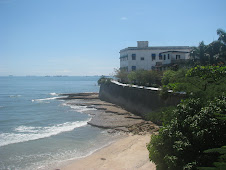
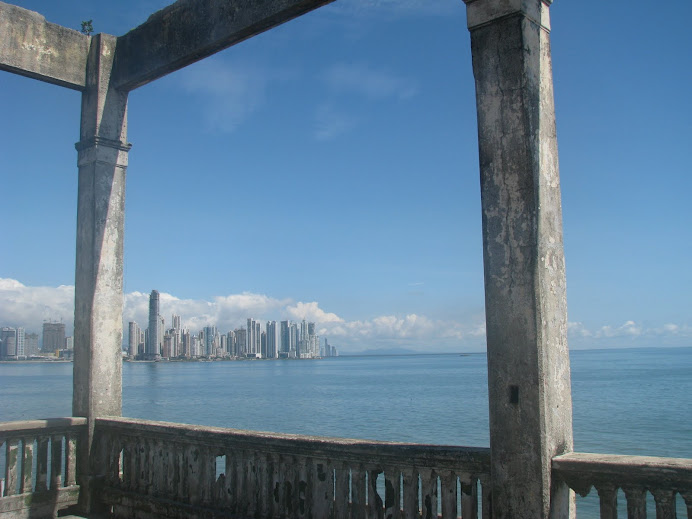
For the past few weeks, Terry Perdu held her yoga classes out on the terrace of the old Union Club. Decades ago, the exclusive, old-family members of the club abandoned the building and relocated directly across Panama Bay, not unlike most of the gentry, who moved away from Casco Viejo during the ‘70s to newer, more modern houses and apartments in Marbella, El Congrejo or the condo canyon of Paitilla. For a while, Manuel Noriega had taken over the club, which previously denied him membership (A sign of a powerful, established club is when the dictator of the country cannot gain admittance.), and reportedly made it one of his favorite hangouts which he renamed Club de Clases y Tropas, even though there were many more military than working class in attendance. That was until the U.S. invasion of 1989 put Noriega out of business and in a Miami jail. The once elegant, neo-classical building, which was built in 1917, looks like it must have been bombed out, during operation “Just Cause,” but apparently simply collapsed from neglect into a roofless ruin, with vultures lounging on a railing around the empty trash-strewn swimming pool, and a tree growing out of a chimney.
What remains is a wide terrace, perched out over the waves of the Pacific, with a skyline view that stretches around the entire bay past the ocean’s horizon and over to where ships, lighted at night, wait at the entrance of the canal for their turn to pass through. Attempts to keep the entrance blocked and locked seemed half-hearted and futile as skateboarders often found a way out on to the terrace, which Mitch Multusky claimed “had to be one of the most gorgeous skate parks in the world,” especially in the pink of evening. There were occasionally art shows and/or discotheques staged on the premises and scenes from the James Bond movie The Quantum of Solace were shot there, but for the most part the structure stood in magnificent decay with a front door latched by a broken chain and a padlock cut with bolt cutters.
So why not hold yoga class out on the sunny, mostly breezy terrace (it did get hot and glary sometimes), with pelicans flying by and the sound of waves washing below. Then one day, the door had been reinforced and locked, but even more meaningful to Perdu’s class was that an eight-foot wall of corrugated steel had been constructed over night around the building. Actually, it took the workers the full previous day, into the evening to complete the barricade, but that was still lightning quick by local standards. Those members of the class, principally, Barb Multusky, who lived down the block and even Beth Page, who made a point to know about such things, noticed the wall go up, but still figured that they could gain access. The rest of Tony’s students were surprised to discover that construction was indeed beginning on what had been rumored for years to be a new boutique hotel. A sign depicting an artist’s conception of what the totally renovated building would look like, was even tacked up at the front of what used to be the second story. Allan Myers, Perdu’s only male client, pointed out that a corner of the grand terrace was represented in the picture, so “at least, that is a good thing;” to which the ladies standing around in loose-fitting tee shirts and draw-string pants, with plastic mats tucked under their arms, readily agreed.
“Okay,” Tony Perdu announced, “we’ll have to walk over to Columbus House. Sorry for the delay.” Perdu, all in white, leotard, short shorts and sneakers, with her brown hair in her usual ponytail, looked peeved, even though her dozen devotees didn’t seem to mind at all. Probably only Beth Page knew that Tony’s seldom-seen husband was interested in developing the old Union Club, which was rumored to be for sale but Beth couldn’t identify the owners, so was unable to represent Mr. Perdu’s Polish money in obtaining the potentially lucrative property. “Please follow me,” Tony said with a raised hand, as her twelve followers walked in double file like a school field trip.
“Welcome, to Casco,” Madge Cole smiled. It was a statement, a version of which was repeated often among the expat community. “Welcome to Panama” or “Welcome to Casco” or “Welcome to Bocas Del Toro” or “…to Boquete.” So what does it mean? Since most of the misplaced yoga enthusiasts nodded knowingly in agreement, the attitude represented by the statement had to do, at least in part, with a kind of agreed-to Murphy’s Law approach to the way things were in Panama. Things never quite worked out smoothly. Plans were often changed; or sabotaged by forces uniquely Panamanian and out of the control of the gringo making the statement. The electricity would go out for three hours after a spectacular thunder storm—Welcome to Panama. An Atlas beer truck would get wedged in between a balcony and Toyota Prada parked on a narrow street—Welcome to Casco. The entire city would close down for Carnival week—Welcome to Panama. The third restaurant at the same location over the past two years would close—Welcome to Casco. A fellow pushing a shaved-ice cart, would be run over by a Diablo Rojo, one of the colorful busses (often painted red—that’s why they’re called Red Devils), that jam the city’s streets—Welcome to Panama. A real estate agent could not ascertain the names of the owners of a desirable property, which, in fact, had a “Se Vende” sign out front--Welcome to Casco. The mountain streams and rivers would flood the town and ruin the annual flower festival—Welcome to Boquete. A tourist would hand his camera to a passerby, who would then run off with it instead of taking a picture—Welcome to Panama. A retired expat couple’s beach cottage would finally be ready for occupancy, nearly a year and a half late—Welcome to Panama. (Just ask Madge’s husband Jerry about that.) Even though the statement was most often used in a negative, what-can-go-wrong-will-go-wrong manner it also was used to refer to other more positive things that seemed inevitable about Panama. Many new faces at an expat mixer—Welcome to Panama. Nearly two dozen cats being fed nightly around the kiosk at the public parking lot—Welcome to Casco. Very hot, humid bright sunny days fading into cool, breezy, star-lit nights—Welcome to Panama.
The group did not march in silence. All Tony Peru needed was to be in a nun’s costume with a clicker and Barb Multusky’s memory of Catholic school would have been complete. She walked next to Madge Cole, whose constant smile seemed more nervous than usual. “So, how’s it goin’?” Barb inquired routinely. Madge pushed up her big white-framed glasses with a finger between her eyes, and sighed. Her hair was bleach blonde, but so light it didn’t make her look any younger than if she had allowed her natural gray to show.
“Sometimes, I feel so guilty,” Madge said. “Here I am off to find inter-peace, while Jerry’s out there at the beach descending further into a hell of his own design.”
Barb laughed. She couldn’t help herself. “Don’t be silly,” she said. “You have every right to relax every once in a while.” Even though their little group seemed agitated in talkative two by twos, Barb persisted. “Yoga class is supposed be to where you learn to relax and reflect, so instead of feeling guilty that you’re here and he’s not, you should get him to come along. It would probably do him a world of good.”
“Oh, yeh, I can see that…” Madge seldom stopped with the smile. Often sincere, it was almost always plastered on her round face, which Barb described as cute, a term that Madge would probably interpret as a euphemism for chubby. “Jerry sitting in the lotus position, while gritting his teeth—he’s wound too tight.”
“That’s just my point—it might loosen him up.”
“Hardly.”
“So what’s happened now?” Barb asked, even though she didn’t really want to know any details.
“Sometimes, I think he’s like a Job character,” Madge said, warming to the subject, just as Barb had feared she would. “It’s like the gods are torturing him for the fun of it.”
“What’s happened now?” Barb was resigned.
“Oh, I don’t know. You mean like having the floor tile in the upstairs bathroom come out three tiles short, after they’ve laid ‘em. Or the fact that he was careful and hired a new plumber before he fired the old plumber; but then the new guy didn’t show up and didn’t call or answer his cell phone.”
“Well, welcome to Panama.” Barb provided the standard response.
“Oh, I almost forgot. Last Saturday, Jerry was cleaning up the area, you know, picking up loose concrete bags so they wouldn’t blow into our neighbor’s garden, stuff like that. He had all the trash in a big barrel on the site, so he splashes a little bit of gasoline on the pile and throws a match on. Well, it explodes and knocks Jerry off his feet into a hedge bordering our neighbors’ driveway about fifteen feet away.”
“Geeeezus, Madge. Is he all right?”
“He says he wasn’t hurt.” Madge shrugged, and her smile looked wistful. “Someone must have thrown away a container of gasoline is all we can figure. Jerry’s gas can didn’t explode; and he says he was careful; and he usually is; but he coulda been burnt, or hurt or killed for Christ sake.”
“That’s scary.” Barb had to admit that Madge’s latest tale of woe exceeded the normal level of griping—and oh yeh, my husband was almost killed or maimed at our construction site last week. “Things are just going to have to get better,” Barb said. “They can’t get any worse.” Barb heard her own cliché, but continued, “things are bound to improve.”
“Don’t be so sure,” Madge countered. “Jerry’s ordered a stun gun over the internet. Apparently, it’s legal down here. Guns are hard to get a license for if you’re not a citizen, we’ve been told, so he’s getting a stun gun instead.”
“Guns, are you kidding me?” Barb was surprised. “What do you need a stun gun for?”
“I don’t know; protection, I guess. Jerry says he needs one, so that’s it.”
“Protection from what? Who?”
* * *
“So, you still seein’ that Berger guy?” Allan Myers enquired as casually as he could. He and Beth were the last two in line.
“I was never seeing him,” Beth said with added emphasis; “and excuse me, why is that any concern of yours?”
“Now, don’t get bent out of shape, I’m just making conversation.” Allan made an exaggerated move to back off with his hands at shoulder height and his open palms facing Beth. What Beth didn’t know was that Allan already had a pretty good idea about Berger’s status with her.
The evening before, Beth arrived home from grocery shopping at Riba Smith’s and got Jamon to carry the bags into her kitchen through the front door. As she handed Jamon, who was showing his crooked smile and dirty finger nails, two quarters, Joe Berger’s head appeared over the street guy’s shoulder. He said, “Hi, Beth” in a sudden, high pitched, kinda loud voice. Jamon almost jumped out of his beat-up Crocks, as Beth bleated “Oh, shit!” Jamon spun off the stoop and down the steps in a rather graceful stumble, leaving Berger facing Beth with a surprised look on both their faces. Damn.
“I was hoping to get a chance to talk, you know. It was a big misunderstanding. I didn’t know about the dog and that it was like your pet or whatever.”
“Oh stop. That doesn’t matter. This has nothing to do with the stupid dog; and she’s not my pet.” Beth backed into her open doorway.
“Okay, okay. I was just waiting for you, so we could clear things up, you know, straighten everything out, so we could, you know, get back together.”
“Are you stalking me, you son of a bitch? What do you mean ‘waiting’? You nearly scared Jamon to death, sneaking around…”
“I wasn’t sneaking and I’m not stalking anybody, I was simply in your area and saw that guy at your door, so I figured you were home and so I waited a minute and then I came up to talk.” It was all true, but Joe knew he wasn’t getting anywhere (his explanation sounded contrived to him), and that his timing turned out as bad as always. “Can’t we just sit down and talk for a while. This is all a big mistake.”
“You’re right about that Buster,” Beth said; and closed the door firmly just short of a slam.
Buster ? Berger stood staring at the closed door for a moment and then turned to go. It was his turn to be caught by surprise. What the hell. Walking by slowly, just then at the foot of the three steps, Allan Myers smiled up at Joe and said, “Hey, Berger, how’s it hangin’?”
Before he could compose himself, Berger came out with, “Huh? Okay, I guess.” To Joe, it looked more like a smirk than a smile on Myer’s always confident, smooth face. After a moment, he wished he had said “None of your business, you bald bastard,” but the moment had passed. Dressed in one of his many flower-print Hawaiian shirts, this time green with yellow and white blossoms, chino shorts and flip flops, Myers didn’t stop to talk. He had all the information he needed. He left Berger to linger at the foot of the stairs, befuddled and embarrassed.
“Okay, if you’re not dating anybody, how about me? I would really like to take you out to dinner; how about tonight?
That was not what Beth was expecting, so she came up with a rather weak, “are you kidding?”
“No. I couldn’t be more serious. It occurred to me that we’re perfect for each other.”
Beth quickly regained her footing and countered with “Oh, really. How do you figure that?”
“We’re both smart, independent and good looking and approximately the same age. I wouldn’t be surprised if we had a lot in common, besides a love for yoga.”
“Smooth,” Beth thought, “maybe too.” It had occurred to Beth, when Berger sought her out that she was a relatively limited edition. There just weren’t that many widowed, or single for that matter, gringo women around above the age of 30. The younger women were all graduate students or interns or chics on round-the-world adventures, just passing through. Beth did know of a couple of other middle-aged single gals, one divorced and dating a younger Panamanian guy, who Beth thought of as her “boy toy”; the other a widow. Her husband drowned in their backyard swimming pool, which was considered suspicious in some circles (Beth thought the whole situation, with a lucrative insurance payout was fishy as hell), and so the so-called “black widow” was not in as much demand as her voluptuous figure might have indicated. This made Beth feel like a rather unique and probably desirable commodity; certainly from a businesswoman’s perspective. And Beth was a businesswoman, first and foremost. That’s why she hated the idea of giving in to Berger’s attention, like some sort of school girl. As a couple they had no prospects, but there they were cozied up on her couch. Yes, she was bored and horny and that’s how bad decisions are made. Allan, on the other hand, was loaded, Beth knew that; and therefore self-sufficient. Even though Beth liked hair on a head, Allan wasn’t bad looking and had to be smart—he was a wealthy doctor, divorced and on the lam, but still smart enough to keep his money close.
“So what about that bouncy little bimbo I’ve seen you with, there buddy boy,” Beth wasn’t giving in without putting up some sort of defense.
“You gotta admit, she is good looking,” Allan pointed out. Not the rebuttal Beth expected. Allan paused for Beth’s opinion.
“Well, sure, in a young, full bloom, kind of slutty way,” Beth countered.
“A lot of Latin women dress sorta slutty,” Allan said, again avoiding getting pinned down.
“But she’s so young,” Beth said.
“Exactly,” Allan said, pointing his figure in the air. “Bebe’s a sweet kid (That was good—Beth didn’t remember her name), and she’s sexy (at that Allan made direct eye contact, which Beth did not avoid,) and fun (Beth’s eyebrows went up at that), but we have nothing to talk about.”
“I’m sure Spanish is part of the problem.” Beth was enjoying the exchange.
“But, not totally.”
“And she’s a hooker.”
“And yes of course, there’s that,” Allan admitted readily. “I just can’t trust that she’s into me, and not my money; you know, rich gringo and all that goes with that. What she doesn’t know, is that I have no intention of any sort of commitment. She’s young and needs to move on.”
“Well, good for you,” Beth thought. Too many guys, way too many, came down to Panama and Costa Rica especially, first with the intention of exploiting all the young willing women, only to fall for one of their intended sexual conquests. Soon the older dude was deluded into thinking he had found his love match and before he knew it, the girl had moved in, followed in short order, by one or two unexplained and previously not mentioned children, and soon by the mother or sister or cousin. Then it was time to cash in. The hopeless romantic was soon accused of abuse and she had witnesses. That scenario never worked out to the financial benefit of the then not-so-rich gringo. To be honest, that was the path Beth assumed Allan was on, but not anymore.
“To be quite frank, I think I looked kinda foolish in the company of that particular young lady.”
Beth was disarmed. “You did.”
“I know. So help me out here. Let me take somebody out, who I would be proud to be seen with.” Allan stood expectantly, his hands spread out in front, bowed at the waist ever so slightly.
“Oh, all right,” Beth said and slapped him lightly on the shoulder, “but it better be someplace nice.”
“No problemo, I only go to nice places. How about Indigo’s?”
“Fine.” Beth was pleased. This was more like it. Allan suggested one of the most popular restaurants in Casco Viejo. She had been embarrassed by having given in to Berger so easily. She didn’t know anything about him and didn’t really care. Allan was obviously going to be more fun, clearly had money—that Joe character might not—and any way, she was simply going out on a date, not getting engaged or anything stupid like that.
The line had spread out to over a block, with Beth and Allan bringing up the rear. They were approaching the Columbus House, when the group’s newest couple passed by a Chino’s. All, not almost all, all the small grocery stores in the city and even out along the highway and in the towns are owned and run by Chinese. At the beginning of the 20th century, many Chinese migrated to Panama to help first build the railroad across the Isthmus and then the canal. Over the following generations, they came to control the small grocery business. While there are three or four supermarket chains, one owned by the president of the country, all the mini-marts and corner groceries have simply become known as Chino’s.
It was there that Beth spotted a man sitting out front on a bench with a newspaper. Open in front of him, she could read the front page headline Revelador Pone en Peligro Designation de Patrimonio Universal, which translates to Developer Endangers World Heritage Designation.
“Oh, shit!” Beth said as she rushed in to buy a copy of El Diario, the country’s leading daily. Beth could read Spanish, but not with confidence, but she had no difficulty spotting the name Rodrigo Feliz in the first paragraph. She skimmed the rest of the article but did not locate her name, which was good since she had not spoken with any reporters. Beth waved Allan on, but he stood there with a puzzled look on his tanned, clean shaven face. Yoga class was forgotten. In the next instant, Beth had her lawyer Bobby Boar on her cell phone.
“No worries,” Boar said, “you’re not in it. I’ll translate it for you, if you want me to, but it makes him look bad, I assure you. There are a couple of references to ‘local property owners’ and ‘concerned developers’ but no specific reference to you or the building of yours in question.”
“I think he’ll still know it’s me.”
“Of course he will,” Boar sounded condescending and Beth couldn’t help picturing him with that irritating grin on his face. To her quizzical “um” sound, he went on, “you seem to forget my dear, that we’ve filed a formal but useless complaint and we’ve stuck him with a 90-day restraining order, so it’s pretty obvious that you’re one of the local concerned property owner developers. However, when our boy Feliz contacts the editor, and he will, the editor can not link you to the story directly or indirectly. I steered the reporter, who owes me a couple of favors, to some other people. You’re not the only one who thinks this guy is up to no good, you know. You just happen to be the one with the building next door.”
“What do you think he’ll do?” Beth was surprised at how worried she felt.
“Like I said, he’ll try to find out the sources of the story, but I think the guys over at El Diario can stonewall him. Then I think he’ll be somewhat embarrassed tonight at dinner at the Union Club.”
“Big fuckin’ deal,” Beth interjected.
“I thought that’s what we’re trying to do.” Boar sounded impatient. “There are judges, and government officials and big-time real estate types and even a few people, wives mostly who value things like historical heritage, who are members of the Union Club and don’t admire bad publicity. And that’s where we’ll probably get our main benefit. I don’t mean any of those folks will come riding in on a white horse and save Casco Viejo from the jerk. What I hope will happen is that Feliz will want things to die down, so he’ll hopefully decide not to fight the restraining order. Maybe by then a couple of our city fathers will see the light and put a stop to his flagrant disregard for the cultural integrity of Casco Antiquo.”
Beth was impressed and actually gave Allan a thumbs-up sign. “Well, good job, Bobby, really. I hope you’re right.”
“I hope I am too. If not, the shit’s really going to hit the fan.” Pause, Beth did not laugh or say anything. “I’m kidding, okay, just kidding. The worst that can happen is we’re where we are now, with his building lowering our property values.”
“Okay, keep me informed.” With that Beth closed her phone and walked over to Allan and with a shrug said. “Business.”
Meanwhile, it had taken Tony several minutes to locate the concierge to open the door to the Columbus House roof-top terrace that wasn’t supposed to be locked in the first place. Welcome to Casco. As they waited Madge surprised Barb by asking how she was doing. Usually, at the end of a one-way conversation, Barb wondered why it was so seldom that anyone ever returned the favor and asked about her, so she welcomed an opportunity to share a concern of her own.
“Well, you’re not going to believe this,” Barb started tentatively, “but Mitch has volunteered to coach a youth basketball team.” Madge continued to actually look somewhat interested and even a bit surprised.
“That’s nice,” she said, a trite response which immediately discouraged Barb, but then “Where?”
“In Chorrillo.” Barb waited a moment for the information to register with her friend and it finally did.
“You’re kidding isn’t that where he was carjacked?” At that, both women looked around furtively because Barb had asked Madge not to tell anyone else that Mitch had been victimized in the dangerous neighborhood that bordered Casco Viejo to the north. None of the other yoga pilgrims seemed to be paying attention to their conversation, so Madge adjusted her porthole glasses, yet again, and said in a hushed tone “Isn’t that a bit risky?”
“Obviously,” Barb said, but then with a shrug, “but you know my Mitch was never a wimp or anything like that. I mean he won two state championships and then as a vice principal it was his job to deal with the hoodlums in the school; but anyway, he says it has something to do with facing your enemies and overcoming your fears, by simply not giving in to ‘em. Yeh, I know it’s kinda macho,” Barb said in response to the raised eyebrows behind Madge’s glasses. “But, he also said that ‘the best revenge is doing something good’ but I’ll be honest with ya, I’m not so sure that he has to go back into the lion’s den to be positive and constructive.”
“Compared to Jerry, he’s a saint,” Madge said. “My husband would have at least fantasized about machine-gunning down those bastards.”
“Oh, Mitch went thru that stage, I assure you.” Barb was relieved she could tell somebody else about the aftermath of the attack. “His plan was to rent or steal, no kidding, a pickup truck and then load about a dozen suitcases in the open back. Each case was to be booby-trapped with explosives; so when the citizens of Chorrillo stole the luggage and then broke the locks the bombs would go off and wreak havoc in those awful buildings. The charm of the plan, as far as Mitch was concerned, was that ‘if they don’t steal the cases, then there won’t be any explosions.’”
“Where was he going to get explosives,” Madge wondered.
“And where’s Jerry going to get his hands on a machine gun?” Barb said impatiently. “That’s not the point. There are certain ways of dealing with these situations, and this is what Mitch is going to do and even though it worries me, a lot, I’m going to try and support him.”
That left Madge contemplating some topics for meditation, as the group filed up the final stairway and out onto the sunny terrace. “Whew, this might be a hot one,” she said.
Barb left it at that, but she had more on her mind. Even before those gang members attacked Mitch, her husband was showing signs of losing it, but since then his mental acuity seemed to be fading faster. Ever since she knew him, Mitch never, ever took a nap, not even on the weekends; or on vacation and not even when he retired. After the incident, however, he would fall asleep virtually every afternoon and that was after sleeping in until 9—9:30 most mornings. For a guy who used to stay up to watch Jay Leno, Mitch often took a book to bed before 10 p.m. and was snoring soon after.
Mitch’s memory was slipping too. There was a time when Mitch could name every member of every team he coached; and recall the scores of every playoff game and many more. Lately, however, he was hard pressed to recollect the names of people they met at parties or dinners or other people in their building. Of course most people when they get into their sixties experience more difficulty remembering names and items on the thing-to-do list, but Mitch wasn’t bad at all before the attack but afterward he constantly had to walk back downstairs to remember why he had gone upstairs; he was forever searching for his keys and cell phone; he always had to be reminded of names of people they had known for a while; he seldom came back from the Chino’s with everything he was supposed to get; punch lines for jokes (a Mitch specialty), were lost; and appointments, if they weren’t immediately written on the calendar were forgotten.
Before the carjacking or whatever you want to call it, Mitch was not excelling at learning Spanish, but he knew his numbers, days of the week, months and quite a few basic vocab words. It was just that he had problems putting a sentence together. Not anymore—he often had to ask Barb for simple terms; time; everyday objects; place names; basic verbs. From the passenger seat, Barb was concerned about how many times she had to remind Mitch the driver how to get to a place they had been to before, like the grocery store or the Felipe Motta wine shop. He wasn’t drinking any more—that was a good thing. Mitch was still “a couple of beers” kind of guy. Sometimes, though, he would tell a story as if he had not told the same story just a day or two before, if not only an hour or two earlier.
Yes, Barb knew that a faulty memory was a consequence of aging, but she was stunned how quickly Mitch’s memory deteriorated after he had his bad experience. It was like he had become distracted, that there were things on his mind that occupied too much space and didn’t leave room for names, places, dates and/or events. Recently, he persistently called Carmen Butch, a name of a very different (Labrador) dog they used to own back in Michigan. Most of the time, Mitch acted as if nothing was different, though to Barb his memory was twice as bad if not more so than just months before. At other times, however, her big masculine husband, would get a worried look on his broad face, and say “I can’t remember shit.” At times he would look almost frightened. That was why Barb was worried about the basketball plan. Mitch was recruited by a local community organizer Tito Romero, a reformed gang-banger in a blue Casco Antiquo tee shirt with an earnest look in his eye.
Getting back involved with basketball could be a good thing, Barb knew. It might help Mitch get rid of the blues and get him out of the apartment and doing something he was good at and enjoyed. But what if he got lost driving home after practice in the same bad neighborhood where he had already found trouble? Then would he feel even more foolish and impotent and old? Romero, who had a diamond in his left ear that was so big it had to be fake, assured Barb, when she bumped into him while walking Carmen, that he would keep an eye on Mister Mitch. Tito spoke a passable version of Spanglish, enough that Barb could understand and vice versa, but Barb was sure he wouldn’t always be around, even if he gave her a reassuring wink. Her husband was a big guy, who knew how to look confident, even when he wasn’t. What could she do? Coaching a team made up of boys who robbed his car could be therapeutic or not. Tito Romero suggested that after the folks in Chorrillo got to know “el amigo grande” that they would actually look after him as “un compadre de barrio.” Barb hoped that Tito wasn’t being overly optimistic or simply filling a coaching position with the only person he could find; and she figured that a 5’7” part-Indian wouldn’t be overly protective of a man who weighed nearly a hundred pounds more than he did. She sincerely hoped that good things would happen—that challenged, Mitch would sharpen up and maybe even help a couple of kids avoid a life of crime, or straighten up and fly right or whatever. Barb surprised herself at how cynical she had become. Unfortunately, she couldn’t help it, Barb had doubts.
Wednesday, March 24, 2010

Monday, March 1, 2010
Casco Viejo: the Second Season
Chapter Five
“Okay,” Beth thought, “this is a bad idea.” Joe Berger was asleep beside her, snoring in a regular, apparently contented rhythm. “I don’t need a man in my life, right now or ever, as a matter of fact, but definitely not now.”
They had dinner at a new place called Callejon de Gato, the Alley Cat, and Beth thought the food, tapas, langostinos and meat balls, was pretty good. Joe was attentive and complimentary and most importantly not overly interested in real estate. Sure, he would like her to help him find a “nice little, inexpensive condo in Casco,” like everybody else. Nobody ever seemed to be looking for a horrible, big, expensive place, but that seemed normal for the situation he claimed to be in. But that was a point—there was something about the guy she didn’t trust exactly; or quite believe; even though he didn’t seem to be scamming her or trying to weasel his way into her operation or anything remotely like that—he didn’t want to be a partner, in the business at least; or that’s what she thought. Her judgment or sense of human nature gave her just a hint that this guy wasn’t one hundred percent honest or candid or aboveboard, whatever that meant.
So, why did she go to bed with him? It seemed so natural, inevitable even. After dinner, they went for a drink at Havana Viejo, the Old Havana, which sometimes had a lively crowd, many of whom Beth knew, but not that night—only a couple of couples. Joe made pleasant enough conversation and told two or three mildly funny jokes. So, “what the hell,” she invited him back to her place and they ended up sitting on the couch and smoking a joint. Beth was in the mood to get high and so she did. Joe was neither smooth nor not. He smiled, put his arm around her shoulder, like a date at the movies (years, actually decades ago), and kissed her. To Beth the kiss seemed friendly, not overly aggressive or desperate, and to be honest, she was kinda, sorta, okay, rather horny.
Joe, who was completely naked, rolled over on his side, with his back to her. The hair on his narrow shoulders was gray and wispy. Beth was aware of how thin and ordinary he looked. “Well, he’s not moving in here,” she decided in advance; “and I don’t think he should assume that I’ll be falling on my back every time I see him either.” The point was that she could use a male escort sometimes and Joe already demonstrated that he was willing to at least try to fend off unwelcome attention.
The problem was that Beth Page, real estate operator and deal maker, was involved in a number of disputes at the moment. In fact, the least of her concerns had to do with that grumpy old Jerry Cole, who Beth considered nothing more than a chronic complainer, who made matters worse by getting bent out of shape with the builder and contractors and even the ordinary workers out at his site in Gorgona. Even though Beth did feel sorry for Madge, who was obviously bullied by Jerry, there was nothing she could do, even if she wanted to, to help him out of a work slowdown inspired by his own asinine behavior.
No, Beth was swimming with bigger fish, much bigger fish than Madge Cole’s silly overwrought husband. As far as Beth was concerned she was in a tricky war, one she could lose, and on two fronts at that. Her first battle was with Billy Belize, a 35-year-old developer from Columbia, who acted like he had a lot of money until it came time for him to pay his bills. They were in a partnership in a promising three-story building on Avenida “B” between Calles Quarto and Cinco. The plan was to restore the building that had lovely arched windows, wrought-iron balconies on the second and third floors and thick stone walls, with a commercial property on the first floor and two condos on each of the remaining levels. Belize showed up with his half of the down payment, no problema, but since then there were promises but no more money coming in from his side. He had become a classic “fly-by-night” guy, as far as Beth was concerned, with long absences, purportedly back and forth from Cartagena, where he was also developing a couple of old buildings. At first, she was confident and liked the guy, thin, classic dark short hair and what was becoming a more and more mischievous smile. Eventually, she was going to have to sue him, a deal she was sure was a “lose-lose” situation.
The biggest fish in her particular sea of troubles was Rodrigo Feliz, a short, dumpy fellow, maybe fifty, probably closer to sixty, with a male-pattern bald head trimmed in jet black hair. The first time she met him, Beth suspected that he dyed the hair he had. Feliz reportedly owned 19 buildings scattered around Casco Viejo. Eighteen were just sitting there moldering, some with squatters including a couple that were inhabited by drug dealers and some gang members, and most that were either boarded up or empty shells. Apparently, Feliz’s plan was to eventually sell off his buildings, when they acquired more value due to the restoration of the rest of the neighborhood. Far be it from him to actually contribute to the revitalization by actually investing any money or effort himself.
There was one notable exception; the building directly next to Barb’s on Avenue B, right at the corner at Fifth Street. Here the other half of Feliz’s plan seemed to be taking shape. Not only had the building been gutted, but because of the lack of support, two of the four walls had collapsed as well; which meant that the entire building needed to be rebuilt from the ground up. At first, this particular rebuilding project seemed like a positive, until the structure rose to a grand six stories, with modern rectangular windows.
Casco Viejo, after all, is a World Heritage Site officially designated by UNESCO. What that means is that there are a complicated set of rules and regulations that stipulate that any restoration of a building must be consistent with its original, historical design and that all the buildings have to be compatible and true to the heritage of the “protected” area. As far as Beth was concerned, this historical designation was what gave the district its value. There were and could only be some 800 buildings in a clearly defined area, which was to be preserved as a memorial to the original city of Panama. Old Town San Juan came immediately to mind, and of course Billy’s stomping grounds Cartagena.
Before anyone could restore a structure, a detailed building permit was required, that insured the integrity of the original (for example, if the old building had a courtyard, the new building had one too), specifically having to do with appropriate design and dimensions. “What in the hell is goin’on,” is what Beth wanted to know with the monstrosity next door. Her building was literally hunched in the shadow of what looked like a Soviet apartment block. Naturally, she had her lawyer, Bobby Boar, a Zonian, file a complaint, only to find out that Feliz “allegedly” had all the permits.
“That’s not possible,” Barb pointed out. “That place, has nothing to do with the original building or anything remotely like preservation of the surroundings.”
“Obviously,” Boar said with a grin that Beth never knew quite how to interpret. “We’ve just experienced a change in administrations (Ricardo Martinelli ran on a reform, anti-corruption ticket and soundly defeated Balbina Herrera and the party that had been in charge previously.), but it appears that our boy Feliz may have pulled a fast one right before the end or during the transition.”
“You mean he bribed someone and got phony permits or what,” Barb said.
“We have no proof that such a thing happened,” Boar pointed out in his smug lawyerly fashion.
Beth knew she was swimming in shark infested waters, but decided to file a formal complaint against Feliz. Boar also managed to get a judge to issue a restraining order that forced Feliz to stop construction, at least temporarily for 90 days. Boar was cautious.
“I just don’t see how he can win this,” Beth said. “The old building was no more than four stories. Rodrigo’s skyscraper is at least six stories, if the fat bastard is going to stop there. He should not only be made to cease and desist, but he needs to be taken down a coupla pegs—like about two stories.”
“I am sure he will not like that idea,” Boar said, then flashed a brief grin.
“Too fuckin’ bad,” Beth said. “The rules are the rules and they have to be followed or…”
“Or what,” Boar interrupted. “I got a theory for ya, that ya might not have considered.”
“Oh, good,” Beth said. Even though Boar wasn’t very personable, Beth knew he was smart, fairly well connected and knew the so-called ropes. “Tell me.”
“Were you aware that the bi-annual review of the status as a World Heritage Site by UNESCO is scheduled for next month?” Beth nodded but Boar did not grin. “Have you heard that there are a number of problems with the maintenance of several of the government buildings; the cobblestone streets (which were a mess because of truck traffic and had been filled in at several points with black top or concrete); and the fact that the previous government supposedly failed to file much of the necessary paperwork?” Beth had heard rumors too. “Now, I don’t know if any or all of it is accurate or if it will even affect the World Heritage status. What I am pretty sure of is that Senor Feliz would be just as happy if UNESCO was no longer involved with his building plans, so he could do whatever he wanted with his properties; maybe even put up a coupla towers, if you get my drift.”
“Are you telling me that that shit is trying to sabotage the ruling by putting up a building that is clearly in violation?”
“I don’t have any proof and I’m not in Senor Feliz’s inner circle, but it is curious that he has recently become interested in developing one of his properties. You know don’t you that if it comes to a battle in the Panamanian courts that it could take two or more years and you could quite possibly lose.”
“Oh, I know,” Beth said, “and if I don’t fight the fat, bald bastard, I lose. What do you suggest?”
That was when the biggest grin of the day came over Boar’s narrow face. “I do have some connections with the local press. Let’s see if I can get a reporter or two to start asking the right questions.”
“I’ll be glad to talk to the press,” Beth said and stood up to make her point.
“I don’t think you fully understand,” Boar stopped grinning. “My job is to protect you and your interests, so the last thing I want you to do is hold a press conference or even be quoted in the papers.”
"Fine." As the sun came up, Beth lay in her bed going over her current “challenges” in her head and wondering what would happen next. Nothing good, she was sure. All the while Joe Berger, who had not yet fully achieved the status of boyfriend, slept soundly at her side.
* * *
Joe Berger didn’t have to pretend to be asleep. Following the first sex he had had in over a year, he slept soundly, content that his life had taken a positive turn. After all, Beth was an attractive, apparently prosperous woman, and she had asked him up. He hadn’t needed to be pushy or suggest it or anything. He was goin’ with the flow, as they say, and it was working. God knows, he was nervous and had even practiced some small talk before their dinner date. He also brought cash in case there was a problem with his credit card. He checked himself in the mirror and even brushed his teeth twice, before venturing out.
At times, Beth acted maybe a bit too casual, as if she wasn’t all that interested much less excited; but then she invited him up for a drink. Beth looked good too. She seemed to favor strapless outfits and had on a snug-fitting green and brown striped dress that showed off her faintly freckled shoulders. Her perfume had what seemed to Joe a tropical fruit scent.
Yes! Berger shouted in his head while he attempted to accept the invitation naturally. Then she came out of the bathroom with a joint. Even though Joe hadn’t smoked pot since his first wife (His second would not allow it.), he thought this was a positive sign as well. He tried not to inhale, so he wouldn’t go nuts or fall asleep, but he still managed to get a pretty good buzz, which scared him. Don’t fuck up now. Beth seemed to relax and had kicked off her sandals. When she stretched out her legs and put her bare feet, with bright red toenails, on the coffee table, he, oh, so smoothly, put his arm around her shoulder. She actually leaned into him and rested her blonde head on his shoulder. So far, so good. The only thing he could think to do then was kiss her, so he did. Pretty soon, she stood up, put out her hand, with bright red fingernails, and led him into the bedroom. Sweet dreams.
* * *
Most mornings, Carmen would cruise on over to a construction site on Avenida “B”, where a number of construction workers would be sitting on the curb having breakfast. Carmen was cool. She would not attempt to steal any food, patacones or bread, but simply hang about, nearby, until something was dropped or more often tossed in her direction. How the workers knew the dog’s name was Carmen was a mystery, but some greeted their small black and white friend with jovial "buenos dias, Carmenlita" and none of them ever kicked at her or shooed her away.
Mitch, the provisional owner, often took an early morning walk and more than once noticed his would-be pet working the crowd at one construction site or another. “It is hard to believe that our puppy isn’t mucha gorda,” he would say to Barb upon his return. “Carmen has breakfast with us, each morning and joins the local work force for desayuno numero dos.” Actually Mitch had learned very little Spanish and what he did know he often used for comic effect, a classic defensive maneuver for the language challenged. Sometimes Carmen would abandon her amigos and follow Mitch for the rest of his walk and sometimes she would allow the man to go on his own.
Mitch never caught her at Beth’s breakfast nook and had no idea. Mitch did know that one of his pup’s best amigos was Jamon; and that particular morning, (the one Joe Berger would always think of as the morning after) Mitch watched as Carmen stopped in a doorway, where Jamon was curled up after apparently spending the night. Mitch always called him Horace, because he just couldn’t get himself to call the guy “Ham” to his face. Jamon/Horace did not look very good –his clothes were dirty and extremely wrinkled and his socks could be seen sliding down into his shoes, baring chubby ankles. There was a smile on Jamon’s pink, puffy face as he fiddled with Carmen’s black ear. It appeared to Mitch, that the left side Horace’s face was swollen and redder than the right side, though both of the guy’s eyes were half hooded by red lids. He certainly wasn’t fat, but he was soft and formless and pretty much deserved his nickname.
“Buenos dias, jefe,” Jamon said as he stood up on uneasy legs. An empty half-pint bottle rattled at his feet. Mitch was just liberal enough to be uncomfortable being called boss, but he reached in his pocket and handed Horace a dollar and said emphatically “para desayuno.” Jamon almost bowed to his flabby waist and said “gracias, jefe.” Mitch went on with his morning constitutional, while Carmen, her white tail wagging, lingered for more pets, from her gentle friend. “I am such an enabler,” Mitch thought as he turned the corner, “but whatcha gonna do?”
Soon too, Carmen left Jamon on the doorstep to contemplate yet another lost day. With the big old man still in sight in the distance with his back to her, Carmen ducked down an alley and then slid under the gate toward the smell of coffee and her third breakfast of the morning. Halfway, up the walkway, she noticed a strange man sitting on her chair. He had short gray hair and was wearing a blue and white flower-print shirt open to the waist, a pair of chino slacks and was barefoot. Carmen went directly to her place and looked up at the man expectantly.
“Oh, oh,” the man said. “Where did you come from, you little rascal?” Berger was amused, but thought it best to shoo the dog away. “Scat,” he said and waved his hand, palm down, at the mutt. The dog just stood there, with its black and white face cocked at a quizzical angle. “Scat!” Joe said, in what he felt was a commanding voice. When the dog didn’t budge, Joe tried “Vamos!” thinking maybe Spanish would work. Nope. The dog stood stoically beside his chair. This is when Joe’s hopes took an unfortunate turn. Berger made what he felt was a playful swing at the dog with his bare foot, in an attempt to get the animal to move away. What Beth saw as she passed through the door was the guy who she had spent the night with kicking her favorite breakfast companion. Poor Joe didn’t see or hear Beth until he attempted an even firmer nudge, no not exactly, kick, not really, swipe with his foot at the dog, who he thought was the intruder.
“What in the fuck do you think you’re doing?” It wasn’t a scream exactly, but the protest was decibels louder than a simple question. It caught Berger completely by surprise as Carmen leapt from the terrace and hid behind a rose bush.
To his eternal regret, Joe answered “Nothing.”
“Nothing,” Beth snarled. “I just saw you kick Carmen. What gives you the right to kick that dog?”
“I didn’t know it was your dog,” Berger said, and then immediately corrected his defense to “I didn’t really kick him. I was like, you know, shooing him away.”
“It’s a her, you idiot.” Beth looked like she was shaking in rage, which put Berger in a panic. “And, I saw you kick her. So don’t deny it.”
“But, I didn’t.” By that time, the argument was lost and Berger knew it. Nothing. Why did I say nothing? I am an idiot.
“Get the fuck out of my house.” Beth stood rigid and pointed toward the doorway, where Tica, the maid, stood with two large plates and one small one of scrambled eggs. Apparently the maid had adapted much better to the situation than Joe, who only expected that two would be having breakfast that morning.
“Oh, please Beth—this is a silly misunderstanding.” When Joe stood up, it must have looked to Carmen as if he was threatening Beth, because she started barking at him.
“I wasn’t kicking your dog,” Joe insisted.
“She’s not my dog,” Beth said waving her arm in an exasperated manner.
Joe’s mind was racing. Not her dog, so what’s the big deal. He was playing around, not trying to hurt him or her or whoever. “Oh, come on,” he said, while Carmen barked incessantly, from the foot of the terrace. Joe also saw Tica smiling broadly, and that pissed him off. “This is stupid,” he said in a voice with a brand new but not welcome tone of anger.
“Get__the__fuck__out__of__my__house,” Beth pronounced each word with individual emphasis, “Right, now.”
“Jesus Christ, Beth, would you calm down for a moment.” It was too late for Joe to attempt to take some sort of control.
At that Beth whirled around and told Tica to “telefone las policias, por favor.” Joe didn’t speak Spanish, but he could figure that out.
“Okay, okay, Christ this is stupid, but I’ll leave. Just let me get my shoes, and wallet and stuff.”
“Tica, policias, pronto.” Tica put the plates down and went inside.
“You are overreacting,” Joe said, pointing his finger in his ex-girlfriend’s face. However, he didn’t hesitate and soon had his wallet in his pocket and his shoes in his hand. In another moment, he was out the front door, which was slammed behind him.
“How in the hell was I supposed to know that that dog was going to have breakfast with us,” Joe asked rhetorically, out loud, as he sat on the steps and slipped the boat shoes on his feet.
Chapter Five
“Okay,” Beth thought, “this is a bad idea.” Joe Berger was asleep beside her, snoring in a regular, apparently contented rhythm. “I don’t need a man in my life, right now or ever, as a matter of fact, but definitely not now.”
They had dinner at a new place called Callejon de Gato, the Alley Cat, and Beth thought the food, tapas, langostinos and meat balls, was pretty good. Joe was attentive and complimentary and most importantly not overly interested in real estate. Sure, he would like her to help him find a “nice little, inexpensive condo in Casco,” like everybody else. Nobody ever seemed to be looking for a horrible, big, expensive place, but that seemed normal for the situation he claimed to be in. But that was a point—there was something about the guy she didn’t trust exactly; or quite believe; even though he didn’t seem to be scamming her or trying to weasel his way into her operation or anything remotely like that—he didn’t want to be a partner, in the business at least; or that’s what she thought. Her judgment or sense of human nature gave her just a hint that this guy wasn’t one hundred percent honest or candid or aboveboard, whatever that meant.
So, why did she go to bed with him? It seemed so natural, inevitable even. After dinner, they went for a drink at Havana Viejo, the Old Havana, which sometimes had a lively crowd, many of whom Beth knew, but not that night—only a couple of couples. Joe made pleasant enough conversation and told two or three mildly funny jokes. So, “what the hell,” she invited him back to her place and they ended up sitting on the couch and smoking a joint. Beth was in the mood to get high and so she did. Joe was neither smooth nor not. He smiled, put his arm around her shoulder, like a date at the movies (years, actually decades ago), and kissed her. To Beth the kiss seemed friendly, not overly aggressive or desperate, and to be honest, she was kinda, sorta, okay, rather horny.
Joe, who was completely naked, rolled over on his side, with his back to her. The hair on his narrow shoulders was gray and wispy. Beth was aware of how thin and ordinary he looked. “Well, he’s not moving in here,” she decided in advance; “and I don’t think he should assume that I’ll be falling on my back every time I see him either.” The point was that she could use a male escort sometimes and Joe already demonstrated that he was willing to at least try to fend off unwelcome attention.
The problem was that Beth Page, real estate operator and deal maker, was involved in a number of disputes at the moment. In fact, the least of her concerns had to do with that grumpy old Jerry Cole, who Beth considered nothing more than a chronic complainer, who made matters worse by getting bent out of shape with the builder and contractors and even the ordinary workers out at his site in Gorgona. Even though Beth did feel sorry for Madge, who was obviously bullied by Jerry, there was nothing she could do, even if she wanted to, to help him out of a work slowdown inspired by his own asinine behavior.
No, Beth was swimming with bigger fish, much bigger fish than Madge Cole’s silly overwrought husband. As far as Beth was concerned she was in a tricky war, one she could lose, and on two fronts at that. Her first battle was with Billy Belize, a 35-year-old developer from Columbia, who acted like he had a lot of money until it came time for him to pay his bills. They were in a partnership in a promising three-story building on Avenida “B” between Calles Quarto and Cinco. The plan was to restore the building that had lovely arched windows, wrought-iron balconies on the second and third floors and thick stone walls, with a commercial property on the first floor and two condos on each of the remaining levels. Belize showed up with his half of the down payment, no problema, but since then there were promises but no more money coming in from his side. He had become a classic “fly-by-night” guy, as far as Beth was concerned, with long absences, purportedly back and forth from Cartagena, where he was also developing a couple of old buildings. At first, she was confident and liked the guy, thin, classic dark short hair and what was becoming a more and more mischievous smile. Eventually, she was going to have to sue him, a deal she was sure was a “lose-lose” situation.
The biggest fish in her particular sea of troubles was Rodrigo Feliz, a short, dumpy fellow, maybe fifty, probably closer to sixty, with a male-pattern bald head trimmed in jet black hair. The first time she met him, Beth suspected that he dyed the hair he had. Feliz reportedly owned 19 buildings scattered around Casco Viejo. Eighteen were just sitting there moldering, some with squatters including a couple that were inhabited by drug dealers and some gang members, and most that were either boarded up or empty shells. Apparently, Feliz’s plan was to eventually sell off his buildings, when they acquired more value due to the restoration of the rest of the neighborhood. Far be it from him to actually contribute to the revitalization by actually investing any money or effort himself.
There was one notable exception; the building directly next to Barb’s on Avenue B, right at the corner at Fifth Street. Here the other half of Feliz’s plan seemed to be taking shape. Not only had the building been gutted, but because of the lack of support, two of the four walls had collapsed as well; which meant that the entire building needed to be rebuilt from the ground up. At first, this particular rebuilding project seemed like a positive, until the structure rose to a grand six stories, with modern rectangular windows.
Casco Viejo, after all, is a World Heritage Site officially designated by UNESCO. What that means is that there are a complicated set of rules and regulations that stipulate that any restoration of a building must be consistent with its original, historical design and that all the buildings have to be compatible and true to the heritage of the “protected” area. As far as Beth was concerned, this historical designation was what gave the district its value. There were and could only be some 800 buildings in a clearly defined area, which was to be preserved as a memorial to the original city of Panama. Old Town San Juan came immediately to mind, and of course Billy’s stomping grounds Cartagena.
Before anyone could restore a structure, a detailed building permit was required, that insured the integrity of the original (for example, if the old building had a courtyard, the new building had one too), specifically having to do with appropriate design and dimensions. “What in the hell is goin’on,” is what Beth wanted to know with the monstrosity next door. Her building was literally hunched in the shadow of what looked like a Soviet apartment block. Naturally, she had her lawyer, Bobby Boar, a Zonian, file a complaint, only to find out that Feliz “allegedly” had all the permits.
“That’s not possible,” Barb pointed out. “That place, has nothing to do with the original building or anything remotely like preservation of the surroundings.”
“Obviously,” Boar said with a grin that Beth never knew quite how to interpret. “We’ve just experienced a change in administrations (Ricardo Martinelli ran on a reform, anti-corruption ticket and soundly defeated Balbina Herrera and the party that had been in charge previously.), but it appears that our boy Feliz may have pulled a fast one right before the end or during the transition.”
“You mean he bribed someone and got phony permits or what,” Barb said.
“We have no proof that such a thing happened,” Boar pointed out in his smug lawyerly fashion.
Beth knew she was swimming in shark infested waters, but decided to file a formal complaint against Feliz. Boar also managed to get a judge to issue a restraining order that forced Feliz to stop construction, at least temporarily for 90 days. Boar was cautious.
“I just don’t see how he can win this,” Beth said. “The old building was no more than four stories. Rodrigo’s skyscraper is at least six stories, if the fat bastard is going to stop there. He should not only be made to cease and desist, but he needs to be taken down a coupla pegs—like about two stories.”
“I am sure he will not like that idea,” Boar said, then flashed a brief grin.
“Too fuckin’ bad,” Beth said. “The rules are the rules and they have to be followed or…”
“Or what,” Boar interrupted. “I got a theory for ya, that ya might not have considered.”
“Oh, good,” Beth said. Even though Boar wasn’t very personable, Beth knew he was smart, fairly well connected and knew the so-called ropes. “Tell me.”
“Were you aware that the bi-annual review of the status as a World Heritage Site by UNESCO is scheduled for next month?” Beth nodded but Boar did not grin. “Have you heard that there are a number of problems with the maintenance of several of the government buildings; the cobblestone streets (which were a mess because of truck traffic and had been filled in at several points with black top or concrete); and the fact that the previous government supposedly failed to file much of the necessary paperwork?” Beth had heard rumors too. “Now, I don’t know if any or all of it is accurate or if it will even affect the World Heritage status. What I am pretty sure of is that Senor Feliz would be just as happy if UNESCO was no longer involved with his building plans, so he could do whatever he wanted with his properties; maybe even put up a coupla towers, if you get my drift.”
“Are you telling me that that shit is trying to sabotage the ruling by putting up a building that is clearly in violation?”
“I don’t have any proof and I’m not in Senor Feliz’s inner circle, but it is curious that he has recently become interested in developing one of his properties. You know don’t you that if it comes to a battle in the Panamanian courts that it could take two or more years and you could quite possibly lose.”
“Oh, I know,” Beth said, “and if I don’t fight the fat, bald bastard, I lose. What do you suggest?”
That was when the biggest grin of the day came over Boar’s narrow face. “I do have some connections with the local press. Let’s see if I can get a reporter or two to start asking the right questions.”
“I’ll be glad to talk to the press,” Beth said and stood up to make her point.
“I don’t think you fully understand,” Boar stopped grinning. “My job is to protect you and your interests, so the last thing I want you to do is hold a press conference or even be quoted in the papers.”
"Fine." As the sun came up, Beth lay in her bed going over her current “challenges” in her head and wondering what would happen next. Nothing good, she was sure. All the while Joe Berger, who had not yet fully achieved the status of boyfriend, slept soundly at her side.
* * *
Joe Berger didn’t have to pretend to be asleep. Following the first sex he had had in over a year, he slept soundly, content that his life had taken a positive turn. After all, Beth was an attractive, apparently prosperous woman, and she had asked him up. He hadn’t needed to be pushy or suggest it or anything. He was goin’ with the flow, as they say, and it was working. God knows, he was nervous and had even practiced some small talk before their dinner date. He also brought cash in case there was a problem with his credit card. He checked himself in the mirror and even brushed his teeth twice, before venturing out.
At times, Beth acted maybe a bit too casual, as if she wasn’t all that interested much less excited; but then she invited him up for a drink. Beth looked good too. She seemed to favor strapless outfits and had on a snug-fitting green and brown striped dress that showed off her faintly freckled shoulders. Her perfume had what seemed to Joe a tropical fruit scent.
Yes! Berger shouted in his head while he attempted to accept the invitation naturally. Then she came out of the bathroom with a joint. Even though Joe hadn’t smoked pot since his first wife (His second would not allow it.), he thought this was a positive sign as well. He tried not to inhale, so he wouldn’t go nuts or fall asleep, but he still managed to get a pretty good buzz, which scared him. Don’t fuck up now. Beth seemed to relax and had kicked off her sandals. When she stretched out her legs and put her bare feet, with bright red toenails, on the coffee table, he, oh, so smoothly, put his arm around her shoulder. She actually leaned into him and rested her blonde head on his shoulder. So far, so good. The only thing he could think to do then was kiss her, so he did. Pretty soon, she stood up, put out her hand, with bright red fingernails, and led him into the bedroom. Sweet dreams.
* * *
Most mornings, Carmen would cruise on over to a construction site on Avenida “B”, where a number of construction workers would be sitting on the curb having breakfast. Carmen was cool. She would not attempt to steal any food, patacones or bread, but simply hang about, nearby, until something was dropped or more often tossed in her direction. How the workers knew the dog’s name was Carmen was a mystery, but some greeted their small black and white friend with jovial "buenos dias, Carmenlita" and none of them ever kicked at her or shooed her away.
Mitch, the provisional owner, often took an early morning walk and more than once noticed his would-be pet working the crowd at one construction site or another. “It is hard to believe that our puppy isn’t mucha gorda,” he would say to Barb upon his return. “Carmen has breakfast with us, each morning and joins the local work force for desayuno numero dos.” Actually Mitch had learned very little Spanish and what he did know he often used for comic effect, a classic defensive maneuver for the language challenged. Sometimes Carmen would abandon her amigos and follow Mitch for the rest of his walk and sometimes she would allow the man to go on his own.
Mitch never caught her at Beth’s breakfast nook and had no idea. Mitch did know that one of his pup’s best amigos was Jamon; and that particular morning, (the one Joe Berger would always think of as the morning after) Mitch watched as Carmen stopped in a doorway, where Jamon was curled up after apparently spending the night. Mitch always called him Horace, because he just couldn’t get himself to call the guy “Ham” to his face. Jamon/Horace did not look very good –his clothes were dirty and extremely wrinkled and his socks could be seen sliding down into his shoes, baring chubby ankles. There was a smile on Jamon’s pink, puffy face as he fiddled with Carmen’s black ear. It appeared to Mitch, that the left side Horace’s face was swollen and redder than the right side, though both of the guy’s eyes were half hooded by red lids. He certainly wasn’t fat, but he was soft and formless and pretty much deserved his nickname.
“Buenos dias, jefe,” Jamon said as he stood up on uneasy legs. An empty half-pint bottle rattled at his feet. Mitch was just liberal enough to be uncomfortable being called boss, but he reached in his pocket and handed Horace a dollar and said emphatically “para desayuno.” Jamon almost bowed to his flabby waist and said “gracias, jefe.” Mitch went on with his morning constitutional, while Carmen, her white tail wagging, lingered for more pets, from her gentle friend. “I am such an enabler,” Mitch thought as he turned the corner, “but whatcha gonna do?”
Soon too, Carmen left Jamon on the doorstep to contemplate yet another lost day. With the big old man still in sight in the distance with his back to her, Carmen ducked down an alley and then slid under the gate toward the smell of coffee and her third breakfast of the morning. Halfway, up the walkway, she noticed a strange man sitting on her chair. He had short gray hair and was wearing a blue and white flower-print shirt open to the waist, a pair of chino slacks and was barefoot. Carmen went directly to her place and looked up at the man expectantly.
“Oh, oh,” the man said. “Where did you come from, you little rascal?” Berger was amused, but thought it best to shoo the dog away. “Scat,” he said and waved his hand, palm down, at the mutt. The dog just stood there, with its black and white face cocked at a quizzical angle. “Scat!” Joe said, in what he felt was a commanding voice. When the dog didn’t budge, Joe tried “Vamos!” thinking maybe Spanish would work. Nope. The dog stood stoically beside his chair. This is when Joe’s hopes took an unfortunate turn. Berger made what he felt was a playful swing at the dog with his bare foot, in an attempt to get the animal to move away. What Beth saw as she passed through the door was the guy who she had spent the night with kicking her favorite breakfast companion. Poor Joe didn’t see or hear Beth until he attempted an even firmer nudge, no not exactly, kick, not really, swipe with his foot at the dog, who he thought was the intruder.
“What in the fuck do you think you’re doing?” It wasn’t a scream exactly, but the protest was decibels louder than a simple question. It caught Berger completely by surprise as Carmen leapt from the terrace and hid behind a rose bush.
To his eternal regret, Joe answered “Nothing.”
“Nothing,” Beth snarled. “I just saw you kick Carmen. What gives you the right to kick that dog?”
“I didn’t know it was your dog,” Berger said, and then immediately corrected his defense to “I didn’t really kick him. I was like, you know, shooing him away.”
“It’s a her, you idiot.” Beth looked like she was shaking in rage, which put Berger in a panic. “And, I saw you kick her. So don’t deny it.”
“But, I didn’t.” By that time, the argument was lost and Berger knew it. Nothing. Why did I say nothing? I am an idiot.
“Get the fuck out of my house.” Beth stood rigid and pointed toward the doorway, where Tica, the maid, stood with two large plates and one small one of scrambled eggs. Apparently the maid had adapted much better to the situation than Joe, who only expected that two would be having breakfast that morning.
“Oh, please Beth—this is a silly misunderstanding.” When Joe stood up, it must have looked to Carmen as if he was threatening Beth, because she started barking at him.
“I wasn’t kicking your dog,” Joe insisted.
“She’s not my dog,” Beth said waving her arm in an exasperated manner.
Joe’s mind was racing. Not her dog, so what’s the big deal. He was playing around, not trying to hurt him or her or whoever. “Oh, come on,” he said, while Carmen barked incessantly, from the foot of the terrace. Joe also saw Tica smiling broadly, and that pissed him off. “This is stupid,” he said in a voice with a brand new but not welcome tone of anger.
“Get__the__fuck__out__of__my__house,” Beth pronounced each word with individual emphasis, “Right, now.”
“Jesus Christ, Beth, would you calm down for a moment.” It was too late for Joe to attempt to take some sort of control.
At that Beth whirled around and told Tica to “telefone las policias, por favor.” Joe didn’t speak Spanish, but he could figure that out.
“Okay, okay, Christ this is stupid, but I’ll leave. Just let me get my shoes, and wallet and stuff.”
“Tica, policias, pronto.” Tica put the plates down and went inside.
“You are overreacting,” Joe said, pointing his finger in his ex-girlfriend’s face. However, he didn’t hesitate and soon had his wallet in his pocket and his shoes in his hand. In another moment, he was out the front door, which was slammed behind him.
“How in the hell was I supposed to know that that dog was going to have breakfast with us,” Joe asked rhetorically, out loud, as he sat on the steps and slipped the boat shoes on his feet.
Friday, February 12, 2010
Casco Viejo: The Second Season
Chapter Four
It got lonely, sometimes. Barb Multusky sat on her favorite bench along the promenade at the end of Las Bovedas and watched an afternoon thunderhead build ominously behind and above the line of skyscrapers that surrounded the steel gray Bay of Panama. The windows of the buildings reflected the late afternoon sun and seemed to burn bright in contrast to the smooth gray of the water and the darkening gray of the clouds behind. She puffed on her cigarette, only the second of the day, while Carmen rested at ease at her feet. With her two front black paws crossed in a dainty prone pose, Carmen waited patiently, the leash slack on Barb’s wrist, until the cigarette was flicked over the wall and their routine stroll would continue. Two benches down, a small black guy, with a natty black straw hat, sat and strummed a ukulele and sang a guttural version of The Banana Boat Song. Every once in a while, a tourist (usually the male member of a couple) would drop a quarter in the tin can at his feet as a reward for a rendition that reminded Barb more of Tom Waits than Harry Belafonte.
Barb had lots of acquaintances, people she liked, like Marge and Beth and Suzanne, who ran a store filled with Peruvian rugs and handmade hammocks; but she didn’t really count on any of them as friends. Most of the expats and especially most of the Panamanians she met, were friendly enough and in fact were more social, meaning that they actually liked going out to dinner and having cocktail parties and meeting for drinks, which Barb seldom did back in Saginaw. (Back in Michigan, people would say “We have to get together, sometime…,” but that wouldn’t necessarily mean soon, or within a fortnight or ever really.) But friends? Like Morgan, who she taught with off and on for her entire career, or Jackie, her best friend from high school, who was her maid of honor—no, there was nobody like that in Panama. Of course, those friendships took time, and if anything most of the retirees she knew were getting older and running out of time. They just didn't share the background—West Coast; East Coast; Midwest; South or Great Britain or South Africa. In some ways they were as different from the people Barb knew back home as were the Panamanians.
“Everybody has their ways,” Mitch would say and it was true. It seemed like everyone spoke with an accent. There were however a couple of things most people that made up the so-called expat community seemed to have in common. The first thing was a willingness, maybe even a need, to meet other people, what Mitch called “a common bond between strangers in a strange land.” Many of the ladies would share shopping tips, particularly leads on where to find certain hard-to-get grocery items, like tender beef for example (Panamanian beef was grass fed, lean and tough. Barb never realized how important “corn-fed” was until she tried to chew a piece of grass-fed steak.) The guys would discuss car repair places (Flat tires were not rare, but only cost three bucks to repair) and service people like plumbers, electricians and movers. Plenty of folks were generous with advice. Barb tried to be.
Carmen seemed to always be on the lookout for bits of food and the promenade, which was the main tourist attraction in Casco Viejo, was a good place to find chunks of hot dog buns; a solitary fried yucca; or chicken bones. Barb felt embarrassed sometimes and thought people might think that she didn’t feed her dog enough. Pollo was obviously Carmen’s favorite and she seemed to have a knack for locating the remains of a chicken dinner, whereever she sniffed. “It’s genetic,” Mitch liked to say. “She’s a street dog and always will be and the love of pollo is in her blood.”
The other thing that Barb understood, but didn't always appreciate was how self-centered many of the expats were. When Barb complained, Mitch would ask rhetorically, “Well, who isn't a bit self-centered when you get down to it.” Barb agreed that everybody was a bit and so the only ones who were actually designated as “self-centered” were those who were very much so. Many expats were very much so. When Barb said something like “Everybody is so damned self-centered,” Mitch would get agitated and throw his meat hooks in the air and say “Everybody. It can’t be everybody. It’s not all, by any means, but, I gotta admit it’s not some, or a few, either.”
“No, you’re right,” Barb would fight back, “I wouldn’t just say many, though—I think it’s more like most.”
“Many, most, more than some, lots,” Mitch would agree, “whatever, it’s too many.” When the topic came up, like over cocktails before dinner at Indigo’s, the couple would allow each other to vent for a while and then agree that it was rather self-centered of them to complain about how self-centered everybody else was, but “then again, we’re expats too and can’t help it.” Mitch would grin and get Barb to smile.
When she met somebody new, which seemed to be a weekly occurrence, if not more frequently, the new comers had plenty of questions: Where’s the nearest mall/ liquor store/ beauty shop/ garage/ hardware store/ dry cleaners/ kosher deli/ movie theatre (with the latest Hollywood movies—which translates to “in English.”)/ bookstore (with books in English)/ etc.? Who’s your Spanish instructor/ doctor (Educated where?)/ lawyer (Jewish? Male?)/ architect/ builder/ masseuse/ hairdresser/ dentist/ psychic/ mechanic/ manicurist/ gardener/ maid/ etc., and do they speak English? What’s your favorite restaurant/bar/radio station (…English?)/ bakery/ beach/hardware store/route to the airport? And, can you lend me your can opener/telephone book/car/sports jacket/ maid (“I really need her Tuesday, just this once. Naturally, that would be the Multusky’s regular day.)/ lap-top/ tweezers/map of Panama City/corkscrew? Barb didn’t mind exactly, (except when somebody tried to steal her maid), but after awhile it got tedious, maybe even relentless.
Had Mitch and she done the same thing? Of course, but they mostly went out and bought stuff they needed or waited for it to arrive in their container; and if they did borrow something it was never anything essential to the other person like their coffee maker; and as far as they know they returned what was borrowed. Mitch and she would drive around town in their new lime green Hyundai Santa Fe SUV to explore and find where the stores were located. It was part of the adventure. It just seemed like more give and much less take than seemed fair. It was highly unlikely that they would need to borrow something from a “newbie”; or get directions to the dentist office; or advice on title insurance; only vice versa.
Sometimes, Carmen would pull on the leash that was attached to a small harness strapped neatly around her white fuzzy shoulders. Most of the time, her pulling meant that she needed to relieve herself, which was one of the purposes of the walk. When Barb and Carmen came around the tip of the peninsula past the Ministry of Culture building, they were hit by a stiff breeze. That was when Carmen squatted and took a dump. Barb was good. She carried a small plastic bag for just such a situation. However, when Barb leaned over with the bag covering her hand, the wind blew the dog droppings away; not far but just out of reach. Barb quickly grabbed one as two or three others rolled along the tiled sidewalk. “Oh, shit!” Barb said and then laughed at herself for the unintended pun. With Carmen helping not in the least, but actually wanting to pull away, Barb scuttled along and eventually captured the last tootsie-roll sized bit of puppy poop. Barb knew that at that point Mitch would have quoted Johnny Carson and said “No good deed goes unpunished.”
The other thing about expats, especially newcomers, was that many, maybe not most but a majority, quite naturally assumed that the other person, like Barb, for example, was not only interested but eager to hear “their story.” Seldom was “how are you?” met with a simple “Fine.” In Barb's experience, the new wife of the retired car dealer from Jacksonville or the retired Air Force Colonel immediately assumed you wanted to hear all about them and how the furnishing of their condo was going. Maybe what bothered Barb most was that the stories were hardly ever unique or interesting. The shipping container arrived two weeks late from the States; or the air conditioners blew only hot air; or the construction of a new high-rise had just broken ground right in front of their view of the sea. One guy spoke non-stop for 45 minutes about cabinets he was having installed. “He never once seemed to notice that we were just sitting there,” Barb pointed out. “If I was his wife, I would have kicked him under the table. But she didn’t and that amazed me as well.”
“I just hope I’m never the guy who deserves to get kicked,” Mitch said.
“The longer I stay here,” Barb would say as Mitch would admit that it was true, “the more the same old stories repeat themselves; and we haven't been here that long. If I hear another sad tale of woe about a tile job that didn't turn out perfect, I'm gonna scream.”
Mitch agreed that there was “a lot of the same-old, same-old bitching and moaning” going on, but tried to be philosophical about it. “I guess it's kinda new and scary for them; they don't know what to expect.”
“Fine,” Barb replied “but how about after a blow by blow by blow description of their visit to Immigration; how about inquiring or even faking some interest in our experiences. Half of ‘em; more than half of ‘em; go right on to their next topic,” which was often how screwy, or stupid or simply wrong things were in Panama.
The thing Barb almost couldn't stand at times was Panamanian bashing. It appeared that a significant minority of the expat community hated the people who populated their adopted country, or at least talked as if they did. “Those damn Panamanians...” was like a refrain that drove Barb batty sometimes. Another refrain was “It's hard to believe the locals can stand...” followed by something like the heat or the lack of customer service that frustrated the usually white, elderly speaker. Okay, traffic was nuts, with drivers honking their horns as they cut off whomever they wanted to be in front of. And manana was a fact. The cable guy; the fellas delivering your new couch; the investigating police officer; your regularly scheduled maid; or your dinner guests seldom if ever arrived on time and often came a day or two later than scheduled.
For the most part, Barb really liked the Panamanians she had met. It's not very practical to generalize about a nation, even a small country of three million, (She wasn’t generalizing about the expats—they were an identifiable self-centered group.), but the people of Panama seemed to be quite friendly, a bit shy but quick to smile and most tried to be helpful. Barb readily admitted that she found it infuriating that the telephone repair guy had called that he was on his way but didn't make it until 11 a.m. the following day. Yes, she's not so old and out of it that she doesn't remember that the government agencies were somewhat more efficient in the States; but she also remembers dreading going to the MVA or standing in line at a U.S. post office during the holidays. Part of the problem, Barb was sure, was that expats were seen quite legitimately as foreigners (by some locals as rich foreigners), who couldn't be bothered to learn to speak Spanish. So some of the tradesmen and business people who the newcomers encountered did in fact try to take advantage or simply dealt with people, in what to foreigners, seemed like a cockeyed manner. Again, if it was different in the States, it was more a matter of degree rather than opposites. “I guess all construction superintendents in the States are honest, on-time perfectionists and the fact that problems sometimes arise down here catch people by surprise,” Mitch would say with a straight face and Barb would laugh.
Often, when Barb dropped what both Mitch and she called a “doggy bag” into the trash can, she would recall her husband’s misadventure trying to pick up what his dog dropped. One day, Carmen apparently wasn't feeling well, because when she did her duty, it was in puddle form in the middle of the walkway and Mitch didn't have a spatula to scoop her dirty work into the bag. So, he force marched his dog back to their building and found a nice new bucket where the concierge had left it in the laundry room. Mitch filled it with warm water at the utility sink and hurried back to the scene of the crime.
As he briskly approached, Mitch spotted a woman in the distance, who looked like she was doing that old sixties dance called the frug, with a little mashed potatoes thrown in. He guessed that she had hit the spot, which usually has a positive connotation, but not in this case. After some slippin' an' sliddin', she finally did an awkward spin and then landed on the seat of her pedal pushers. Mitch felt terrible and rushed to her aid, but not before putting the bucket down, not only so he could move faster, but admittedly so she might not realize that he somehow had partial ownership of the brown slick. Luckily, she was okay, only slightly shaken up but stained. Mitch walked her down the stairs and over to where he hailed a taxi for her, in front of the French Embassy.
Whirling quickly, Mitch hustled past several vendors selling molas, jewelry and old Panamanian license plates and took the steps two at a time with his long legs. There were a half dozen skate boarders attempting to crack all the tiles on the promenade. That's when he noticed one groovy guy skidding dangerously close to Carmen’s catastrophe. The surfing term “wipe out” probably popped into his head an instant before it popped into Mitch’s, as it became clear that his board was planing. For a split second, Mr. Multusky witnessed the scene in slow motion. The board went one way and spun in the air as the boarder danced tip-toe in the direction of the wall. For a moment, Mitch feared that the skate-boarding “dude” would suffer the same fate as the ancient prisoners at high tide; but instead of going over the wall, he rather gracefully belly flopped on to the rim of the precipice.
Well, enough of that. Mitch wasn't interested in going for a third strike, so he dashed for the bucket. It wasn't where he thought he left it. Breathing heavily, Mitch darted back and forth, guessing that he had simply forgotten the exact location. It wasn't anywhere. Somebody had stolen the bucket.
Maybe they were lucky. When they first arrived, a couple a years back, Mitch and she knew no one. They retained a young lawyer by the name of Benito Cortez (They saw a small ad for “Newcomers” in Focus, a tourist magazine, and liked his historic sounding last name.), who helped them with their pensioners’ visas and setting up a corporation and a bank account. In Panama, a lawyer is required to get anything done. Immigrants who try to get things accomplished on their own are always frustrated and soon gone, as Barb had dutifully advised several newcomers. Benito was 28 and engaged to Candida Riva who was 24 and had majored in hospitality and tourism management at the University of Miami. Both spoke English very well (“Beni”, as he was called, had gone to military school in Virginia, before attending Texas Tech. He got his law degree in Panama). What Barb and Mitch didn’t know until later was that they were the very first clients of the brand new company Newcomer Services, Inc., that “Candi” and her fiancée had set up.
Barb and Mitch were pleased and impressed by how much time Beni and Candi spent on their behalf. They didn’t know that there were no other customers to distract their guides. Beni, tall, dark and, yes, handsome, maybe even male-model handsome looked the part of an up-and-coming lawyer. Even though she was thin and blonde, Candi was still very Spanish in the way she passionately approached every conversation, with big brown eyes and plenty of gestures and vehemence. While Beni, with his “Jon-Jon style” as Barb liked to refer to his approach, was there for any legal matters, Candi, who wasn’t pretty exactly but stylish in peasant blouses, jeans and high heels, was almost like a personal assistant. After she had shown them the apartment in Casco Viejo that they really liked and could afford; she would pick them up and take them furniture shopping (she would demand a discount and usually get it); arrange for the place to be painted (she scolded the painters about tardiness and drips.); and answer any question, since the Multuskys had her cell phone number and called it once or twice a day, at least.
Usually, an older couple would take a young couple under their wing and show them “the ropes,” whatever that meant. However in this case it was the younger couple who looked out for the older ones, who lacked the experience. Yes, at first, the Multuskys paid for the services provided, but soon after spending literally whole days together, the two couples started spending social time together. The Multuskys were invited to the Cortez family beach house out near Coranado. Before long, they attended Candi and Beni’s wedding and danced and drank until three in the morning. Mitch stood out on the terrace and smoked cigars with Beni’s uncles Alfredo, Juan and Mike. More than once, Barb had lunch with Senora Riva, Candi’s mother, who spoke pretty good English, was always charming, but seemed impatient with Barb’s very limited Spanish. Candi’s parents were the same age as the Multuskys, while Beni’s parents were actually a couple of years younger; and yet, Barb and Mitch would still go out to dinner or at least have drinks with their younger mentors at least once a week and spoke several times a week on the phone.
Barb and Mitch didn’t get it exactly. Why would these youngsters take such an interest in them, but the Multuskys considered themselves very fortunate indeed. It certainly had something to do with the Multuskys being the first “newcomers” that Candi and Beni worked with and wanting it to be a successful venture, but after a while, the two couples (who Mitch called “the geezers and the go-getters”) had actually become friends. Neither Barb nor Mitch had strong family ties back in Michigan, which made leaving relatively easy. What they didn’t expect was to be included into a nice, generous Panamanian family, who welcomed them to birthday parties and Easter dinner and Mitch’s favorite, New Year’s Eve, with plenty of fireworks.
In fact, Newcomer Services, Inc. was not a successful business and “the kids” as Mitch and Barb referred to them but never addressed them as such, shut the operation down soon after it started. It was never determined how many clients were served, but it did seem that the Multuskys were members of an exclusive club. It was a shame; Barb thought that more expats couldn’t have benefitted from the same type of help that Mitch and she had received. But then again, there were only so many newly retired couples that Candi and Beni could adopt.
Barb unlocked the gate that led to the canopied walk way back to the courtyard in front of their apartment. She always let go of the leash and flipped it into the air. Carmen seemed to like to catch the leash in her teeth and carry it back to the next set of locked doors herself. Carmen then stood patiently by the door to the building and then the apartment door itself as Barb unlocked each. In moments the little harness was off and hooked in the front closet. “Okay, kiddo” Barb said as Carmen walked over to her water bowl, “you’re free.”
That was when Barb noticed Mitch sitting on the couch in the shadows with his head in his hands. “Oh, my,” Barb could tell from his slumped posture that something was very wrong, “what’s the matter Darling? Are you all right?”
“I’m okay, I guess,” Mitch said, as his tiny wife tried to put her arms around his wide shoulders. “I just got mugged, or car jacked or whatever you want to call it.”
“Oh, no, Darling.”
“Yeh, I was short-cutting through Chorrillo, had just turned down a side road off Avenita de los Poetas, to cut across to Avenita “A”, when this young guy, who was crossing the street stopped in front of my car. He stood there smiling at me; smirking actually. I was being patient, you know, not honking my horn or anything. Well, I should have run the little prick over. It all took about five seconds. Suddenly all four of my doors were open and guys, young men, teenagers, I don’t know, were lunging into the car. Yes, my doors were unlocked and the front windows were open, I know, but it was 2 p.m. and I’ve gone that way a dozen times; well anyway, this one guy has a hold of my St. Christopher medal and I grab him by the wrist when I see a hand reaching for the keys in the ignition. Some punk had dived across the seat; so I let go and grabbed his wrist as I elbowed the first fella in the forehead as he pops the chain and gets the medal. The guy has the keys so I don’t let go. I’m holding on with both hands, basically as they clean out the rest of the car. CDs; my golf clubs; our groceries and the case of beer I just picked up; but I wasn’t going to let that bastard get my car keys. Somebody had opened my door and had his arm around my neck and was trying to pull me out, but as they did the keys slipped into my hand and allowed me to start throwing elbows. I was standing next to the car and pushed the one guy down as I watched a couple of other punks running off with my golf clubs.”
Barb was sitting straight up, rigid. She noticed that Mitch had a scratch on his face and his hair was mussed and that he seemed smaller, more vulnerable than he had ever seemed before. He was her giant, bigger than most men; and he could have been killed.
“No kidding, the cops arrived right then. Obviously, they patrol that area regularly. They pull up in one of those pickup truck van things and two guys in flak jackets get out with shotguns and stand there looking mean, basically guarding me, but it’s over. They didn’t get my wallet, which I was sitting on for most of it and they didn’t get our phone which was in my front pocket, so I called Beni, who I got to talk to the police, who shrugged when I asked them ‘Hablan ingles?’ Beni said the cops said I had to go down to the main police station and file a report where they have translators; and ‘what the hell was I doing in that neighborhood?’
“I’m telling you, it was over in seconds and the cops were sending me on my way within minutes. They weren’t pursuing any perpetrators. I was so angry and so frustrated and so embarrassed, I can’t tell you. You could tell the police thought I was an idiot, but I had been that way before, and I’m a big guy, you know and it was broad daylight and there is road construction the other way and traffic and this was so much quicker, but the windows were open and Jesus, the doors were even unlocked. I was probably their easiest mark in months.”
Carmen had slowly inched up to where she was leaning against one of Mitch’s long legs. Mitch absentmindedly fingered her black ear.
“It’s not your fault,” Barb said firmly. “People should be able to drive around, without being attacked.”
“Not in that neighborhood,” Mitch said, and he was right. Chorrillo, which was next door to Casco Viejo, was one of the most notoriously dangerous sections of the city. Nobody would consider driving through there at night, not even with the doors locked and the windows up—not even a big old guy like Mitch, who had spent most of his life not really being afraid of anyone. What neither one said but both were thinking was that Mitch was lucky none of his attackers appeared to have a gun.
Chorrillo was where the 1989 US invasion of Panama had taken place. Noriega’s old neighborhood had been bombed out and never really recovered from what was called at the time Operation Just Cause. Much of Panama was poor, but Chorrillo had the most resentment, the meanest streets, the toughest gangs and the worst reputation, fully deserved. So more than anything else Mitch felt foolish, naïve, like just any other silly gringo, who didn’t know shit. The first guy probably spotted the open windows and stepped forward. Unlocked doors were a bonus. It was sad that thugs would hang around waiting for marks to happen by, a grim way to live, but that was how it was in Chorrillo, truly infested with crime. Mitch’s plight didn’t even draw much of a crowd; a few kids gawked, while some might have been hoping for an opportunity of their own. That’s why the police stood around looking menacing, but that is also why they copped an attitude. It was obvious in Spanish, English or body language that they had very little sympathy for this tall, white ignorant man who walked into the lion’s den wearing a pork chop jacket. What a fool.
“So what are we going to do?” Barb asked.
“Well, I’m going to talk to Beni and see if there’s any point in filling out a police report. I mean I doubt if I could ID anyone except maybe that jerk who stopped my car. I’d like to wipe that look off of his face. Otherwise, I’m going to have a beer, lick my wounds and I guess we’ll never be able to go that way again.”
All valid, but that wasn’t actually what Barb meant. For the first time since they had moved to Panama, Barb thought that it was all a big mistake. “We can’t stay here,” is what Barb thought as Mitch fished a Panama out of the frig. The only problem was that their small apartment in Casco Viejo was their only home. They had no place back in the States. There was no place to go.
Chapter Four
It got lonely, sometimes. Barb Multusky sat on her favorite bench along the promenade at the end of Las Bovedas and watched an afternoon thunderhead build ominously behind and above the line of skyscrapers that surrounded the steel gray Bay of Panama. The windows of the buildings reflected the late afternoon sun and seemed to burn bright in contrast to the smooth gray of the water and the darkening gray of the clouds behind. She puffed on her cigarette, only the second of the day, while Carmen rested at ease at her feet. With her two front black paws crossed in a dainty prone pose, Carmen waited patiently, the leash slack on Barb’s wrist, until the cigarette was flicked over the wall and their routine stroll would continue. Two benches down, a small black guy, with a natty black straw hat, sat and strummed a ukulele and sang a guttural version of The Banana Boat Song. Every once in a while, a tourist (usually the male member of a couple) would drop a quarter in the tin can at his feet as a reward for a rendition that reminded Barb more of Tom Waits than Harry Belafonte.
Barb had lots of acquaintances, people she liked, like Marge and Beth and Suzanne, who ran a store filled with Peruvian rugs and handmade hammocks; but she didn’t really count on any of them as friends. Most of the expats and especially most of the Panamanians she met, were friendly enough and in fact were more social, meaning that they actually liked going out to dinner and having cocktail parties and meeting for drinks, which Barb seldom did back in Saginaw. (Back in Michigan, people would say “We have to get together, sometime…,” but that wouldn’t necessarily mean soon, or within a fortnight or ever really.) But friends? Like Morgan, who she taught with off and on for her entire career, or Jackie, her best friend from high school, who was her maid of honor—no, there was nobody like that in Panama. Of course, those friendships took time, and if anything most of the retirees she knew were getting older and running out of time. They just didn't share the background—West Coast; East Coast; Midwest; South or Great Britain or South Africa. In some ways they were as different from the people Barb knew back home as were the Panamanians.
“Everybody has their ways,” Mitch would say and it was true. It seemed like everyone spoke with an accent. There were however a couple of things most people that made up the so-called expat community seemed to have in common. The first thing was a willingness, maybe even a need, to meet other people, what Mitch called “a common bond between strangers in a strange land.” Many of the ladies would share shopping tips, particularly leads on where to find certain hard-to-get grocery items, like tender beef for example (Panamanian beef was grass fed, lean and tough. Barb never realized how important “corn-fed” was until she tried to chew a piece of grass-fed steak.) The guys would discuss car repair places (Flat tires were not rare, but only cost three bucks to repair) and service people like plumbers, electricians and movers. Plenty of folks were generous with advice. Barb tried to be.
Carmen seemed to always be on the lookout for bits of food and the promenade, which was the main tourist attraction in Casco Viejo, was a good place to find chunks of hot dog buns; a solitary fried yucca; or chicken bones. Barb felt embarrassed sometimes and thought people might think that she didn’t feed her dog enough. Pollo was obviously Carmen’s favorite and she seemed to have a knack for locating the remains of a chicken dinner, whereever she sniffed. “It’s genetic,” Mitch liked to say. “She’s a street dog and always will be and the love of pollo is in her blood.”
The other thing that Barb understood, but didn't always appreciate was how self-centered many of the expats were. When Barb complained, Mitch would ask rhetorically, “Well, who isn't a bit self-centered when you get down to it.” Barb agreed that everybody was a bit and so the only ones who were actually designated as “self-centered” were those who were very much so. Many expats were very much so. When Barb said something like “Everybody is so damned self-centered,” Mitch would get agitated and throw his meat hooks in the air and say “Everybody. It can’t be everybody. It’s not all, by any means, but, I gotta admit it’s not some, or a few, either.”
“No, you’re right,” Barb would fight back, “I wouldn’t just say many, though—I think it’s more like most.”
“Many, most, more than some, lots,” Mitch would agree, “whatever, it’s too many.” When the topic came up, like over cocktails before dinner at Indigo’s, the couple would allow each other to vent for a while and then agree that it was rather self-centered of them to complain about how self-centered everybody else was, but “then again, we’re expats too and can’t help it.” Mitch would grin and get Barb to smile.
When she met somebody new, which seemed to be a weekly occurrence, if not more frequently, the new comers had plenty of questions: Where’s the nearest mall/ liquor store/ beauty shop/ garage/ hardware store/ dry cleaners/ kosher deli/ movie theatre (with the latest Hollywood movies—which translates to “in English.”)/ bookstore (with books in English)/ etc.? Who’s your Spanish instructor/ doctor (Educated where?)/ lawyer (Jewish? Male?)/ architect/ builder/ masseuse/ hairdresser/ dentist/ psychic/ mechanic/ manicurist/ gardener/ maid/ etc., and do they speak English? What’s your favorite restaurant/bar/radio station (…English?)/ bakery/ beach/hardware store/route to the airport? And, can you lend me your can opener/telephone book/car/sports jacket/ maid (“I really need her Tuesday, just this once. Naturally, that would be the Multusky’s regular day.)/ lap-top/ tweezers/map of Panama City/corkscrew? Barb didn’t mind exactly, (except when somebody tried to steal her maid), but after awhile it got tedious, maybe even relentless.
Had Mitch and she done the same thing? Of course, but they mostly went out and bought stuff they needed or waited for it to arrive in their container; and if they did borrow something it was never anything essential to the other person like their coffee maker; and as far as they know they returned what was borrowed. Mitch and she would drive around town in their new lime green Hyundai Santa Fe SUV to explore and find where the stores were located. It was part of the adventure. It just seemed like more give and much less take than seemed fair. It was highly unlikely that they would need to borrow something from a “newbie”; or get directions to the dentist office; or advice on title insurance; only vice versa.
Sometimes, Carmen would pull on the leash that was attached to a small harness strapped neatly around her white fuzzy shoulders. Most of the time, her pulling meant that she needed to relieve herself, which was one of the purposes of the walk. When Barb and Carmen came around the tip of the peninsula past the Ministry of Culture building, they were hit by a stiff breeze. That was when Carmen squatted and took a dump. Barb was good. She carried a small plastic bag for just such a situation. However, when Barb leaned over with the bag covering her hand, the wind blew the dog droppings away; not far but just out of reach. Barb quickly grabbed one as two or three others rolled along the tiled sidewalk. “Oh, shit!” Barb said and then laughed at herself for the unintended pun. With Carmen helping not in the least, but actually wanting to pull away, Barb scuttled along and eventually captured the last tootsie-roll sized bit of puppy poop. Barb knew that at that point Mitch would have quoted Johnny Carson and said “No good deed goes unpunished.”
The other thing about expats, especially newcomers, was that many, maybe not most but a majority, quite naturally assumed that the other person, like Barb, for example, was not only interested but eager to hear “their story.” Seldom was “how are you?” met with a simple “Fine.” In Barb's experience, the new wife of the retired car dealer from Jacksonville or the retired Air Force Colonel immediately assumed you wanted to hear all about them and how the furnishing of their condo was going. Maybe what bothered Barb most was that the stories were hardly ever unique or interesting. The shipping container arrived two weeks late from the States; or the air conditioners blew only hot air; or the construction of a new high-rise had just broken ground right in front of their view of the sea. One guy spoke non-stop for 45 minutes about cabinets he was having installed. “He never once seemed to notice that we were just sitting there,” Barb pointed out. “If I was his wife, I would have kicked him under the table. But she didn’t and that amazed me as well.”
“I just hope I’m never the guy who deserves to get kicked,” Mitch said.
“The longer I stay here,” Barb would say as Mitch would admit that it was true, “the more the same old stories repeat themselves; and we haven't been here that long. If I hear another sad tale of woe about a tile job that didn't turn out perfect, I'm gonna scream.”
Mitch agreed that there was “a lot of the same-old, same-old bitching and moaning” going on, but tried to be philosophical about it. “I guess it's kinda new and scary for them; they don't know what to expect.”
“Fine,” Barb replied “but how about after a blow by blow by blow description of their visit to Immigration; how about inquiring or even faking some interest in our experiences. Half of ‘em; more than half of ‘em; go right on to their next topic,” which was often how screwy, or stupid or simply wrong things were in Panama.
The thing Barb almost couldn't stand at times was Panamanian bashing. It appeared that a significant minority of the expat community hated the people who populated their adopted country, or at least talked as if they did. “Those damn Panamanians...” was like a refrain that drove Barb batty sometimes. Another refrain was “It's hard to believe the locals can stand...” followed by something like the heat or the lack of customer service that frustrated the usually white, elderly speaker. Okay, traffic was nuts, with drivers honking their horns as they cut off whomever they wanted to be in front of. And manana was a fact. The cable guy; the fellas delivering your new couch; the investigating police officer; your regularly scheduled maid; or your dinner guests seldom if ever arrived on time and often came a day or two later than scheduled.
For the most part, Barb really liked the Panamanians she had met. It's not very practical to generalize about a nation, even a small country of three million, (She wasn’t generalizing about the expats—they were an identifiable self-centered group.), but the people of Panama seemed to be quite friendly, a bit shy but quick to smile and most tried to be helpful. Barb readily admitted that she found it infuriating that the telephone repair guy had called that he was on his way but didn't make it until 11 a.m. the following day. Yes, she's not so old and out of it that she doesn't remember that the government agencies were somewhat more efficient in the States; but she also remembers dreading going to the MVA or standing in line at a U.S. post office during the holidays. Part of the problem, Barb was sure, was that expats were seen quite legitimately as foreigners (by some locals as rich foreigners), who couldn't be bothered to learn to speak Spanish. So some of the tradesmen and business people who the newcomers encountered did in fact try to take advantage or simply dealt with people, in what to foreigners, seemed like a cockeyed manner. Again, if it was different in the States, it was more a matter of degree rather than opposites. “I guess all construction superintendents in the States are honest, on-time perfectionists and the fact that problems sometimes arise down here catch people by surprise,” Mitch would say with a straight face and Barb would laugh.
Often, when Barb dropped what both Mitch and she called a “doggy bag” into the trash can, she would recall her husband’s misadventure trying to pick up what his dog dropped. One day, Carmen apparently wasn't feeling well, because when she did her duty, it was in puddle form in the middle of the walkway and Mitch didn't have a spatula to scoop her dirty work into the bag. So, he force marched his dog back to their building and found a nice new bucket where the concierge had left it in the laundry room. Mitch filled it with warm water at the utility sink and hurried back to the scene of the crime.
As he briskly approached, Mitch spotted a woman in the distance, who looked like she was doing that old sixties dance called the frug, with a little mashed potatoes thrown in. He guessed that she had hit the spot, which usually has a positive connotation, but not in this case. After some slippin' an' sliddin', she finally did an awkward spin and then landed on the seat of her pedal pushers. Mitch felt terrible and rushed to her aid, but not before putting the bucket down, not only so he could move faster, but admittedly so she might not realize that he somehow had partial ownership of the brown slick. Luckily, she was okay, only slightly shaken up but stained. Mitch walked her down the stairs and over to where he hailed a taxi for her, in front of the French Embassy.
Whirling quickly, Mitch hustled past several vendors selling molas, jewelry and old Panamanian license plates and took the steps two at a time with his long legs. There were a half dozen skate boarders attempting to crack all the tiles on the promenade. That's when he noticed one groovy guy skidding dangerously close to Carmen’s catastrophe. The surfing term “wipe out” probably popped into his head an instant before it popped into Mitch’s, as it became clear that his board was planing. For a split second, Mr. Multusky witnessed the scene in slow motion. The board went one way and spun in the air as the boarder danced tip-toe in the direction of the wall. For a moment, Mitch feared that the skate-boarding “dude” would suffer the same fate as the ancient prisoners at high tide; but instead of going over the wall, he rather gracefully belly flopped on to the rim of the precipice.
Well, enough of that. Mitch wasn't interested in going for a third strike, so he dashed for the bucket. It wasn't where he thought he left it. Breathing heavily, Mitch darted back and forth, guessing that he had simply forgotten the exact location. It wasn't anywhere. Somebody had stolen the bucket.
Maybe they were lucky. When they first arrived, a couple a years back, Mitch and she knew no one. They retained a young lawyer by the name of Benito Cortez (They saw a small ad for “Newcomers” in Focus, a tourist magazine, and liked his historic sounding last name.), who helped them with their pensioners’ visas and setting up a corporation and a bank account. In Panama, a lawyer is required to get anything done. Immigrants who try to get things accomplished on their own are always frustrated and soon gone, as Barb had dutifully advised several newcomers. Benito was 28 and engaged to Candida Riva who was 24 and had majored in hospitality and tourism management at the University of Miami. Both spoke English very well (“Beni”, as he was called, had gone to military school in Virginia, before attending Texas Tech. He got his law degree in Panama). What Barb and Mitch didn’t know until later was that they were the very first clients of the brand new company Newcomer Services, Inc., that “Candi” and her fiancée had set up.
Barb and Mitch were pleased and impressed by how much time Beni and Candi spent on their behalf. They didn’t know that there were no other customers to distract their guides. Beni, tall, dark and, yes, handsome, maybe even male-model handsome looked the part of an up-and-coming lawyer. Even though she was thin and blonde, Candi was still very Spanish in the way she passionately approached every conversation, with big brown eyes and plenty of gestures and vehemence. While Beni, with his “Jon-Jon style” as Barb liked to refer to his approach, was there for any legal matters, Candi, who wasn’t pretty exactly but stylish in peasant blouses, jeans and high heels, was almost like a personal assistant. After she had shown them the apartment in Casco Viejo that they really liked and could afford; she would pick them up and take them furniture shopping (she would demand a discount and usually get it); arrange for the place to be painted (she scolded the painters about tardiness and drips.); and answer any question, since the Multuskys had her cell phone number and called it once or twice a day, at least.
Usually, an older couple would take a young couple under their wing and show them “the ropes,” whatever that meant. However in this case it was the younger couple who looked out for the older ones, who lacked the experience. Yes, at first, the Multuskys paid for the services provided, but soon after spending literally whole days together, the two couples started spending social time together. The Multuskys were invited to the Cortez family beach house out near Coranado. Before long, they attended Candi and Beni’s wedding and danced and drank until three in the morning. Mitch stood out on the terrace and smoked cigars with Beni’s uncles Alfredo, Juan and Mike. More than once, Barb had lunch with Senora Riva, Candi’s mother, who spoke pretty good English, was always charming, but seemed impatient with Barb’s very limited Spanish. Candi’s parents were the same age as the Multuskys, while Beni’s parents were actually a couple of years younger; and yet, Barb and Mitch would still go out to dinner or at least have drinks with their younger mentors at least once a week and spoke several times a week on the phone.
Barb and Mitch didn’t get it exactly. Why would these youngsters take such an interest in them, but the Multuskys considered themselves very fortunate indeed. It certainly had something to do with the Multuskys being the first “newcomers” that Candi and Beni worked with and wanting it to be a successful venture, but after a while, the two couples (who Mitch called “the geezers and the go-getters”) had actually become friends. Neither Barb nor Mitch had strong family ties back in Michigan, which made leaving relatively easy. What they didn’t expect was to be included into a nice, generous Panamanian family, who welcomed them to birthday parties and Easter dinner and Mitch’s favorite, New Year’s Eve, with plenty of fireworks.
In fact, Newcomer Services, Inc. was not a successful business and “the kids” as Mitch and Barb referred to them but never addressed them as such, shut the operation down soon after it started. It was never determined how many clients were served, but it did seem that the Multuskys were members of an exclusive club. It was a shame; Barb thought that more expats couldn’t have benefitted from the same type of help that Mitch and she had received. But then again, there were only so many newly retired couples that Candi and Beni could adopt.
Barb unlocked the gate that led to the canopied walk way back to the courtyard in front of their apartment. She always let go of the leash and flipped it into the air. Carmen seemed to like to catch the leash in her teeth and carry it back to the next set of locked doors herself. Carmen then stood patiently by the door to the building and then the apartment door itself as Barb unlocked each. In moments the little harness was off and hooked in the front closet. “Okay, kiddo” Barb said as Carmen walked over to her water bowl, “you’re free.”
That was when Barb noticed Mitch sitting on the couch in the shadows with his head in his hands. “Oh, my,” Barb could tell from his slumped posture that something was very wrong, “what’s the matter Darling? Are you all right?”
“I’m okay, I guess,” Mitch said, as his tiny wife tried to put her arms around his wide shoulders. “I just got mugged, or car jacked or whatever you want to call it.”
“Oh, no, Darling.”
“Yeh, I was short-cutting through Chorrillo, had just turned down a side road off Avenita de los Poetas, to cut across to Avenita “A”, when this young guy, who was crossing the street stopped in front of my car. He stood there smiling at me; smirking actually. I was being patient, you know, not honking my horn or anything. Well, I should have run the little prick over. It all took about five seconds. Suddenly all four of my doors were open and guys, young men, teenagers, I don’t know, were lunging into the car. Yes, my doors were unlocked and the front windows were open, I know, but it was 2 p.m. and I’ve gone that way a dozen times; well anyway, this one guy has a hold of my St. Christopher medal and I grab him by the wrist when I see a hand reaching for the keys in the ignition. Some punk had dived across the seat; so I let go and grabbed his wrist as I elbowed the first fella in the forehead as he pops the chain and gets the medal. The guy has the keys so I don’t let go. I’m holding on with both hands, basically as they clean out the rest of the car. CDs; my golf clubs; our groceries and the case of beer I just picked up; but I wasn’t going to let that bastard get my car keys. Somebody had opened my door and had his arm around my neck and was trying to pull me out, but as they did the keys slipped into my hand and allowed me to start throwing elbows. I was standing next to the car and pushed the one guy down as I watched a couple of other punks running off with my golf clubs.”
Barb was sitting straight up, rigid. She noticed that Mitch had a scratch on his face and his hair was mussed and that he seemed smaller, more vulnerable than he had ever seemed before. He was her giant, bigger than most men; and he could have been killed.
“No kidding, the cops arrived right then. Obviously, they patrol that area regularly. They pull up in one of those pickup truck van things and two guys in flak jackets get out with shotguns and stand there looking mean, basically guarding me, but it’s over. They didn’t get my wallet, which I was sitting on for most of it and they didn’t get our phone which was in my front pocket, so I called Beni, who I got to talk to the police, who shrugged when I asked them ‘Hablan ingles?’ Beni said the cops said I had to go down to the main police station and file a report where they have translators; and ‘what the hell was I doing in that neighborhood?’
“I’m telling you, it was over in seconds and the cops were sending me on my way within minutes. They weren’t pursuing any perpetrators. I was so angry and so frustrated and so embarrassed, I can’t tell you. You could tell the police thought I was an idiot, but I had been that way before, and I’m a big guy, you know and it was broad daylight and there is road construction the other way and traffic and this was so much quicker, but the windows were open and Jesus, the doors were even unlocked. I was probably their easiest mark in months.”
Carmen had slowly inched up to where she was leaning against one of Mitch’s long legs. Mitch absentmindedly fingered her black ear.
“It’s not your fault,” Barb said firmly. “People should be able to drive around, without being attacked.”
“Not in that neighborhood,” Mitch said, and he was right. Chorrillo, which was next door to Casco Viejo, was one of the most notoriously dangerous sections of the city. Nobody would consider driving through there at night, not even with the doors locked and the windows up—not even a big old guy like Mitch, who had spent most of his life not really being afraid of anyone. What neither one said but both were thinking was that Mitch was lucky none of his attackers appeared to have a gun.
Chorrillo was where the 1989 US invasion of Panama had taken place. Noriega’s old neighborhood had been bombed out and never really recovered from what was called at the time Operation Just Cause. Much of Panama was poor, but Chorrillo had the most resentment, the meanest streets, the toughest gangs and the worst reputation, fully deserved. So more than anything else Mitch felt foolish, naïve, like just any other silly gringo, who didn’t know shit. The first guy probably spotted the open windows and stepped forward. Unlocked doors were a bonus. It was sad that thugs would hang around waiting for marks to happen by, a grim way to live, but that was how it was in Chorrillo, truly infested with crime. Mitch’s plight didn’t even draw much of a crowd; a few kids gawked, while some might have been hoping for an opportunity of their own. That’s why the police stood around looking menacing, but that is also why they copped an attitude. It was obvious in Spanish, English or body language that they had very little sympathy for this tall, white ignorant man who walked into the lion’s den wearing a pork chop jacket. What a fool.
“So what are we going to do?” Barb asked.
“Well, I’m going to talk to Beni and see if there’s any point in filling out a police report. I mean I doubt if I could ID anyone except maybe that jerk who stopped my car. I’d like to wipe that look off of his face. Otherwise, I’m going to have a beer, lick my wounds and I guess we’ll never be able to go that way again.”
All valid, but that wasn’t actually what Barb meant. For the first time since they had moved to Panama, Barb thought that it was all a big mistake. “We can’t stay here,” is what Barb thought as Mitch fished a Panama out of the frig. The only problem was that their small apartment in Casco Viejo was their only home. They had no place back in the States. There was no place to go.
Monday, January 25, 2010
Casco Viejo: The Second Season
Chapter Three
All the usual suspects turned up around 5:30 to stand around the rather small pool situated on the roof of the Columbus House, a four-story building on Avenita “A.” Ice tinkled in a couple of vodka tonics as a light cool breeze came in off the Pacific about four blocks away.
Jerry Cole leaned over and fished an Atlas beer out of a large cooler. Retired at 62, the minimum age for social security, Jerry used to be an engineer with a few different oil companies over the years, but now he and his wife Madge, a nurse—not yet retired at 58, but on leave, were building a beach house on the Pacific coast about two hours away from Panama City. They had moved around quite a bit, Texas, Indonesia, Venezuela, and so, with no roots anywhere, found Panama to be both an exotic enough place for their tastes and rather affordable as compared to where else they had lived. Madge was not thin, with big white framed glasses perched on a small nose and a perpetual smile, and looked larger than her husband, who was thin, nervous and just a bit hunched over. She referred to herself as a “bottle redhead” and kept a wary eye on her husband who wanted to have words with Beth Page, “if or when she has the chutzpah to show her face.”
Madge and Jerry were renting an apartment in the Columbus House until the construction of their house in Gorgona was complete. The problem was that completion was already six months overdue, with no end in sight. Beth had put the deal together, so Jerry held her responsible, even though she had nothing to do with construction and had never even been to the site. Lately, Jerry’s mood was more and more angry and agitated, and he often snapped at Madge, whose “bedside-manner” approach didn’t seem to calm him down like it used to. Jerry expressed machine gun and machete fantasies to Madge at one time or another involving their contractor, most of the work crew and even Beth Page. Madge was glad to see that Jerry was drinking beer and not scotch, so if Beth did show, he might not be tempted to throw her off the roof.
Not only was there a view of the sea, just a few blocks away, but the spires of the church of Saint Francis out toward the water and the National Cathedral, off to the side, stood out above the red tiled roofs of the old stone and concrete buildings that were protected as a World Heritage site by UNESCO. The skyscrapers of the city were visible off across the bay, because nothing in Casco was allowed over its original height, almost in every case three stories and seldom higher than four.
It might have looked like Jack Smith was chatting casually with Allen Myers, but he was actually checking out Allen’s date, a small pretty Latin girl in a tiny, tight white dress. Jack, a widower, who lost his Panamanian wife nearly five years ago, had an eye for “Latin ladies,” and the young woman standing beside Meyers, seemed to appreciate it when Jack spoke to her in reasonably coherent Spanish. She smiled shyly, even though there was nothing shy about her outfit. Her breasts were squeezed together and looked as if they might burst free from the low-cut neckline held taught by two thin spaghetti straps.
Allen Myers already had a reputation as a lady’s man, even though he had been in Panama for less than six months. A very successful plastic surgeon, Allen escaped a nasty divorce by moving his millions, tucked neatly away in several foundations, to Panama for safe keeping. According to Allen his wife “got greedy” and wanted a substantial share of his future earnings “on top of” what Meyers characterized as a generous settlement. “Now she gets nothing,” Allen often summarized, with a wink and a sneer, even though it wasn’t quite true, since she owns all their assets that are still located in the States, including a country club home, a beach house, three cars, their joint bank account, which he didn’t clean out (“I’m no criminal,” he said.) and his beloved Chocolate Lab, Buddy, who had been named after Bill Clinton’s dog. At 50, Myers was young for retirement and still planned to practice his specialty in the future, but currently was in Panama on an investor’s visa. Because of pending law suits and warrants (He failed to appear at a couple of court dates.) Myers considered it “ill advised” (according to his lawyer.) to return to the United States, anytime in the near future. So, with plenty of money to spend and his life on hold, he dressed the part of a playboy, with a huge gold Rolex, a heavy gold chain around his neck, a black silk sport shirt open to his navel , sharp slacks and Gucci shoes. Since he was balding already, he decided to go all the way and shave his head for what he called the “Telly Savalas look.”
Obviously, Allen’s date, a 24-year-old hooker from Columbia, had no idea who Savalas was, but it did sound kind of Spanish. Bebe Castro, actually was allowed into Panama to be a prostitute and worked as a pole dancer and professional escort at one of the city’s most popular “gentlemen’s clubs” The Desert Island Club. Bebe had a single ambition in life and that was to marry a rich gringo. It certainly looked like Allen Myers fit the bill; and since Allen seemed to be on a self proclaimed quest “to fuck as many good looking women as humanly possible,” they appeared to Jack, anyway, as a “perfect couple.”
Old Jack had no such ambitions, though he wouldn’t mind getting into Senorita Castro’s panties, that is, if she were wearing any. No, he was happy to just look. To be honest, he still really missed his wife, Patricia, who he had met 40 years ago, when he taught English in the Canal Zone at Balboa High School, and she was a first-year teacher in the History department. After his two-year contract, they moved to College Park, Maryland, where he scratched his way up through grad school at the university and got his doctorate in Composition Studies, while Patricia worked as a school secretary at High Point High School. Pretty soon, he landed a job teaching Freshman Comp at Western Maryland College, eventually becoming head of the department; and that was where he ended up until retirement.
Jack tried not to be bitter because he remembered many good times when he considered himself a popular, successful member of the faculty, with stints as the college senate president and the editor of a respected though small circulation journal, with the uninspired title College Composition. The last few years, however, didn’t go smoothly, with his students showing up for class with earphones and plagiarized essays downloaded off the internet. Somehow, over the years, the English Department, had, according to Jack, turned into a bunch of “school marms,” who saw themselves more as counselors than instructors dedicated to maintaining standards. Nobody seemed to flunk English 101 anymore, even though few of the students knew the difference between there, their or they’re or cared. He wasn’t forced out or anything so dramatic, but the time to leave Western Maryland felt long overdue, and so he and Patricia decided to retire back to good old Panama, where his wife still had plenty of family and they both had fond memories.
It was a shame because Patricia, the little dark-eyed love of his life and mother of two American daughters, died from a stroke soon after their condo on the third floor of The Columbus House was completed, nearly two years before. Patricia had grown up in Casco Viejo and gone to primary school there, so it had been a true homecoming for her. Jack Smith had no other place to go, so he stayed. The fact that he wrote restaurant reviews for a bilingual tourist newspaper called The Visitor/El Visitante, helped pass some of the time. Because his reviews were often witty while still being reliable, even though he really wasn’t supposed to pan any potential advertiser, Jack had become a personality in the expat community. “I’m not sure how,” one of his readers had written in an e-mail, “but somehow I can tell if the place is really first-rate or not, and especially not, even when Jack seems to be saying all the right things about yet another new restaurant .”
“Hardly a celebrity,” Jack pointed out, but “known around town” and often asked for his opinion or for a recommendation for a nice place to eat, “not too expensive.” Actually, that was exactly what Allen Myers was asking him about, just without the price proviso.
“Jeese,” Jack thought, “he doesn’t have to impress this chick. She’s already ready, willing and able to turn him every way but…oh, never mind.” Jack graciously suggested a couple of spots including his usual standby, La Posta, a fine restaurant located in an old house in the center of the city. At that, Jack turned to survey the group that was steadily growing as the roof-top terrace continued to fill with middle-aged ladies in flowing dresses and thin-strapped sandals and “geezer” guys in flower print shirts and boat shoes with no socks. No shorts—long pants was how men “dressed up” in Panama. The building only had eleven apartments, so obviously some of the twenty-plus people were friends and neighbors, most of a certain age.
The exception to the rule (besides bouncy Bebe, who was standing off to the side, not welcomed into any of the gaggles of gals), was Tony Perdu, the young (35) fit and trim yoga instructor, who lived on the top floor with her Polish businessman husband (He was at least 60, wealthy and often absent). Their apartment took up the entire top floor, while the third floor was divided into two suites (Meyers owned one and Jack the other), and the first two floors housed four small apartments each. In a tank top and dark, slim slacks, Tony looked healthy rather than sexy, with her brown hair pulled back in a ponytail. She was popular with the ladies, who came regularly for her “tough” classes held up on the roof-top terrace in the early morning sun and then again in the late afternoon, three times a week. Tony struck most of the ladies as inspired and thus inspiring, always encouraging her students firmly but positively to do better. The classes were somewhat informal, and Tony allowed the participants to pick and choose among the six classes a week by providing a coupon book, with a dozen prepurchased classes at a reasonable ten bucks a pop. “She’s obviously not in it for the money,” was a common refrain among her ladies, even though it was unclear what she was in it for, besides a vaguely defined missionary zeal for the benefits of yoga and a healthy mind and body. Most of her students (including a couple of guys, with Allen Myers on a semi-regular basis) felt lucky to have Tony.
According to the notice in the hallway, the party was supposed to start at 5:00 p.m. and so Joe Berger arrived a few minutes before. He thought he might be able to ingratiate himself, with whoever was setting up, a good first impression. The only problem was that when Joe stepped off the elevator and climbed the last few steps to the terrace, nobody was there. Nada, not a soul.
“Oh, shit,” Joe said out loud, as his face and neck flushed red in what would have been an obvious blush had anyone seen it. Clutching a bottle of white wine and a bag of tortilla chips, he virtually leaped back to the landing, slammed his palm against the button and slumped into the elevator. Going down. Even though Joe had been looking forward to the get-together since he saw the sign, he didn’t want people to think he was desperate and that’s how he was sure he would have looked to whoever found him waiting forlornly for somebody else to show up. Berger was relieved when nobody was there when the doors opened to the second floor to find him muttering to himself about possibly having “the wrong date or time; or being the only idiot to show up on time; or at all for that matter.”
Back inside his nearly empty bachelor pad, with only one picture on the wall, that of a large pineapple, Joe sat down on one of the two chairs around the kitchen table and considered what to do next. Well, I’ll never show up early again, that’s for sure. He wondered if he could check the sign downstairs one more time without being detected, but thought it was too risky. Instead he decided to wait until “at least 5:30,” and then try again. If nobody was there by then it would be clear that it wasn’t going to happen; maybe it got cancelled or postponed; or maybe they all hid until he left; or it was a cruel practical joke on the new guy.
So Joe was both relieved and surprised when he found nearly two dozen people fully engaged in conversation when he next ascended the final few steps. “Timing’s everything,” Joe thought as he placed the bottle on a table stacked with plastic cups and looked around helplessly for a bowl for the chips.
“Hi, there,” Madge said with what looked to Joe like a smirk. “You’re late.” She immediately regretted the remark because of the odd expression that flashed across this stranger’s face. It was an instant, but the guy looked shocked and bewildered before he quickly composed himself, and with a faint smile, said “Hi. My name is Joe Berger, and I’m new in this building and in Panama for that matter.”
“Well, good to meet you Joe,” Madge said and offered her cheek for an air kiss. “Let’s put these chips on the table, and I’ll introduce you to some of your neighbors.”
“Thank, god,” Joe thought, “for a second there…, oh, fuck it, I’ll get used to stuff around here, soon enough;” but meanwhile, he was actually going to meet some new people. It didn’t take Joe long to spot Tony Perdu, who was pouring herself a glass of white wine. Joe pounced. “Hello,” he said “I hope you’ll like that wine. That’s the one I brought.”
“Oh, great,” Tony thought, “he’s hitting on me.” To be fair, Joe was, and that was a problem since Tony had grown tired of “older guys” constantly coming on to her. She wore her wedding ring and tried not to make eye contact, but without fail, some optimistic “old dude” with hair in his ears, would give her “that look” which meant she was going to be cornered. Within a moment, Madge, in her green and white flower print dress swooped in to save Joe, who immediately recognized the meaning of his target’s body language. “Jesus Christ,” he thought, as he noticed her faint cringe and pursed lips. “I still got it, and it’s not good.”
“Hey there, Tony, I’d like you to meet our newest neighbor, Joe from Florida,” Madge said. “This is Tony, everybody’s favorite yoga instructor,” she continued as Joe observed the woman across from him fain a cordial smile. “Yoga, huh? Maybe I’ll take some lessons,” Joe offered, as he watched Tony do a poor job of concealing her lack of enthusiasm. He then tried out the retired sports agent angle on the two physical opposites,one slim and trim and one not, but it was clear that neither were interested, much less impressed. “Oh, I don’t even understand sports,” Marge said with a giggle and a wave of her hand. “Neither do I,” said Tony. Conversation over. Joe wandered over to the railing and watched as one falcon and then a second landed on the red roof of the building across the street. They were small, compact birds, with sharp curved beaks, brown/gray wings and a row of horizontal grey bars across their white breasts; and held on to the peak of tiles with what looked like oversized yellow claws.
When Joe turned around he noticed the blonde woman, he had seen a couple of days before on the street, come up onto the terrace. “Oh, good,” he thought, “she’s more in my age bracket, and nice lookin’ too.” Beth Page, who did look good in a Spanish style peasant blouse that showed off her bare shoulders, lived around the corner and knew just about everybody in the building and most of the gringos in Casco Viejo. She immediately spotted a fellow she didn’t know by the railing staring at her. “Oh, oh,” she thought as she tried to avoid eye contact, and quickly stepped up to little Barb Multusky, who was standing by herself with a glass of white wine in her hand.
“Who’s that new guy,” Beth said as she moved her head slightly in his direction.
“I have no idea,” Barb replied. “There are always new people and sometimes I just can’t keep up with all the comings and goings. You know what I mean?”
“Absolutely. So where’s Mitch?” Just as she asked, Beth spotted Barb’s husband’s head sticking out from a group of average height men across the room. She could see Allen Myers and Jack Smith with Jerry Cole, whose back was to her. “Well, the gang’s all here.” Barb shrugged. First Mitch, from his higher vantage point, saw Beth and smiled, but then Allen and Jack turned and smiled as well. At that, Jerry literally spun around and glared in Beth’s direction. “Oh, Jesus, not again,” Beth moaned and Barb shrugged again.
“You have a lot of gall, showing your face around here,” Jerry said as he strode over to confront the woman he held personally responsible for getting him into a construction nightmare that seemed destined never to end. At the same time Madge was literally scuttling across the terrace in what turned out be an unsuccessful attempt to intercept her husband before he confronted Beth Page.
“Oh, come off it.” Beth stood defiantly with her hands on her hips. “I don’t even have a drink yet. Gimme a break.”
“Jerry, now…” Madge cautioned.
“Shut up, Madge,” Jerry said a decibel too loud and in an angry tone that made everyone on the terrace take note and feel uncomfortable. “I simply want to find out what Mrs. Page has done to facilitate matters as far as our house project is concerned. For example, did you know that our contractor has not been on site for a week and is not returning my phone calls?”
“I’m not surprised,” Beth said as she pushed past toward the bar. “Why would anybody want to call you back?” It was the way she said you (dripping with asshole connotation) that even stopped Jerry for a moment to contemplate the answer to the question. A quick scan of the audience showed that the group of guys Jerry had abandoned was thoroughly enjoying the confrontation, while Barb, Tony and even Bebe seemed more interested than distressed. Only Madge looked worried. “Please, honey, she said in a voice so plaintive that her husband, paused a moment, before he continued “it’s your damn responsibility, and you know it.”
“Okay, friend, enough is enough.” It was the new guy standing between Jerry and Beth. If a group could ever have a communal thought, it was then; and could be generalized as something to the effect of “What the fuck does he think he’s doing?”
What Joe Berger, the new guy who had been renting an apartment on the second floor for almost two weeks, thought he was doing was coming to the aid of a damsel in distress. He saw his opportunity to impress this attractive woman and he leapt on it. The surprising thing was that it appeared to work. Jerry, for a second, hunched over even more than usual and clenched and unclenched his fists, but it was clear that the air was leaking out of his balloon. Madge pushed her glasses back up her nose as far as they would go and hesitantly placed her chubby hand on her husband’s thin arm. Jerry turned to Beth’s back as she poured herself a full glass of red wine and hissed, “I’ll being calling you first thing, Monday morning.”
“Good luck, with that,” Myers said under his breath to Jack and Mitch, who nodded, while attempting to stifle a laugh. Everyone, except Bebe of course, whose bare back shined with a thin coat of perspiration, turned back and attempted to remember what they were talking about before Jerry went on his rampage.
That left Beth to turn around and deal with a smiling guy, standing right behind her, who she didn’t know and had never met before, but for some reason had decided to take her side.
“So, who in the hell are you,” she said as she brushed past the rather ordinary looking guy with a short gray haircut, and a dumb grin on his face. (“Joe …) After she balanced the wine glass on the railing, (Berger, I’m…), Beth rummaged through her purse for a second (new in the building…), and brought out a pack of Kools. (…and you’re?) Joe was thrilled—he too was a smoker, a dying breed. In a flash he whipped out his lighter. Beth couldn’t help it; she touched his hand to steady the lighter and lit her cigarette. She regretted the tiny intimate gesture and tried to make it appear that she was shielding the flame from the breeze, but it was too late. The Joe fella reached into his shirt pocket and pulled out a pack of Marlboro Lights.
“You know back in the States, it’s almost impossible to smoke in public anymore,” Joe said, as he beamed at Beth. “We’re outside here though, so I guess it’s all right.”
“Listen Joe,” Beth said, more exasperated than peeved, “I really don’t need your help, and in the future, I would appreciate it, if…”
“Oh, don’t worry,” Joe said, hoping to keep up his confidence for at least a few more moments, “you’re obviously a very capable woman. I’ve seen you before, around town, and I wanted to meet you; and I was worried that that jerk would cause such a scene that you would leave or sock him or something and I wouldn’t get a chance to introduce myself.”
“Okay,” Beth thought. “He’s not going away, and that is a pretty good line, which could even be true, so what the shit…” and with a sigh, she asked the mandatory series of introductory questions.
“So, where in Florida are you from?”
“Miami. And where are you from?”
“Arizona. The Phoenix area. My husband and I had a real estate business and we moved down here because of the many opportunities in that field.” When she noticed a quizzical look on Joe’s face, Beth added, “He died almost two years ago, but I’m still at it. So, what did you do in Miami, and what brings you to Panama?”
“I was a sports agent, but it wasn’t as glamorous as some people suppose,” Joe offered.
“I really have no idea what that entails,” Beth admitted.
“Good,” Joe thought. “And, to be honest, I’m not sure why I ended up down here.” Joe reverted to honesty for just a brief moment. “I’m retired and looking for something new.”
Beth took a long sip of her wine. “Oh, shit,” she thought, “if he says that he’s keeping his options open, I’ll just throw myself over the railing.”
“So anyway, I’m pretty much keeping my options open.” When Joe noticed Beth shrink back, barely perceptibly, he laughed. After years of experience, Joe had become sensitive to even the slightest sign of distain or rejection, but he was turning over a new leaf, so he pretended not to be discouraged, and countered with, “Pretty weak huh?”
“Well…” Beth knew he had detected her cringe.
“Actually, I’m escaping,” Joe said.
“Oh, great, probably the police” Beth thought, even though she was aware that he seemed to be acutely aware and reading her thoughts, or at least anticipating her reactions.
“The cops,” Joe said, and when a look of amazement appeared on Beth’s face, “just kiddin’. I caught my wife in bed with another man—literally my neighbor. It’s the worst kind of divorce, because to prove you have grounds, you have to prove you’re a cuckold, which is no fun at all. So, any way, that’s what I left behind in Florida. That’s what I’m getting away from.”When Beth looked relieved, Joe’s confidence soared. Honesty isn’t always the best policy. “Here let me get you another glass of wine.”
When he returned from the bar, Barb and Mitch Multusky were standing beside Beth, who introduced them to Joe. Unlike at first, Beth did not feel any more like she needed to lose this Bozo, and actually filled Joe in when they turned to go. No they didn’t live at Columbus House either, but had a little courtyard apartment down Avenida “A” “in a building called Casa something, I don’t remember; but they’re the nicest couple.”
At seven o’clock sharp, as if a factory whistle had sounded, people gathered at the stairwell and made their goodbyes. Beth and Joe were smoking off to the side, near the pool. “So, how about a bite to eat,” Joe enquired, keeping things casual.
“Sure,” Beth said, "why not?”
Chapter Three
All the usual suspects turned up around 5:30 to stand around the rather small pool situated on the roof of the Columbus House, a four-story building on Avenita “A.” Ice tinkled in a couple of vodka tonics as a light cool breeze came in off the Pacific about four blocks away.
Jerry Cole leaned over and fished an Atlas beer out of a large cooler. Retired at 62, the minimum age for social security, Jerry used to be an engineer with a few different oil companies over the years, but now he and his wife Madge, a nurse—not yet retired at 58, but on leave, were building a beach house on the Pacific coast about two hours away from Panama City. They had moved around quite a bit, Texas, Indonesia, Venezuela, and so, with no roots anywhere, found Panama to be both an exotic enough place for their tastes and rather affordable as compared to where else they had lived. Madge was not thin, with big white framed glasses perched on a small nose and a perpetual smile, and looked larger than her husband, who was thin, nervous and just a bit hunched over. She referred to herself as a “bottle redhead” and kept a wary eye on her husband who wanted to have words with Beth Page, “if or when she has the chutzpah to show her face.”
Madge and Jerry were renting an apartment in the Columbus House until the construction of their house in Gorgona was complete. The problem was that completion was already six months overdue, with no end in sight. Beth had put the deal together, so Jerry held her responsible, even though she had nothing to do with construction and had never even been to the site. Lately, Jerry’s mood was more and more angry and agitated, and he often snapped at Madge, whose “bedside-manner” approach didn’t seem to calm him down like it used to. Jerry expressed machine gun and machete fantasies to Madge at one time or another involving their contractor, most of the work crew and even Beth Page. Madge was glad to see that Jerry was drinking beer and not scotch, so if Beth did show, he might not be tempted to throw her off the roof.
Not only was there a view of the sea, just a few blocks away, but the spires of the church of Saint Francis out toward the water and the National Cathedral, off to the side, stood out above the red tiled roofs of the old stone and concrete buildings that were protected as a World Heritage site by UNESCO. The skyscrapers of the city were visible off across the bay, because nothing in Casco was allowed over its original height, almost in every case three stories and seldom higher than four.
It might have looked like Jack Smith was chatting casually with Allen Myers, but he was actually checking out Allen’s date, a small pretty Latin girl in a tiny, tight white dress. Jack, a widower, who lost his Panamanian wife nearly five years ago, had an eye for “Latin ladies,” and the young woman standing beside Meyers, seemed to appreciate it when Jack spoke to her in reasonably coherent Spanish. She smiled shyly, even though there was nothing shy about her outfit. Her breasts were squeezed together and looked as if they might burst free from the low-cut neckline held taught by two thin spaghetti straps.
Allen Myers already had a reputation as a lady’s man, even though he had been in Panama for less than six months. A very successful plastic surgeon, Allen escaped a nasty divorce by moving his millions, tucked neatly away in several foundations, to Panama for safe keeping. According to Allen his wife “got greedy” and wanted a substantial share of his future earnings “on top of” what Meyers characterized as a generous settlement. “Now she gets nothing,” Allen often summarized, with a wink and a sneer, even though it wasn’t quite true, since she owns all their assets that are still located in the States, including a country club home, a beach house, three cars, their joint bank account, which he didn’t clean out (“I’m no criminal,” he said.) and his beloved Chocolate Lab, Buddy, who had been named after Bill Clinton’s dog. At 50, Myers was young for retirement and still planned to practice his specialty in the future, but currently was in Panama on an investor’s visa. Because of pending law suits and warrants (He failed to appear at a couple of court dates.) Myers considered it “ill advised” (according to his lawyer.) to return to the United States, anytime in the near future. So, with plenty of money to spend and his life on hold, he dressed the part of a playboy, with a huge gold Rolex, a heavy gold chain around his neck, a black silk sport shirt open to his navel , sharp slacks and Gucci shoes. Since he was balding already, he decided to go all the way and shave his head for what he called the “Telly Savalas look.”
Obviously, Allen’s date, a 24-year-old hooker from Columbia, had no idea who Savalas was, but it did sound kind of Spanish. Bebe Castro, actually was allowed into Panama to be a prostitute and worked as a pole dancer and professional escort at one of the city’s most popular “gentlemen’s clubs” The Desert Island Club. Bebe had a single ambition in life and that was to marry a rich gringo. It certainly looked like Allen Myers fit the bill; and since Allen seemed to be on a self proclaimed quest “to fuck as many good looking women as humanly possible,” they appeared to Jack, anyway, as a “perfect couple.”
Old Jack had no such ambitions, though he wouldn’t mind getting into Senorita Castro’s panties, that is, if she were wearing any. No, he was happy to just look. To be honest, he still really missed his wife, Patricia, who he had met 40 years ago, when he taught English in the Canal Zone at Balboa High School, and she was a first-year teacher in the History department. After his two-year contract, they moved to College Park, Maryland, where he scratched his way up through grad school at the university and got his doctorate in Composition Studies, while Patricia worked as a school secretary at High Point High School. Pretty soon, he landed a job teaching Freshman Comp at Western Maryland College, eventually becoming head of the department; and that was where he ended up until retirement.
Jack tried not to be bitter because he remembered many good times when he considered himself a popular, successful member of the faculty, with stints as the college senate president and the editor of a respected though small circulation journal, with the uninspired title College Composition. The last few years, however, didn’t go smoothly, with his students showing up for class with earphones and plagiarized essays downloaded off the internet. Somehow, over the years, the English Department, had, according to Jack, turned into a bunch of “school marms,” who saw themselves more as counselors than instructors dedicated to maintaining standards. Nobody seemed to flunk English 101 anymore, even though few of the students knew the difference between there, their or they’re or cared. He wasn’t forced out or anything so dramatic, but the time to leave Western Maryland felt long overdue, and so he and Patricia decided to retire back to good old Panama, where his wife still had plenty of family and they both had fond memories.
It was a shame because Patricia, the little dark-eyed love of his life and mother of two American daughters, died from a stroke soon after their condo on the third floor of The Columbus House was completed, nearly two years before. Patricia had grown up in Casco Viejo and gone to primary school there, so it had been a true homecoming for her. Jack Smith had no other place to go, so he stayed. The fact that he wrote restaurant reviews for a bilingual tourist newspaper called The Visitor/El Visitante, helped pass some of the time. Because his reviews were often witty while still being reliable, even though he really wasn’t supposed to pan any potential advertiser, Jack had become a personality in the expat community. “I’m not sure how,” one of his readers had written in an e-mail, “but somehow I can tell if the place is really first-rate or not, and especially not, even when Jack seems to be saying all the right things about yet another new restaurant .”
“Hardly a celebrity,” Jack pointed out, but “known around town” and often asked for his opinion or for a recommendation for a nice place to eat, “not too expensive.” Actually, that was exactly what Allen Myers was asking him about, just without the price proviso.
“Jeese,” Jack thought, “he doesn’t have to impress this chick. She’s already ready, willing and able to turn him every way but…oh, never mind.” Jack graciously suggested a couple of spots including his usual standby, La Posta, a fine restaurant located in an old house in the center of the city. At that, Jack turned to survey the group that was steadily growing as the roof-top terrace continued to fill with middle-aged ladies in flowing dresses and thin-strapped sandals and “geezer” guys in flower print shirts and boat shoes with no socks. No shorts—long pants was how men “dressed up” in Panama. The building only had eleven apartments, so obviously some of the twenty-plus people were friends and neighbors, most of a certain age.
The exception to the rule (besides bouncy Bebe, who was standing off to the side, not welcomed into any of the gaggles of gals), was Tony Perdu, the young (35) fit and trim yoga instructor, who lived on the top floor with her Polish businessman husband (He was at least 60, wealthy and often absent). Their apartment took up the entire top floor, while the third floor was divided into two suites (Meyers owned one and Jack the other), and the first two floors housed four small apartments each. In a tank top and dark, slim slacks, Tony looked healthy rather than sexy, with her brown hair pulled back in a ponytail. She was popular with the ladies, who came regularly for her “tough” classes held up on the roof-top terrace in the early morning sun and then again in the late afternoon, three times a week. Tony struck most of the ladies as inspired and thus inspiring, always encouraging her students firmly but positively to do better. The classes were somewhat informal, and Tony allowed the participants to pick and choose among the six classes a week by providing a coupon book, with a dozen prepurchased classes at a reasonable ten bucks a pop. “She’s obviously not in it for the money,” was a common refrain among her ladies, even though it was unclear what she was in it for, besides a vaguely defined missionary zeal for the benefits of yoga and a healthy mind and body. Most of her students (including a couple of guys, with Allen Myers on a semi-regular basis) felt lucky to have Tony.
According to the notice in the hallway, the party was supposed to start at 5:00 p.m. and so Joe Berger arrived a few minutes before. He thought he might be able to ingratiate himself, with whoever was setting up, a good first impression. The only problem was that when Joe stepped off the elevator and climbed the last few steps to the terrace, nobody was there. Nada, not a soul.
“Oh, shit,” Joe said out loud, as his face and neck flushed red in what would have been an obvious blush had anyone seen it. Clutching a bottle of white wine and a bag of tortilla chips, he virtually leaped back to the landing, slammed his palm against the button and slumped into the elevator. Going down. Even though Joe had been looking forward to the get-together since he saw the sign, he didn’t want people to think he was desperate and that’s how he was sure he would have looked to whoever found him waiting forlornly for somebody else to show up. Berger was relieved when nobody was there when the doors opened to the second floor to find him muttering to himself about possibly having “the wrong date or time; or being the only idiot to show up on time; or at all for that matter.”
Back inside his nearly empty bachelor pad, with only one picture on the wall, that of a large pineapple, Joe sat down on one of the two chairs around the kitchen table and considered what to do next. Well, I’ll never show up early again, that’s for sure. He wondered if he could check the sign downstairs one more time without being detected, but thought it was too risky. Instead he decided to wait until “at least 5:30,” and then try again. If nobody was there by then it would be clear that it wasn’t going to happen; maybe it got cancelled or postponed; or maybe they all hid until he left; or it was a cruel practical joke on the new guy.
So Joe was both relieved and surprised when he found nearly two dozen people fully engaged in conversation when he next ascended the final few steps. “Timing’s everything,” Joe thought as he placed the bottle on a table stacked with plastic cups and looked around helplessly for a bowl for the chips.
“Hi, there,” Madge said with what looked to Joe like a smirk. “You’re late.” She immediately regretted the remark because of the odd expression that flashed across this stranger’s face. It was an instant, but the guy looked shocked and bewildered before he quickly composed himself, and with a faint smile, said “Hi. My name is Joe Berger, and I’m new in this building and in Panama for that matter.”
“Well, good to meet you Joe,” Madge said and offered her cheek for an air kiss. “Let’s put these chips on the table, and I’ll introduce you to some of your neighbors.”
“Thank, god,” Joe thought, “for a second there…, oh, fuck it, I’ll get used to stuff around here, soon enough;” but meanwhile, he was actually going to meet some new people. It didn’t take Joe long to spot Tony Perdu, who was pouring herself a glass of white wine. Joe pounced. “Hello,” he said “I hope you’ll like that wine. That’s the one I brought.”
“Oh, great,” Tony thought, “he’s hitting on me.” To be fair, Joe was, and that was a problem since Tony had grown tired of “older guys” constantly coming on to her. She wore her wedding ring and tried not to make eye contact, but without fail, some optimistic “old dude” with hair in his ears, would give her “that look” which meant she was going to be cornered. Within a moment, Madge, in her green and white flower print dress swooped in to save Joe, who immediately recognized the meaning of his target’s body language. “Jesus Christ,” he thought, as he noticed her faint cringe and pursed lips. “I still got it, and it’s not good.”
“Hey there, Tony, I’d like you to meet our newest neighbor, Joe from Florida,” Madge said. “This is Tony, everybody’s favorite yoga instructor,” she continued as Joe observed the woman across from him fain a cordial smile. “Yoga, huh? Maybe I’ll take some lessons,” Joe offered, as he watched Tony do a poor job of concealing her lack of enthusiasm. He then tried out the retired sports agent angle on the two physical opposites,one slim and trim and one not, but it was clear that neither were interested, much less impressed. “Oh, I don’t even understand sports,” Marge said with a giggle and a wave of her hand. “Neither do I,” said Tony. Conversation over. Joe wandered over to the railing and watched as one falcon and then a second landed on the red roof of the building across the street. They were small, compact birds, with sharp curved beaks, brown/gray wings and a row of horizontal grey bars across their white breasts; and held on to the peak of tiles with what looked like oversized yellow claws.
When Joe turned around he noticed the blonde woman, he had seen a couple of days before on the street, come up onto the terrace. “Oh, good,” he thought, “she’s more in my age bracket, and nice lookin’ too.” Beth Page, who did look good in a Spanish style peasant blouse that showed off her bare shoulders, lived around the corner and knew just about everybody in the building and most of the gringos in Casco Viejo. She immediately spotted a fellow she didn’t know by the railing staring at her. “Oh, oh,” she thought as she tried to avoid eye contact, and quickly stepped up to little Barb Multusky, who was standing by herself with a glass of white wine in her hand.
“Who’s that new guy,” Beth said as she moved her head slightly in his direction.
“I have no idea,” Barb replied. “There are always new people and sometimes I just can’t keep up with all the comings and goings. You know what I mean?”
“Absolutely. So where’s Mitch?” Just as she asked, Beth spotted Barb’s husband’s head sticking out from a group of average height men across the room. She could see Allen Myers and Jack Smith with Jerry Cole, whose back was to her. “Well, the gang’s all here.” Barb shrugged. First Mitch, from his higher vantage point, saw Beth and smiled, but then Allen and Jack turned and smiled as well. At that, Jerry literally spun around and glared in Beth’s direction. “Oh, Jesus, not again,” Beth moaned and Barb shrugged again.
“You have a lot of gall, showing your face around here,” Jerry said as he strode over to confront the woman he held personally responsible for getting him into a construction nightmare that seemed destined never to end. At the same time Madge was literally scuttling across the terrace in what turned out be an unsuccessful attempt to intercept her husband before he confronted Beth Page.
“Oh, come off it.” Beth stood defiantly with her hands on her hips. “I don’t even have a drink yet. Gimme a break.”
“Jerry, now…” Madge cautioned.
“Shut up, Madge,” Jerry said a decibel too loud and in an angry tone that made everyone on the terrace take note and feel uncomfortable. “I simply want to find out what Mrs. Page has done to facilitate matters as far as our house project is concerned. For example, did you know that our contractor has not been on site for a week and is not returning my phone calls?”
“I’m not surprised,” Beth said as she pushed past toward the bar. “Why would anybody want to call you back?” It was the way she said you (dripping with asshole connotation) that even stopped Jerry for a moment to contemplate the answer to the question. A quick scan of the audience showed that the group of guys Jerry had abandoned was thoroughly enjoying the confrontation, while Barb, Tony and even Bebe seemed more interested than distressed. Only Madge looked worried. “Please, honey, she said in a voice so plaintive that her husband, paused a moment, before he continued “it’s your damn responsibility, and you know it.”
“Okay, friend, enough is enough.” It was the new guy standing between Jerry and Beth. If a group could ever have a communal thought, it was then; and could be generalized as something to the effect of “What the fuck does he think he’s doing?”
What Joe Berger, the new guy who had been renting an apartment on the second floor for almost two weeks, thought he was doing was coming to the aid of a damsel in distress. He saw his opportunity to impress this attractive woman and he leapt on it. The surprising thing was that it appeared to work. Jerry, for a second, hunched over even more than usual and clenched and unclenched his fists, but it was clear that the air was leaking out of his balloon. Madge pushed her glasses back up her nose as far as they would go and hesitantly placed her chubby hand on her husband’s thin arm. Jerry turned to Beth’s back as she poured herself a full glass of red wine and hissed, “I’ll being calling you first thing, Monday morning.”
“Good luck, with that,” Myers said under his breath to Jack and Mitch, who nodded, while attempting to stifle a laugh. Everyone, except Bebe of course, whose bare back shined with a thin coat of perspiration, turned back and attempted to remember what they were talking about before Jerry went on his rampage.
That left Beth to turn around and deal with a smiling guy, standing right behind her, who she didn’t know and had never met before, but for some reason had decided to take her side.
“So, who in the hell are you,” she said as she brushed past the rather ordinary looking guy with a short gray haircut, and a dumb grin on his face. (“Joe …) After she balanced the wine glass on the railing, (Berger, I’m…), Beth rummaged through her purse for a second (new in the building…), and brought out a pack of Kools. (…and you’re?) Joe was thrilled—he too was a smoker, a dying breed. In a flash he whipped out his lighter. Beth couldn’t help it; she touched his hand to steady the lighter and lit her cigarette. She regretted the tiny intimate gesture and tried to make it appear that she was shielding the flame from the breeze, but it was too late. The Joe fella reached into his shirt pocket and pulled out a pack of Marlboro Lights.
“You know back in the States, it’s almost impossible to smoke in public anymore,” Joe said, as he beamed at Beth. “We’re outside here though, so I guess it’s all right.”
“Listen Joe,” Beth said, more exasperated than peeved, “I really don’t need your help, and in the future, I would appreciate it, if…”
“Oh, don’t worry,” Joe said, hoping to keep up his confidence for at least a few more moments, “you’re obviously a very capable woman. I’ve seen you before, around town, and I wanted to meet you; and I was worried that that jerk would cause such a scene that you would leave or sock him or something and I wouldn’t get a chance to introduce myself.”
“Okay,” Beth thought. “He’s not going away, and that is a pretty good line, which could even be true, so what the shit…” and with a sigh, she asked the mandatory series of introductory questions.
“So, where in Florida are you from?”
“Miami. And where are you from?”
“Arizona. The Phoenix area. My husband and I had a real estate business and we moved down here because of the many opportunities in that field.” When she noticed a quizzical look on Joe’s face, Beth added, “He died almost two years ago, but I’m still at it. So, what did you do in Miami, and what brings you to Panama?”
“I was a sports agent, but it wasn’t as glamorous as some people suppose,” Joe offered.
“I really have no idea what that entails,” Beth admitted.
“Good,” Joe thought. “And, to be honest, I’m not sure why I ended up down here.” Joe reverted to honesty for just a brief moment. “I’m retired and looking for something new.”
Beth took a long sip of her wine. “Oh, shit,” she thought, “if he says that he’s keeping his options open, I’ll just throw myself over the railing.”
“So anyway, I’m pretty much keeping my options open.” When Joe noticed Beth shrink back, barely perceptibly, he laughed. After years of experience, Joe had become sensitive to even the slightest sign of distain or rejection, but he was turning over a new leaf, so he pretended not to be discouraged, and countered with, “Pretty weak huh?”
“Well…” Beth knew he had detected her cringe.
“Actually, I’m escaping,” Joe said.
“Oh, great, probably the police” Beth thought, even though she was aware that he seemed to be acutely aware and reading her thoughts, or at least anticipating her reactions.
“The cops,” Joe said, and when a look of amazement appeared on Beth’s face, “just kiddin’. I caught my wife in bed with another man—literally my neighbor. It’s the worst kind of divorce, because to prove you have grounds, you have to prove you’re a cuckold, which is no fun at all. So, any way, that’s what I left behind in Florida. That’s what I’m getting away from.”When Beth looked relieved, Joe’s confidence soared. Honesty isn’t always the best policy. “Here let me get you another glass of wine.”
When he returned from the bar, Barb and Mitch Multusky were standing beside Beth, who introduced them to Joe. Unlike at first, Beth did not feel any more like she needed to lose this Bozo, and actually filled Joe in when they turned to go. No they didn’t live at Columbus House either, but had a little courtyard apartment down Avenida “A” “in a building called Casa something, I don’t remember; but they’re the nicest couple.”
At seven o’clock sharp, as if a factory whistle had sounded, people gathered at the stairwell and made their goodbyes. Beth and Joe were smoking off to the side, near the pool. “So, how about a bite to eat,” Joe enquired, keeping things casual.
“Sure,” Beth said, "why not?”
Subscribe to:
Posts (Atom)