Casco Viejo: the Second Season
Chapter Eleven
Mitch was not involved in the investigation. To be honest, he thought it was pointless for his petite, frail wife to even try to get to the bottom of a murder, especially in a third-world or second-world or whatever-Panama-was-considered country. So he never volunteered to stake out any locations or ask a few questions or even get on the computer to do some background checks. Even when he thought of it that way, it seemed absurd, silly even, as if Barb was playing the Angela Landsbury part in Murder, She Wrote. Of course, if that was what his wife wanted to do, he wasn’t going to stand in her way, though he worried that she could get herself in some sort of trouble, maybe even in danger, if she did by some stroke of luck or clever deduction solve the murder.
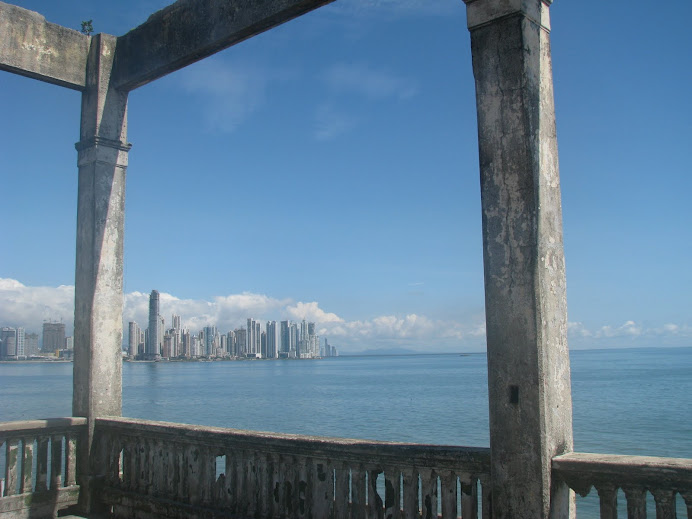
As usual, Mitch sat on a bench with Carmen on her leash out on the promenade and faced a spectacular view of the Panama City skyline. The Pacific Ocean was flat and gray. A few normal thunderheads draped the horizon. Why did Barb care? Poor departed Beth was an acquaintance not a dear old friend. It must be that his wife needed something to do. Ever since they retired, Barb was looking for a hobby or activity to become involved with and she even took some oil painting classes and Spanish language classes and Ti Chi classes but none inspired any more than a passing interest. Whenever, somebody suggested that Barb might want to teach, she always gave the same answer—“Now that wouldn’t be retirement, would it?” Mitch agreed. After all, his main activity was coaching some midget scrubs who appeared to have no chance to win a single game in a rinky-dink league—Now that’s not much of a retirement plan, is it? Plus the season was going to mercifully end soon, and then what? Maybe she could write a novel or a murder mystery or a children’s book or poetry. Barb was an intelligent, sensitive, resourceful, well-educated woman, with a master’s degree in Education and a sharp mind.
Carmen would occasionally pull the leash and stretch out to meet a passerby in hopes of receiving a pat on her clownish head. A woman in sneakers, tee shirt and jeans and a Panama hat leaned over and called Carmen a cute dog. Mitch nodded. Middle-aged women were the most likely to stop and speak baby talk to the dog. “Maybe I should try picking up one of these gals,” Mitch thought, and then “Yeh sure, and then what?” Mitch would give the ladies a smile and a nod and then they would be on their way. Some people both women and men and often Panamanian, but particularly children acted afraid and cringed at the sight of the small white dog with black accents. “What do they see?” Mitch wondered. How could they be frightened by a small 20-pound dog attached to a leash being held by a 230-pound hombre?
What was retirement supposed to be anyway? The rather vague notion was that a person was supposed to rest after a lifetime of work. Just hang out and smell the roses or play golf or travel. Maybe Mitch could get Barb to plan a trip to Columbia or Peru, since they were in the neighborhood; or Argentina; or a safari in Africa; or a tour of England and/or France. That’s what old people do. Of course for a while going to Panama was a rather adventurous trip; and getting settled in was a sometimes frustrating but time-consuming activity; but then they were established, their apartment was furnished; and they knew their way around the city. But, and it was a big but, what then? Boredom, not abject, tedious, hopeless boredom, like convicts in prison or monks in a monastery (Mitch could not picture meditating all day in silence), or collectors in a toll booth might feel, but a feeling of boredom did creep in on an almost daily basis. Part of the deal was that being on a pensioner’s visa in Panama meant that a job was prohibited. Mitch didn’t want to be a greeter at a Wal-Mart anyway. Even starting a business was complicated. The visa required that a foreign business operator had to employ at least three Panamanians and that wouldn’t be retirement, now would it. Retirement was supposed to be like a permanent vacation, and come to think of it, Mitch remembers often being bored at the beach, just sitting there watching the waves or reading a book.
Mitch supposed he could take up golf and play at one of the few courses in Panama, but he had never really been that interested and figured that starting at his age would be futile. On the other hand, little Barb was never into sports. She could almost hide behind a tennis racket and a bicycle seemed like a high seat from which to fall. Mitch remembers one time at a family softball game worrying that the force of a batted ball might knock her over. Involvement in even noncompetitive sports at their age didn’t seem like such good idea. They’d be smashed up against the rocks kayaking down some rapids; or drown scuba diving; or fall off a cliff mountain climbing with no previous experience. So how about hiking?—boring and hard on Mitch’s knees. That left them wondering what to do. Barb, apparently, decided to become a senior sleuth.
There was another key reason why Mitch was not involved in the investigation. Barb never asked him to become involved. Maybe Barb assumed that he would say no, which is probably what he would have said. In fact, he would have tried to talk her out of it. However, she did not ask. Making assumptions after 40 years of marriage is not unheard of, but it did bother Mitch that he wasn’t invited or consulted. Barb simply assumed he would decline and instead announced her intention to look into the matter. What bothered him even more was that she then recruited an associate, a widower approximately their same age and off she went. Was he jealous? Of course he was. Time spent with that Jack fella was time not spent with her own husband. While they were married, his coaching duties and administrator duties often meant that he stayed late after school or attended and chaperoned evening activities, leaving Barb to fend for herself many week nights, which she did—book clubs, charity work, friends, TV and knitting. Not much call for knitting sweaters and scarves in the tropics. However, when he retired, one of the desirable parts of the plan was that he would spend more time with the love of his life. In fact, they were together most of each day, every day since they had only one car and did the grocery shopping, banking, dry cleaners, hardware store and even doctor’s visits together. Mitch appreciated an opportunity to get out of the apartment. He always had plenty of time on his hands and didn’t mind pushing the grocery cart as Barb led the way.
Mitch figured that there would be a renewal of their sex lives, which didn’t in fact turn out. Mitch thought that if they had the time there would be much more sex. He didn’t kid himself and think he suddenly turned into a 6’4” bulky Sean Connery, though Barb was still trim. Maybe he didn’t turn her on anymore. He did think that now both of them had more opportunity that they would take advantage. They had always been careful and that was how they avoided having kids. Mitch would always pull out. He hated condoms. Then when Barb went through menopause, he didn’t have to any more. Frankly, Mitch missed the cum shots, as he liked to call them, while gradually the number of times they had sex tampered off to once or twice a month—more often on weekend trips but those times were rare. Vacations were a time when they always had sex, but now they were on permanent vacation. Even simple affection was harder to come by. There were fewer welcome home kisses because there were no late nights at school; or long basketball practices. They were always together and Mitch had to admit that he had never been much of a hugger and kisser for no reason. They would cuddle up at night in bed but soon either one or the other or both would be snoring away. Often when walking Carmen at night, Mitch envied the young couples seated on the benches or with their legs dangling from the wall that bordered the old town. The young smirky boys in black tee shirts and the girls in their tank tops, their bare arms wrapped around the guys’ necks seemed to be in a different world. It would be foolish for Barb and Mitch to make out on a park bench, when they could snuggle all they wanted on their couch in the privacy of their apartment. Instead they watched DVDs or old movies on Sky TV.
It was hard to imagine, but Mitch hated the idea of his sweet, innocent wife having an affair. Maybe she secretly resented their sex life dropping off a cliff. They never discussed it. It just happened. He had assumed that menopause was part of the cause. Of course the spark had faded if not disappeared completely, but Barb had a cute little figure in a girlish, not too wrinkled way. Plus, he loved her. She was the cutest, nicest, sweetest, most interesting woman he had ever known personally and he was lucky—she was his wife. Now the first thing you don’t go doing is accuse your wife of an affair, without a courthouse full of evidence. Mitch had his doubts that that was what was happening or that it could happen. Then again, Jack was sort of a cool customer, a writer and a restaurant critic and not a bad looking guy for his age and available. The so-called investigation could be nothing more than excuse for those two to see each other. Or not. That was the problem, even if there was no geriatric romance blooming anew; even if Jack never had “any ideas;” or Barb wasn’t even tempted to have one last fling; the question remained—Why Jack? Why did Jack agree to play Watson to Barb’s Sherlock? What was in it for him? Maybe, probably, certainly Mitch could trust his wife of 40 years; but could he trust Jack? Was Jack a break from the routine of decades of marriage? Was he more interesting or more fun; or at least interesting or fun in a different way—a little variety to spice an old girl’s life? Obviously, Mitch had too much time on his hands and was letting his imagination run a bit, but all things considered, Mitch was determined to keep an eye on that Jack guy.
For a while, a long while, Carmen slept under Mitch’s legs, but then stood facing her master, well not exactly, but the guy holding the leash, and looked at him expectantly. “Okay, okay,” Mitch said “it’s time to move. Let’s go back to the apartment and see what Mom’s doing.” Much of the sky was pink as a half dozen pelicans swooped low, just inches above the surface of the sea. As Mitch stood up, the leash went taunt and Carmen gave it a steady pull all the way back, with only a few sniff stops at car tires and door steps. When Mitch unlocked the door, he bent over and slipped the chocker chain off Carmen’s neck, and the dog scooted in and jumped up on Barb, who was standing in the middle of their small living room. An open book was placed face down on the wicker easy chair, and Mitch noticed Barb had on a white tee shirt, red Capri pants and a stern look on her face.
“Where in the world have you been?” Barb asked with her palms raised toward the ceiling fan.
“I took Carmen for a walk, like I always do.” Mitch thought it was obvious.
Barb’s expression changed from peeved to concerned. “You’ve been gone for nearly two hours. That was a mighty long walk there mister. For the last hour, hour and a half, I’ve been worried.”
“I’m sorry,” Mitch said, “but I didn’t realize it had been that long. Are you sure?” To Mitch it seemed unlikely he could have been out for more than a half hour, 45 minutes at the most.
“I’m sure, honey,” Barb said and walked over, stood on her tiptoes and gave her big husband a kiss on the cheek.
The gesture made Mitch feel foolish and instead of apologizing any more he said, “First of all, I don’t believe for minute I was gone any two hours, and so what if I was. Should I punch in and out with a time card, for Christ’s sake?”
It made Mitch even more angry when he heard his wife switch on her teacher voice and inquire, “So do you remember what time you left with Carmen?”
“Oh, I don’t know…” By this time Mitch was snarling. “I suppose it was around 4:00, maybe 4:30.”
“It was a little before 4:00,” Barb said rather too patiently for Mitch’s taste. “And what time is it now? It’s getting dark out.” There were long shadows outside the window.
At that point Mitch didn’t really want to take a look at his wrist watch, but did. “It says 6:15.” The watch hung on his wrist like a handcuff, both proof of his wife’s accusation and evidence of his negligence. Why hadn’t he checked his watch before? Where had the time gone? But also, why was his wife so upset? He wasn’t running around looking for clues. He was just out for a stroll with the dog they had adopted. What was the big deal?
Barb patted him on his bicep and said “Don’t worry honey. Everything is okay. I just got worried is all.”
“Well then, don’t you worry either,” Mitch said, “I’m a big boy and I can take care of myself, and don’t you forget it.” His statement was intended to sound light-hearted, but it sounded silly to Mitch himself and he wondered what his wife was thinking even though she said, “Of course, honey, no problem.”
Well that’s the problem right there. Mitch knew he was being handled—handled with care; with kid gloves; as if he were a problem. The fact of the matter was that Mitch was not so far gone that he didn’t know that to a certain degree he was losing it. The main thing was that he couldn’t remember stuff—what time it was; or day; or month; and plenty of “senior moments”—forgetting why he had gone upstairs; or where he left his glasses; or names of his young hapless players. He even called Carmen “Pesky” more than once which was the name of his dog when he was a boy. At first, Mitch hung on to the senior-moment concept; that it happened to everybody his age, but lately he found the situation more unsettling. He worried that he needed to get a hold of himself. No wonder, he admitted, that Barb didn’t want him involved in anything that needed mental acuity. No wonder Barb was interested in another slightly younger, more with-it guy. It was bad. Mitch knew as much and it bothered him because he didn’t know what to do.
“Oh, Honey,” he said, “I’m so sorry. I’ll watch the time better, I really will. I don’t want you to worry.” Mitch was surprised to find himself near tears. To counteract, he pounded his right fist into his left palm and said a bit too empathically, “I’ll just check my watch more often, that’s all.”
Barb’s small hand fluttered to his shoulder and her bright green eyes met his. “That’s okay Honey; I was just a little worried that’s all.”
At that, Mitch pulled back abruptly and sneered, “You think I’m losing it. Don’t you? You think I’m god damn losing it. Don’t you? Don’t you?”
Once again Barb reached out her small hand and this time gripped her husband’s wide wrist right behind his large, clenched fist. Mitch slumped but did not pull his hand away, as his wife gently kissed his knuckles and said, “Maybe, Honey, sometimes, I don’t know, but sometimes, I’m afraid so.”
* * *
Joe Berger sat at a small corner table under a fake palm tree. The Tropical Island Club, on 37th Street just off Calle Cincuenta, was decorated with artificial palm trees and plastic foliage with what looked like stuffed parrots scattered around in white painted cages hanging from wires attached to the ceiling. Tacky. This was the gentlemen’s club where Bebe worked. It had occurred to Joe that many if not most of the so-called gentlemen’s clubs in Panama City had English language names like The Crazy Horse, where Bebe worked before it closed. There was also Elite II, the Crystal Moon, the Cotton Club, Golden Times, and place names like Miami and Las Vegas and one with a bit of a French flair called Le Palace. It was pretty obvious why, since even the little Tropical Island had a mostly gringo clientele. Some of these guys were businessmen at loose ends but some were in Panama because prostitution was legal. Basically they were sex tourists; or pervs as Joe liked to call them.
Even though it was against the law for Panamanian women to be prostitutes, girls from other countries were actually licensed and were given visas for that expressed purpose. Many of the girls, like Bebe, were from Columbia. Joe did not include himself in the pervert category because he had not come to Panama in order to have legal access to hookers. I’ve never paid for sex and I hope I never will. He told himself he was just keepin’ an eye on my girlfriend. Whatever that meant? He certainly didn’t interfere with her job, which was mainly doing lap dances or table dances as they’re called. Bebe was dressed for the part with big hooped earrings; a thin gold chain with a cross dangling from it; several gold and silver bracelets on her left wrist; five-inch, open toed heels and nothing else. While two naked young ladies danced on small platforms with a pole sticking out to the ceiling, about a half dozen women, a couple of them in g-strings, one in nothing but what must be called a platform bra and the rest like Bebe in high heels and a garter belt for the money she danced for.
Joe liked to watch Bebe do her stuff. Just then Bebe was leaning over a table where two middle-aged guys both in gray suits were seated. Both had removed their ties and were fondling her breasts and butt well past the tan line. She is one sexy piece of ass. Actually, she seldom came over to Joe’s table, because it was understood that he wasn’t a real customer. Once or twice, a new girl tried to entice Joe, but soon learned that he was only paying for rather expensive seven-dollar beers. Bebe and some of the other girls seemed to get a laugh out of watching a newbie do a little dance with no payoff. The performances were pretty much no-holds-barred affairs, since the guys were allowed to touch the dancers, who were humping their legs. What the girls were actually trying to do was provoke enough interest in their marks, so that the guys would soon follow them into a back room, where they would have sex for the house price of $85. The management would take $50 leaving the girl with $35; so the babes tried to go into the back as often as possible. Joe had never actually been in the back. Most of the ladies would also try to make dates for later, so that they could keep more of the money.
It was important that Joe keep Bebe thinking that he was well off financially because she was losing money by dating him. Soon enough, Joe knew his fling with Bebe would come to an end when he refused to marry her. She had already complained about how plain his apartment was, so he printed some photos off the internet of a house he claimed he owned in Boca Raton. The money for the house and the black Mercedes sedan, which he also bragged about, apparently came from the proceeds of his lucrative sports agent operation, a concept that Bebe never seemed to fully comprehend. Yes, he was scamming her, but Joe justified his behavior because he knew that Bebe was scamming him, every time she said “Oh, Joe Baby, I love you mucho.”
The plan that Joe suspected (expected really) was simple. The minute the nuptials were officially sanctioned, Bebe would request, demand more like it, that the happy newlyweds take in her mother and/or sister and/or cousin or her two previously unmentioned kids with Grandma for help. Then just a few days after the family members were moved in, Bebe would charge Joe with physical and psychological abuse backed up by witnesses. This would lead to a divorce and settlement (or criminal proceedings) that seldom benefited the husband. There was even a web site www.gringolovelost.com dedicated to all the forlorn, lovelorn gringo victims. Many anonymous men, who used their dicks to sign away their nest eggs, shared their stories, which were all remarkably alike. It was surprising, almost shocking how prevalent this bait-and-switch scam was—almost as if young women were being trained somewhere; part of their heritage, passed on from generation to generation—how to fleece aging horny gringo men, lonely guys mostly. Joe could identify with that. Loneliness can give a person some weird ideas. Lucky for Joe his ego was low instead of in high gear when he arrived. He was many things and lost way more than he won at life, love and sports, but he wasn’t an idiot. After all, he wasn’t being very honest about his own background either, and so far lied to every woman he met about his resume. However some of these jerk-offs actually believed that the sweet young Columbian thing sucking his Viagra induced hard-on actually cared for him—that she found the little hairs growing out of his nose and ears attractive; and loved Frank Sinatra almost as much as he did. Smucks. Almost nightly, Joe would watch a parade of aging would-be romeos seem to fall for one of the many hookers with hearts of gold. Sure plenty of party boys came through, with no intention of spending more than the going rate in the back room. Then too, there were probably more than a few frauds, like Joe, who never let on that there really wasn’t any gold to dig. Using a user who is using you isn’t using at all. That was why Joe didn’t mind seeing his so-called girlfriend hustling off to the back room with yet another potential husband/payday—it all was a sham, a game and he got to play, at least for a while, before she wised up and moved on to greener pastures.
When Bebe wiggled her way to the back for the third time—this time with a Spanish looking guy in a black tee shirt and jeans, who left a table where three of his friends cheered him on—and it was only 10 p.m., Joe decided it was time to stop nursing his beer and call it a night. Sometimes Bebe came up to his apartment later and sometimes she didn’t. He’d have to wait and see.
When Joe got out of the taxi in front of Columbus House, he spotted Jack Smith sitting on his usual park bench in the square. A light, cool breeze rustled the leaves in the sculpted Fica trees that shaded the sidewalk, casting deep shadows between the streetlights. Berger gave his neighbor a perfunctory wave but was surprised to see Jack motioning toward him as if he wanted Joe to join him. What the fuck could this be about? Slowly, warily Joe sauntered over, hoping to look casual as he did so.
“Good evening,” Jack said, but he didn’t stand up.
“So, what’s happin',” Berger said.
“Have a seat.” Jack patted a space on the other end of the bench.
Oh, oh. Joe remained standing.
“As you probably know, some of us are very concerned about Beth’s murder. We’re also convinced that the suspect in custody is not the one responsible. So I was wondering if you had any theories as to who it might be.”
“Well it wasn’t me,” Joe said with a shrug as he sat down on the edge of the bench, “and even it was, I’m probably not going to confess out here on the square.” He looked up at the imposing statue of Simon Bolivar with what looked like a vulture on his shoulder with his back to the two gringo bachelors shooting the breeze below.
“We’re not accusing anybody,” Jack said, “but we are concerned that the police aren’t doing much to find out who really did it.”
“First of all, they’re not doing diddlysquat,” Joe said, but then more defensively, “and just who is this we you keep referring to?”
“Let’s say it’s a small group of concerned expats,” Smith said. At that Berger stood up again. “Okay, I’m the we, and I didn’t do it either, but somebody did. All right?”
Joe laughed. “Yeh, I know what you mean. So why don’t you start off by telling me who’s on your list of suspects.”
“To be perfectly honest, it’s virtually everybody with whom Beth had some sort of relationship.”
“Exactly, so the list includes you and me there bud.”
“At least theoretically,” Jack said. “Though for obvious reasons, I’ve managed to scratch my name off my personal list.”
“Well, you’re still on mine,” Joe said pointing a finger at the small man in a tidy flower-print shirt, pleated shorts and flip flops sitting across from him. “Okay, I’ll admit that right after Beth broke off what I had hoped would be some sort of, you know, relationship, I was pretty upset…”
“After all, you did kick that little dog,” Jack said, but then seemed to immediately regret making the point.
“Exactly! First of all, I never kicked that fuckin’ dog; but more to the point is how the hell do you even know about it? I’ll tell you how. Beth, your old pal, buddy, friend, lover told you herself. You want to know how I know? After she threw that hissy-fit over that stupid mutt, I decided to wait outside her house in hopes of getting a chance to talk to her. No, I wasn’t stalking her, I didn’t do it all the time, but I would hang out every once in a while, and lo and behold, who do I see coming out the back door and out the back gate, after a kiss on the cheek and hug? Why none other than the restaurant critic for some silly-ass local newspaper, that nobody reads. That’s right, pal, you’re still on my list, for obvious reasons.”
“No need to be aggressive,” Jack said. While Berger was raving on, he did appear to be a bit surprised but not very worried. “After all, if I wasn’t a friend of hers, I wouldn’t be interested in finding her killer, would I?”
“Maybe, as a concerned citizen…Anyway, if you want to continue this conversation, you can drop your righteous attitude. My name’s not on my list either, but I’m not so pompous to expect that somebody else might not wonder if I had something to do with it. So did you kill her?”
“Don’t be silly, of course not.”
“Silly, silly? Then why so secret? The front door didn’t work or something? You’re sneaking out the back door…”
“I wasn’t sneaking anywhere…”
“…but I’m a suspect because I kicked her dog? That doesn’t make much sense.”
“No, but you resented being dismissed as a hateful dog kicker,” Jack said as he attempted to regain the upper hand. “Then you lurk around in the shadows watching the comings and goings even at the back door. That’s pretty suspicious behavior, if you ask me.”
“No, no, you asked me…” By this time Berger was pacing back and forth in front of the bench. “And I only hung around a couple of nights, before I gave up, but just long enough to catch you sneaking out.”
“I wasn’t sneaking, I told you. We were in the kitchen. It was the closest door. She had the front door bolted, against you if you must know.”
“So I am a suspect,” Berger said. And my point is?
“Of course you are,” Smith said it with a slump of his shoulders as if he were exasperated. “You had a grudge against her. And now that I’ve spoken with you, you obviously feel that she rejected you unfairly, whether or not you kicked the dog.”
“I never, ever kicked …, oh what the hell.” Then with a sigh, “Okay, I see your point. I know I didn’t do it, but I don’t know who did. So, like I said, it could very well be you and you’re going around covering your ass or whatever.”
Jack even surprised himself by remaining relatively calm. This Berger fellow was a prime suspect as far as he was concerned and it didn’t seem that the interrogation had gone that well. If Berger was the one, he was certainly on alert from now on; but what if he didn’t do it? He had Beth’s house under surveillance for goodness sake. “Okay, just for argument sake, let’s operate under the assumption that neither one of us did it, because if we did, then this is a pretty foolish conversation we’re having…”
“I didn’t do it, but okay…”
“So, who do you think did?”
“Back to square one, aye? Well, for one thing, I’m not as sure as you seem to be that it wasn’t that bum, Ham or whatever his name is. He hung around her place a lot, and even did odd jobs. Maybe he needed some money. The problem is that if you start thinking about it, the list can get pretty darn long.”
Jack nodded and said “go ahead.”
“So, who saw her last? That prick Allen, right? As far as I’m concerned he’s the leading suspect, except there is no apparent motive. But my gut feeling is that for some sick reason it’s him.”
“I see you’ve done some thinking on the subject,” Jack said, with the same pompous tone that pissed Berger off in the first place.
“Yeh, just like you. When it dawns on you that you’re probably a suspect, and you know that you didn’t do it, you start wondering who did. You’re the one who said he wants to catch the real killer and not just the bum on the corner. So, your turn. Who do you think did it; that is unless you’re ready to confess?”
“I think you would have to consider Jerry Cole,” Jack offered.
“Do you rank him ahead of or behind me and Allen or the street guy?” Joe wanted to know.
“This is quite a conversation…” Jack said with a smile.
“You started it.”
“…but to honest, I haven’t come up with a ranking system, but like you, Jerry Cole is a top suspect. Allen and Jamon, not so much. And since I know I didn’t…”
“Okay, okay! So, what about her fuckin’ lawyer, Billy somebody?”
“No I hadn’t thought of him.” After all, Billy Boar was his lawyer as well. “Why on earth would he be on a list of suspects?”
“I’m not sure, but on the night before the dog incident, Beth was yelling on the phone with some guy named Billy for about half an hour. When she left the room, she said ‘it’s my lawyer, I have to take the call,’ and while I couldn’t hear what she was saying, I could hear that she wasn’t happy. Maybe there were problems. Maybe Beth was a slut. Who knows?”
“Listen, pal,” Jack stood and looked up at Berger, who was much taller with his hands in a defiant pose at his hips. Joe was dressed almost identically to Jack, though his shirt was printed with much fainter flowers, his khaki shorts more rumbled and his flip flops more worn. “We’re not here to besmirch Beth’s reputation.”
“She doesn’t mind. She’s dead,” Berger said, backhanding the air dismissively. “Heck, she slept with me on our first date; and only date. Then moments later she’s in Asshole Allen’s arms; while you’re slipping out the backdoor. Who knows how many others? I believe that the deceased has been around the block more than once. Is all I’m saying.”
“I was not having an affair with Beth and I would appreciate it if you would stop implying that I did. However, I agree that jealousy is a strong motive and keeps you at the top of any list.”
“Okay, I’ll admit that I wasn’t that thrilled seeing Beth and Allen the ass-wipe sashaying around Casco Viejo, but I’ll tell you who really hates our dearly departed…”
“Who?”
“Bebe, that’s who. Listen I’m not kidding myself; but at least half the reason our favorite Columbian cutie is dating me is to piss off Allen, who dumped her the minute he got a foot in the door, so to speak, with Beth. Bebe refers to her simply as ‘that bitch.’ Yup, if I was making a list, I would have to include sweet little bouncy Bebe as someone who wished Beth dead.”
“Do you really think she could have done it? I mean she’s not very big.” Smith was stunned by Joe’s candor; and found himself liking his prime suspect even less than he did before. There had always been something shady, underhanded, creepy even about this Berger fellow, ever since he appeared on the scene. His willingness to implicate his paramour did nothing to improve Berger’s image in Jack’s mind.
“Sure, she’s a tough little cookie. If she gets a hold of you, she’ll turn you every way but loose.” At that, Joe winked. “So you see your little list is getting longer all the time. It might not be me after all.” Another wink.
Just then, a yellow taxi pulled up in front of Columbus House and Bebe emerged. Her black curly hair was down over her shoulders. A white tee shirt with the words Tropical Island Club written across her snug breasts in hot pink was tucked into a very tight pair of jean short shorts. She wobbled toward the two gray-haired men, who stood facing each other, in a pair of red very high heels. “Good evening gentlemen,” she said with a smile that looked genuine to Jack Smith.
“Where?” Joe pretended to look around in search of any gentlemen. Bebe slapped Joe’s arm playfully. “Well, I’ll be seeing you old buddy,” Joe said as he took Bebe by the elbow and steered her toward the door. “Happy huntin’.”
Thursday, August 5, 2010

Monday, July 5, 2010
Casco Viejo: The Second Season
Chapter Ten
Almost forgotten in the aftermath of Beth’s murder was the scheduled visit of Barb’s best friend from high school Jackie and her husband Hank, all the way from Saginaw, Michigan. Even though they didn’t socialize much with the Hanners back in Saginaw—Barb would meet Jackie once or twice a year for lunch—they were the first and so far only people who showed any interest in visiting Panama. “Their visit will give us a chance to become acquainted,” Mitch pointed out. It mystified the Multuskys that so few of their friends, family, colleagues and acquaintances seemed to consider Panama a desirable place to visit. “Maybe they don’t know what’s here,” Mitch reasoned. “I mean how interesting can a canal be?” When Barb raised an eyebrow, “I know, an engineering wonder of the world; but I don’t think people realize how big and impressive the city is or that the entire country is two beautiful coast lines with a mountain range in the middle or …”
“A banana republic with dictators like Noriega running around having machine gun battles with drug cartels,” Barb giggled. “You know when we left, people kept saying how brave we were; like we were hiking into the rainforest with nothing but a water bottle and a machete. If not being able to speak Spanish stops people then no one would go to Miami. I think they’re ignorant of where or what Panama is. All they know is that Carter should have never let Panama have control over the canal.”
“Another real possibility is that the people back in Michigan don’t miss us that much,” Mitch said, as he popped open a can of Atlas beer.
“And vice versa,” Barb said, which was true. She had expected to feel more sentimental about leaving a place where she had spent most of her life, but she didn’t. Before she left, at her school’s end- of-the-year party for example, she got the impression that some of her fellow faculty felt that they were somehow being abandoned—that Barb was turning her back on them, or on America or home or something that comprised all of that. Why would anyone want to live anywhere other than in the good old United States of America?
Mitch and Barb never had kids and there was always a mixture of resentment, disapproval and pity about that, but it also gave the Multuskys the freedom to live wherever they wanted, without worrying about being there for their children and grandchildren and birthdays, graduations, weddings and Christmas. Barb always wondered why her biological alarm clock never went off. Mitch and she never considered themselves particularly selfish or ungenerous, after all they ended up working with thousands of other people’s kids, but the urge to procreate seldom if never came about for them. It wasn’t a problem, except in other people’s minds, some of whom had even inquired over the years if “everything was working properly.” To be honest, they never checked medically, but had always been very careful. When Barb reached menopause, Mitch claimed to “miss a good ol’ cum shot every once in a while.”
With their parents deceased (Mitch noted once that “we’re orphans living in a strange land,” while Barb thought the term orphans seemed inappropriate for two old fart retirees.), and a brother here and a cousin there, family wasn’t as strong a force as it seemed to plenty of folks Barb knew. Again it wasn’t rejection. As far as Barb was concerned they weren’t rejecting family or America. Once when they were discussing what they left behind—partisan politics; real estate tax coupled with a rising cost of living; eight-lane highways; and reality TV; both were quick to admit that there was much they missed including smooth roads; postal service; the local evening news on TV; corn-fed Angus beef; and long summer nights. “I do miss apple pie,” Mitch admitted, “but we have baseball down here and they’re pretty good, so there’s pluses and minuses.” Yes, when they watched CNN International they were informed that other things were happening to people in the world other than U.S. politicians and celebrities. They voted absentee in the federal election (Obama—both wanted Hilary, but never voted for “that idiot Bush” and certainly not McCain), and still paid income tax and worried about the recession and the oil spill. “Okay,” Mitch said when Barb kept fretting, “we’re retired, which means we’re on permanent vacation and we picked some place exotic, instead of some god-awful retirement community outside of Orlando or Tampa or wherever. Not that there’s anything wrong with that (with a wink), but we took the path less travelled and that’s made all the difference.”
“Not an exact quote, but close enough.” Barb loved her husband and appreciated his attempts at humor and/or wisdom and knew there was nothing she could do about the perception of others. Maybe in a busy world, they hadn’t really been gone long enough yet to be missed. And Jackie and her husband were coming in, soon in fact, so Barb washed a couple of glasses in the sink and asked Mitch if he was ready to go to the airport.
At Tocumen Airport, Barb and Mitch waited for nearly an hour after the flight landed for their friends to finally emerge through the door from customs. Many, many people had come out that particular sliding glass door in the past forty-five minutes and were greeted by huggers or guys with signs with names printed in marker, but never the Hanners. There was even a lull, when no one existed for what seemed like five minutes. Then when the Hanners did show, Barb and Mitch failed to immediately recognize them. It might have been the sun glasses (“Why would they need sun glasses inside the terminal?” Mitch wondered later, in private. To which Barb replied “maybe they were ready for the tropic sun.”); or maybe it was that Jackie’s long brown dyed hair was pulled back in a ponytail; or maybe it was because neither one of them knew Hank that well. Then too Jackie and Hank peered past and beyond their hosts before finally focusing on the Multuskys looking around anxiously.
“Can you imagine,” Jackie said as she ducked away from Mitch’s attempt at an air kiss, “the people in customs didn’t even speak English.”
“It’s a Spanish speaking country,” Mitch said.
“At the airport?” Hank was in full eyebrows up; head back; well-I-don’t-think-so attitude that immediately, irrevocably pissed Mitch off.
“Actually, everywhere. Here let me help you with that.” Hank handed over his suitcase happily and allowed Mitch to hoist both his and his wife’s luggage, while he pulled a small carry-on bag on squeaky wheels, while Barb took control of Jackie’s carry-on.
For the next four days, Mitch had to bite his tongue and ignore the urge to grab the much shorter but pudgier man and shake him by the lapels, actually by a fist full of polo shirt. While Barb and Jackie seemed to have plenty to talk about, Hank kept hitting Mitch with statements like:
“I thought they drove on the left in Panama.”
“No that’s the Bahamas and I think maybe Bermuda—nowhere near here.”
“I’m going to need to exchange some money.”
“It’s the U.S. dollar down here.”
“You’re kidding. So I guess we’re still in charge.”
“Not really.”
“So I need to change the time on my watch.”
“Actually, we’re in the same time zone, so your watch is correct.”
“No way. How can that be? You know that was the announcement on the plane when we landed, but I didn’t believe it.”
“Panama is directly south of New York or Miami in the Eastern Time Zone, but we don’t have day-light-savings time, so we match the Midwest.”
“No way. How can that be? Panama’s way over in Central America. Am I right?”
“Well yeah, but its longitude, not latitude. Anyway, your watch is correct.”
“So who is the dictator now?”
“Actually, they have an elected president, a fella by the name of Martinelli, and a vice president, and a democratic legislature and democratically elected representatives and mayor of the city.”
“You’re kidding. So where’s, you know, what’s his name?”
“Noriega?”
“Yeah, that guy.”
“Well, for the past 17 years he’s been in prison in Florida and just recently he was extradited to France for money laundering charges.”
“You must be kidding. That long ago?”
“I kid you not.”
And so it went. When Carmen jumped up to say hello, Jackie acted as if she were being attacked by a giant scorpion. Hank would push down at Carmen and fervently say “Bad dog, bad dog,” until the free-range pet would take the hint and escape through the window grate. Jackie was allergic to seafood in a country of coastline. Hank wasn’t but wanted oysters and something “light and white like haddock”—neither available. Jackie, who was shaped like her husband, kinda round in a not very tall way, seemed to talk constantly, but never directed a single utterance at Mitch, who they both treated like a hired driver, with perpetual requests to turn up or turn down the air conditioner or radio combined with exhortations to “Slow down” or “Look out!”; or concierge with unending requests for different soap, fresh towels, tissues, toilet paper that turned out to be under the bathroom sink and to make fine adjustments to the air conditioning or fan speeds; or bartender, with requests for diet cokes, sparkling water, Corona beers with limes inserted in the bottle, vodka tonics that were too weak more than once, but never too strong and unpredictable switches from white to red or red to white wine almost always when a new bottle needed to be opened. Barb tried to help, but most requests, demands and comments were directed directly at Mitch, who made a point of springing into action like a well trained domestic, after his suggestions that “please feel free to help yourself” went unheeded.
More than once, twice in fact, Hank got up to go to the men’s room just in time to avoid being present when a dinner check arrived. Needless to say, he never inquired about the bill or even offered Mitch the pleasure of receiving a thank you. Hank was quick on the draw for lunch and made a point of saying “My turn,” strongly implying that the next meal—dinner with cocktails, appetizers, dessert and at least two bottles of wine—would be someone else’s turn.
Were they impressed by the locks on the Panama Canal? Not really. “It takes a mighty long time for a boat to get through.” They did think the skyline of Panama City reminded them of Miami Beach, which turned out to be a place they had never been. Too much horn honking, too many pedestrians and way too many tall buildings as far as they were concerned in Panama City.
Ah, but what about Casco Viejo? “Well, it certainly is no New Orleans.” Another place they had never actually visited. Too much construction. Too many tourists. “So what are they?” Mitch wondered under his breath. And the sidewalks. Both Hank and particularly Jackie walked the sidewalks of Casco Antiguo as if they were crossing a lunar minefield. Hank actually said “I can’t look at the architecture because I have to watch my every step.” No doubt there are too many cracks, holes and uneven places, but the Hanners were so not making a go of it, that Mitch was tempted to push Hank off the curb into an oncoming taxi and simply claim that Hank fell. When they saw the cranes, stately exotic birds that had been part of the scene since the 1920s, in the lobby of the presidential palace, they thought it was “weird.” And the views of the Pacific Ocean from the walls of Las Bovedas. “Nice.” For once Mitch did not think that the ancient practice of chaining prisoners to the outside walls during low tide as too cruel. “It would be nice, when high tide came and Hank was chained at rock level.” Mitch smiled at his fantasy. Overall impression of Casco Viejo—“kinda run down, but could be nice (Nice again. Mitch’s nostrils flared.) with a whole lot of elbow grease.” Mitch thought of greasing his elbows. Then in one of Hank’s most gracious moments, “…an interesting place to visit, but I wouldn’t want to live here.” A two or three beat pause, then a nervous little smirk and a lame “I was only kidding. It’s all very nice.” Jackie slapped his arm and said, “They might not believe you’re kidding.” They didn’t. After five days of “getting handled by the Hanners,” as Mitch would remember it, Multusky drove them to the small local airport at Albrook for their flight to David and their stay in a small boutique hotel in the mountains near the town of Bouquete. Since Barb stayed back so she could get back to her private investigation, Mitch saw no reason to do anything other than simply stop at the main entrance of the airport and pull the lever that unlocked the back door of the SUV. Hank struggled some but got the baggage to the curb. When the door was closed, Mitch needed all his self control, developed through years of being the vice principal in charge of discipline at a junior high school, to not burn rubber. Instead, he lowered the passenger side window half way and said “Good bye.” He then pulled off slowly, but without waiting for anything more to be said by his guests.
Barb really had no idea how to conduct an investigation, especially since she did not have any authority to do so. Benito Cortez, her young Panamanian lawyer and guardian angel, tried to get information from the police, who were not very forthcoming. Since Beni was unwilling to misrepresent himself as anything other than a concerned citizen, all he was really able to do is translate the official police report—estimated time of death: sometime between 11:00 p.m. and 7:30 a.m. / cause of death: strangulation / suspect: Horace Gomez, aka Jamon / motive: attempted robbery / evidence: Gomez had an unspecified amount of cash on his person / victim’s purse and wallet were missing / items of value such as a cell phone; wide-screen TV; art work; jewelry including a diamond ring on victim’s small finger were still on the premises / other details: no evidence of forced entry; cat’s bowl was empty and cat had not appeared; front door and back gate locked, while door to back porch left ajar.
Beni was allowed to speak with Jamon, even though he had no intension of representing the street person. Cortez did not do criminal law and couldn’t see how becoming officially involved would benefit his career or reputation. Barb was so anxious to do something that Beni went along but wasn’t very convinced by what he learned during his interview with Jamon. For the most part, Jamon didn’t know what was happening or what happened. He was very sorry, but he didn’t hurt Senora Beth. He had no idea who did, and did not remember seeing anyone. He was around like always, but couldn’t remember exactly where or when. He looked up at the handsome young lawyer with a bewildered expression on his sad face.
Did he have an alibi? No. / Did he go to Senora Beth’s house? Yes, but she was not there. How did he know she wasn’t there? She didn’t answer when he knocked on the front door, looking for a donation. (That answer won’t help him Beni thought.) / Was he with anyone? Sure. Juan, Billy and Carmen. Did he mean the dog? Yes. Was he with them at any particular time? Yes. When? During the night…and so it went. Beni was fairly confident that Jamon had not committed murder, but was also sure that the poor little dumpy helpless man would not be an easy client to defend.
The only method that Barb could come up with was to visit with people who she thought might have done it. In other words involve the suspects themselves in her informal inquiry. For a variety of reasons, not the least of which was that she was a bit afraid of Jerry Cole’s temper herself, she skipped him and went on to Allen Myers, the closest thing she had to someone who would be grieving and maybe who would share her ardor to find the true perpetrator.
She had never been in Allen’s apartment before and was surprised at how much it struck her as a so-called bachelor pad. It was done up in what she considered “retro Playboy Mansion,” even though Barb really had no experience in any such place. There was actually a painting of a busty Nubian princess on black velvet, hung directly above a sectional couch upholstered in a leopard print. A single black-leather Lazyboy-style lounge chair was stationed in front of a huge flat-screen TV hung on a wall that was painted fire-engine red. A three-stool curvy bar with gold studs in red leather stood in one corner. The dining area with an over-formal chandelier seemed neglected with papers, envelopes and magazines scattered on the table surrounded by four chairs, all pushed in. When Barb used the powder room she noted two rather tasteful pen-and-ink drawings of nude women on the wall.
After Barb expressed her concerns about Beth’s killer getting off, while poor Jamon was taking the rap, she asked Allen if he had any idea who might have actually committed the crime.
“Well, it wasn’t me,” Allen said as he pulled out one of the dining set chairs and pushed a couple of old newspapers out of the way. One was a La Penza that had the front-page story of Beth’s death. “Of course you know the husband is always the first and primary suspect, but since Beth’s husband is dead, the boyfriend is the most likely and that was me. To be quite frank, I expected a lot more attention from the police. After all, I was the last person to see her alive.” When Allen saw the surprised look on Barb’s small alert face, he shrugged. “We even had sex, so there should be a boatload of DNA evidence if they even checked. Anyway, I told them I left around 11 and they duly noted that and apparently went out and arrested the bum on the corner.” Barb did not know how to respond to Allen’s incriminating evidence. “Here’s my point,” he said in response to the fact that Barb did not display a poker face. “I know I did not kill Beth. Shit, I liked her, a lot. I mean what would my motive be? End the best chances for a real relationship in years. We were perfect for each other. To be totally honest, I was more than a little put off by how casual or off-handed or however you want to put it that the cops were. Now, I do have a witness, who saw me arrive home at a little after 11, but that still doesn’t mean I shouldn’t be a suspect, if you know what I mean.”
Barb nodded. “Who’s your witness?”
“Jack, Jack Smith. He often sits out on a bench in the square outside our building. I even said ‘hello’ to him.”
Barb’s hands were fluttering like sparrows. She had decided not to take notes, until after she left because she wanted to appear like a concerned friend, rather than a nosey private eye. However, Allen was hitting her with more info than she knew what to do with. Why hadn’t Jack mentioned that he had seen a or the prime suspect that night? Why was Allen being so darn forthcoming? Was he trying to disarm her with candor? What would be a plausible motive for Allen to do Beth wrong? And what am I getting myself into? “So, who do you think did it?”
“I have to admit, I don’t think that worthless homeless guy had anything to do with it. So I agree with you that Beth’s murderer is still at large.”
“So?”
“So I don’t know; but if I had to guess I’d say it could very well be that creep Joe Berger. Beth told me that he had been lurking around her house for days and I actually caught him once on her door step.”
“Why Joe?”
“You’re kidding right? The stupid shit, excuse me, was jealous. I mean you’re not going to broadcast this around, because if it’s not true it’s slander.” Beth gave a wave of her jittery hands to indicate no problem. “But the guy was literally stalking her. Beth told me that she might have encouraged him at first, whatever that meant, but that he kicked her dog or something and she decided he wasn’t her type and that she had trouble getting rid of him.”
“I don’t believe that Beth had a dog,” Barb pointed out patiently. “Maybe it was a cat.”
“No, no, it was that little black and white mutt, that hung around her place.”
“You don’t mean Carmen?” Barb was reeling from too much information, much of which was a total surprise. So, she tried to get back to Berger, since he was in fact near the top of her list of suspects.
“I really don’t know the dog’s name. I mean I think it’s a stray.” Apparently Allen had never encountered Barb or more likely Mitch when Carmen was on a leash. “What I do know, was that Berger lost what chance he had, when he kicked that dog; and then I came into the picture and he wasn’t happy. So much so that the jerk started going out with that bimbo, I was dating before.”
“I believe I met her on at least one occasion,” Barb offered.
“Yeh, the Columbian hooker I forced on you folks a couple of times. I’m sorry about that, but I guess I was showing off or something. I’ll tell you I was thankful that Beth didn’t hold it against me.”
Again Barb was stunned by Allen’s candor, so much so that she found it made her suspicious. “Why are you telling me all this?”
Allen paused, and looked the little woman at his table straight in her eyes. “Am I telling you anything really that you haven’t at least suspected? I mean, you’re the first person that came around, except the police, who has even bothered to ask how I’m doing. Well, I’m fucking upset, if you really want to know. I meet somebody pretty darn cool and we start like dating, really dating and I have sex with her and later that same night, she’s murdered. And you ask me who I think might have done it and so I tell you. What do you want me to say? I think it was that Berger character.”
“Do you think he’s capable of murder?”
“How the shit should I know. Does anybody know anything about the guy?”
Chapter Ten
Almost forgotten in the aftermath of Beth’s murder was the scheduled visit of Barb’s best friend from high school Jackie and her husband Hank, all the way from Saginaw, Michigan. Even though they didn’t socialize much with the Hanners back in Saginaw—Barb would meet Jackie once or twice a year for lunch—they were the first and so far only people who showed any interest in visiting Panama. “Their visit will give us a chance to become acquainted,” Mitch pointed out. It mystified the Multuskys that so few of their friends, family, colleagues and acquaintances seemed to consider Panama a desirable place to visit. “Maybe they don’t know what’s here,” Mitch reasoned. “I mean how interesting can a canal be?” When Barb raised an eyebrow, “I know, an engineering wonder of the world; but I don’t think people realize how big and impressive the city is or that the entire country is two beautiful coast lines with a mountain range in the middle or …”
“A banana republic with dictators like Noriega running around having machine gun battles with drug cartels,” Barb giggled. “You know when we left, people kept saying how brave we were; like we were hiking into the rainforest with nothing but a water bottle and a machete. If not being able to speak Spanish stops people then no one would go to Miami. I think they’re ignorant of where or what Panama is. All they know is that Carter should have never let Panama have control over the canal.”
“Another real possibility is that the people back in Michigan don’t miss us that much,” Mitch said, as he popped open a can of Atlas beer.
“And vice versa,” Barb said, which was true. She had expected to feel more sentimental about leaving a place where she had spent most of her life, but she didn’t. Before she left, at her school’s end- of-the-year party for example, she got the impression that some of her fellow faculty felt that they were somehow being abandoned—that Barb was turning her back on them, or on America or home or something that comprised all of that. Why would anyone want to live anywhere other than in the good old United States of America?
Mitch and Barb never had kids and there was always a mixture of resentment, disapproval and pity about that, but it also gave the Multuskys the freedom to live wherever they wanted, without worrying about being there for their children and grandchildren and birthdays, graduations, weddings and Christmas. Barb always wondered why her biological alarm clock never went off. Mitch and she never considered themselves particularly selfish or ungenerous, after all they ended up working with thousands of other people’s kids, but the urge to procreate seldom if never came about for them. It wasn’t a problem, except in other people’s minds, some of whom had even inquired over the years if “everything was working properly.” To be honest, they never checked medically, but had always been very careful. When Barb reached menopause, Mitch claimed to “miss a good ol’ cum shot every once in a while.”
With their parents deceased (Mitch noted once that “we’re orphans living in a strange land,” while Barb thought the term orphans seemed inappropriate for two old fart retirees.), and a brother here and a cousin there, family wasn’t as strong a force as it seemed to plenty of folks Barb knew. Again it wasn’t rejection. As far as Barb was concerned they weren’t rejecting family or America. Once when they were discussing what they left behind—partisan politics; real estate tax coupled with a rising cost of living; eight-lane highways; and reality TV; both were quick to admit that there was much they missed including smooth roads; postal service; the local evening news on TV; corn-fed Angus beef; and long summer nights. “I do miss apple pie,” Mitch admitted, “but we have baseball down here and they’re pretty good, so there’s pluses and minuses.” Yes, when they watched CNN International they were informed that other things were happening to people in the world other than U.S. politicians and celebrities. They voted absentee in the federal election (Obama—both wanted Hilary, but never voted for “that idiot Bush” and certainly not McCain), and still paid income tax and worried about the recession and the oil spill. “Okay,” Mitch said when Barb kept fretting, “we’re retired, which means we’re on permanent vacation and we picked some place exotic, instead of some god-awful retirement community outside of Orlando or Tampa or wherever. Not that there’s anything wrong with that (with a wink), but we took the path less travelled and that’s made all the difference.”
“Not an exact quote, but close enough.” Barb loved her husband and appreciated his attempts at humor and/or wisdom and knew there was nothing she could do about the perception of others. Maybe in a busy world, they hadn’t really been gone long enough yet to be missed. And Jackie and her husband were coming in, soon in fact, so Barb washed a couple of glasses in the sink and asked Mitch if he was ready to go to the airport.
At Tocumen Airport, Barb and Mitch waited for nearly an hour after the flight landed for their friends to finally emerge through the door from customs. Many, many people had come out that particular sliding glass door in the past forty-five minutes and were greeted by huggers or guys with signs with names printed in marker, but never the Hanners. There was even a lull, when no one existed for what seemed like five minutes. Then when the Hanners did show, Barb and Mitch failed to immediately recognize them. It might have been the sun glasses (“Why would they need sun glasses inside the terminal?” Mitch wondered later, in private. To which Barb replied “maybe they were ready for the tropic sun.”); or maybe it was that Jackie’s long brown dyed hair was pulled back in a ponytail; or maybe it was because neither one of them knew Hank that well. Then too Jackie and Hank peered past and beyond their hosts before finally focusing on the Multuskys looking around anxiously.
“Can you imagine,” Jackie said as she ducked away from Mitch’s attempt at an air kiss, “the people in customs didn’t even speak English.”
“It’s a Spanish speaking country,” Mitch said.
“At the airport?” Hank was in full eyebrows up; head back; well-I-don’t-think-so attitude that immediately, irrevocably pissed Mitch off.
“Actually, everywhere. Here let me help you with that.” Hank handed over his suitcase happily and allowed Mitch to hoist both his and his wife’s luggage, while he pulled a small carry-on bag on squeaky wheels, while Barb took control of Jackie’s carry-on.
For the next four days, Mitch had to bite his tongue and ignore the urge to grab the much shorter but pudgier man and shake him by the lapels, actually by a fist full of polo shirt. While Barb and Jackie seemed to have plenty to talk about, Hank kept hitting Mitch with statements like:
“I thought they drove on the left in Panama.”
“No that’s the Bahamas and I think maybe Bermuda—nowhere near here.”
“I’m going to need to exchange some money.”
“It’s the U.S. dollar down here.”
“You’re kidding. So I guess we’re still in charge.”
“Not really.”
“So I need to change the time on my watch.”
“Actually, we’re in the same time zone, so your watch is correct.”
“No way. How can that be? You know that was the announcement on the plane when we landed, but I didn’t believe it.”
“Panama is directly south of New York or Miami in the Eastern Time Zone, but we don’t have day-light-savings time, so we match the Midwest.”
“No way. How can that be? Panama’s way over in Central America. Am I right?”
“Well yeah, but its longitude, not latitude. Anyway, your watch is correct.”
“So who is the dictator now?”
“Actually, they have an elected president, a fella by the name of Martinelli, and a vice president, and a democratic legislature and democratically elected representatives and mayor of the city.”
“You’re kidding. So where’s, you know, what’s his name?”
“Noriega?”
“Yeah, that guy.”
“Well, for the past 17 years he’s been in prison in Florida and just recently he was extradited to France for money laundering charges.”
“You must be kidding. That long ago?”
“I kid you not.”
And so it went. When Carmen jumped up to say hello, Jackie acted as if she were being attacked by a giant scorpion. Hank would push down at Carmen and fervently say “Bad dog, bad dog,” until the free-range pet would take the hint and escape through the window grate. Jackie was allergic to seafood in a country of coastline. Hank wasn’t but wanted oysters and something “light and white like haddock”—neither available. Jackie, who was shaped like her husband, kinda round in a not very tall way, seemed to talk constantly, but never directed a single utterance at Mitch, who they both treated like a hired driver, with perpetual requests to turn up or turn down the air conditioner or radio combined with exhortations to “Slow down” or “Look out!”; or concierge with unending requests for different soap, fresh towels, tissues, toilet paper that turned out to be under the bathroom sink and to make fine adjustments to the air conditioning or fan speeds; or bartender, with requests for diet cokes, sparkling water, Corona beers with limes inserted in the bottle, vodka tonics that were too weak more than once, but never too strong and unpredictable switches from white to red or red to white wine almost always when a new bottle needed to be opened. Barb tried to help, but most requests, demands and comments were directed directly at Mitch, who made a point of springing into action like a well trained domestic, after his suggestions that “please feel free to help yourself” went unheeded.
More than once, twice in fact, Hank got up to go to the men’s room just in time to avoid being present when a dinner check arrived. Needless to say, he never inquired about the bill or even offered Mitch the pleasure of receiving a thank you. Hank was quick on the draw for lunch and made a point of saying “My turn,” strongly implying that the next meal—dinner with cocktails, appetizers, dessert and at least two bottles of wine—would be someone else’s turn.
Were they impressed by the locks on the Panama Canal? Not really. “It takes a mighty long time for a boat to get through.” They did think the skyline of Panama City reminded them of Miami Beach, which turned out to be a place they had never been. Too much horn honking, too many pedestrians and way too many tall buildings as far as they were concerned in Panama City.
Ah, but what about Casco Viejo? “Well, it certainly is no New Orleans.” Another place they had never actually visited. Too much construction. Too many tourists. “So what are they?” Mitch wondered under his breath. And the sidewalks. Both Hank and particularly Jackie walked the sidewalks of Casco Antiguo as if they were crossing a lunar minefield. Hank actually said “I can’t look at the architecture because I have to watch my every step.” No doubt there are too many cracks, holes and uneven places, but the Hanners were so not making a go of it, that Mitch was tempted to push Hank off the curb into an oncoming taxi and simply claim that Hank fell. When they saw the cranes, stately exotic birds that had been part of the scene since the 1920s, in the lobby of the presidential palace, they thought it was “weird.” And the views of the Pacific Ocean from the walls of Las Bovedas. “Nice.” For once Mitch did not think that the ancient practice of chaining prisoners to the outside walls during low tide as too cruel. “It would be nice, when high tide came and Hank was chained at rock level.” Mitch smiled at his fantasy. Overall impression of Casco Viejo—“kinda run down, but could be nice (Nice again. Mitch’s nostrils flared.) with a whole lot of elbow grease.” Mitch thought of greasing his elbows. Then in one of Hank’s most gracious moments, “…an interesting place to visit, but I wouldn’t want to live here.” A two or three beat pause, then a nervous little smirk and a lame “I was only kidding. It’s all very nice.” Jackie slapped his arm and said, “They might not believe you’re kidding.” They didn’t. After five days of “getting handled by the Hanners,” as Mitch would remember it, Multusky drove them to the small local airport at Albrook for their flight to David and their stay in a small boutique hotel in the mountains near the town of Bouquete. Since Barb stayed back so she could get back to her private investigation, Mitch saw no reason to do anything other than simply stop at the main entrance of the airport and pull the lever that unlocked the back door of the SUV. Hank struggled some but got the baggage to the curb. When the door was closed, Mitch needed all his self control, developed through years of being the vice principal in charge of discipline at a junior high school, to not burn rubber. Instead, he lowered the passenger side window half way and said “Good bye.” He then pulled off slowly, but without waiting for anything more to be said by his guests.
Barb really had no idea how to conduct an investigation, especially since she did not have any authority to do so. Benito Cortez, her young Panamanian lawyer and guardian angel, tried to get information from the police, who were not very forthcoming. Since Beni was unwilling to misrepresent himself as anything other than a concerned citizen, all he was really able to do is translate the official police report—estimated time of death: sometime between 11:00 p.m. and 7:30 a.m. / cause of death: strangulation / suspect: Horace Gomez, aka Jamon / motive: attempted robbery / evidence: Gomez had an unspecified amount of cash on his person / victim’s purse and wallet were missing / items of value such as a cell phone; wide-screen TV; art work; jewelry including a diamond ring on victim’s small finger were still on the premises / other details: no evidence of forced entry; cat’s bowl was empty and cat had not appeared; front door and back gate locked, while door to back porch left ajar.
Beni was allowed to speak with Jamon, even though he had no intension of representing the street person. Cortez did not do criminal law and couldn’t see how becoming officially involved would benefit his career or reputation. Barb was so anxious to do something that Beni went along but wasn’t very convinced by what he learned during his interview with Jamon. For the most part, Jamon didn’t know what was happening or what happened. He was very sorry, but he didn’t hurt Senora Beth. He had no idea who did, and did not remember seeing anyone. He was around like always, but couldn’t remember exactly where or when. He looked up at the handsome young lawyer with a bewildered expression on his sad face.
Did he have an alibi? No. / Did he go to Senora Beth’s house? Yes, but she was not there. How did he know she wasn’t there? She didn’t answer when he knocked on the front door, looking for a donation. (That answer won’t help him Beni thought.) / Was he with anyone? Sure. Juan, Billy and Carmen. Did he mean the dog? Yes. Was he with them at any particular time? Yes. When? During the night…and so it went. Beni was fairly confident that Jamon had not committed murder, but was also sure that the poor little dumpy helpless man would not be an easy client to defend.
The only method that Barb could come up with was to visit with people who she thought might have done it. In other words involve the suspects themselves in her informal inquiry. For a variety of reasons, not the least of which was that she was a bit afraid of Jerry Cole’s temper herself, she skipped him and went on to Allen Myers, the closest thing she had to someone who would be grieving and maybe who would share her ardor to find the true perpetrator.
She had never been in Allen’s apartment before and was surprised at how much it struck her as a so-called bachelor pad. It was done up in what she considered “retro Playboy Mansion,” even though Barb really had no experience in any such place. There was actually a painting of a busty Nubian princess on black velvet, hung directly above a sectional couch upholstered in a leopard print. A single black-leather Lazyboy-style lounge chair was stationed in front of a huge flat-screen TV hung on a wall that was painted fire-engine red. A three-stool curvy bar with gold studs in red leather stood in one corner. The dining area with an over-formal chandelier seemed neglected with papers, envelopes and magazines scattered on the table surrounded by four chairs, all pushed in. When Barb used the powder room she noted two rather tasteful pen-and-ink drawings of nude women on the wall.
After Barb expressed her concerns about Beth’s killer getting off, while poor Jamon was taking the rap, she asked Allen if he had any idea who might have actually committed the crime.
“Well, it wasn’t me,” Allen said as he pulled out one of the dining set chairs and pushed a couple of old newspapers out of the way. One was a La Penza that had the front-page story of Beth’s death. “Of course you know the husband is always the first and primary suspect, but since Beth’s husband is dead, the boyfriend is the most likely and that was me. To be quite frank, I expected a lot more attention from the police. After all, I was the last person to see her alive.” When Allen saw the surprised look on Barb’s small alert face, he shrugged. “We even had sex, so there should be a boatload of DNA evidence if they even checked. Anyway, I told them I left around 11 and they duly noted that and apparently went out and arrested the bum on the corner.” Barb did not know how to respond to Allen’s incriminating evidence. “Here’s my point,” he said in response to the fact that Barb did not display a poker face. “I know I did not kill Beth. Shit, I liked her, a lot. I mean what would my motive be? End the best chances for a real relationship in years. We were perfect for each other. To be totally honest, I was more than a little put off by how casual or off-handed or however you want to put it that the cops were. Now, I do have a witness, who saw me arrive home at a little after 11, but that still doesn’t mean I shouldn’t be a suspect, if you know what I mean.”
Barb nodded. “Who’s your witness?”
“Jack, Jack Smith. He often sits out on a bench in the square outside our building. I even said ‘hello’ to him.”
Barb’s hands were fluttering like sparrows. She had decided not to take notes, until after she left because she wanted to appear like a concerned friend, rather than a nosey private eye. However, Allen was hitting her with more info than she knew what to do with. Why hadn’t Jack mentioned that he had seen a or the prime suspect that night? Why was Allen being so darn forthcoming? Was he trying to disarm her with candor? What would be a plausible motive for Allen to do Beth wrong? And what am I getting myself into? “So, who do you think did it?”
“I have to admit, I don’t think that worthless homeless guy had anything to do with it. So I agree with you that Beth’s murderer is still at large.”
“So?”
“So I don’t know; but if I had to guess I’d say it could very well be that creep Joe Berger. Beth told me that he had been lurking around her house for days and I actually caught him once on her door step.”
“Why Joe?”
“You’re kidding right? The stupid shit, excuse me, was jealous. I mean you’re not going to broadcast this around, because if it’s not true it’s slander.” Beth gave a wave of her jittery hands to indicate no problem. “But the guy was literally stalking her. Beth told me that she might have encouraged him at first, whatever that meant, but that he kicked her dog or something and she decided he wasn’t her type and that she had trouble getting rid of him.”
“I don’t believe that Beth had a dog,” Barb pointed out patiently. “Maybe it was a cat.”
“No, no, it was that little black and white mutt, that hung around her place.”
“You don’t mean Carmen?” Barb was reeling from too much information, much of which was a total surprise. So, she tried to get back to Berger, since he was in fact near the top of her list of suspects.
“I really don’t know the dog’s name. I mean I think it’s a stray.” Apparently Allen had never encountered Barb or more likely Mitch when Carmen was on a leash. “What I do know, was that Berger lost what chance he had, when he kicked that dog; and then I came into the picture and he wasn’t happy. So much so that the jerk started going out with that bimbo, I was dating before.”
“I believe I met her on at least one occasion,” Barb offered.
“Yeh, the Columbian hooker I forced on you folks a couple of times. I’m sorry about that, but I guess I was showing off or something. I’ll tell you I was thankful that Beth didn’t hold it against me.”
Again Barb was stunned by Allen’s candor, so much so that she found it made her suspicious. “Why are you telling me all this?”
Allen paused, and looked the little woman at his table straight in her eyes. “Am I telling you anything really that you haven’t at least suspected? I mean, you’re the first person that came around, except the police, who has even bothered to ask how I’m doing. Well, I’m fucking upset, if you really want to know. I meet somebody pretty darn cool and we start like dating, really dating and I have sex with her and later that same night, she’s murdered. And you ask me who I think might have done it and so I tell you. What do you want me to say? I think it was that Berger character.”
“Do you think he’s capable of murder?”
“How the shit should I know. Does anybody know anything about the guy?”
Wednesday, May 26, 2010
Casco Viejo: The Second Season
Chapter Nine
For a moment, Jack did not realize that the faint buzzing sound was actually coming from the buzzer to his door. It had been weeks, months maybe, since anyone had come to visit and pushed 3B. He was both surprised and irritated. Why was he being bothered? His cell phone seldom rang. Jack Smith had gotten used to being by himself. Sure his name was recognized as the restaurant critic for The Visitor, but that required a certain degree of professional anonymity, so he often flew solo. Every once in a while he brought the editor Edward Jacobs along because the young American, who had learned Spanish while his parents were missionaries in Bolivia, always seemed to appreciate a free meal. Jack had gotten used to his loneliness. In a way, he romanticized his isolation as a tribute to his dead wife. Nobody could take Patricia’s place. She had been his best friend; his lover; the mother of his children ; his confidant. It was disturbing, almost scary to have his solitude interrupted. The buzzer sounded again. Reluctantly, Jack stepped over to the intercom and enquired “Who is it?” Nobody answered. The buzzer sounded again. “I hope this isn’t kids pulling a prank,” Jack thought, because he had heard it happened to other people, though never to him before. So again, “Who is it?” This time he heard a voice, cut off at the first syllable when he released the button. “Oh, shit,” and then with the button held down, “I’m sorry. Who is it please?”
“It’s me, Barb. I need to talk to you. Can I come up for a minute?”
The feeling Jack had at that moment could only be explained as panic. Brief, fleeting, illogical but that is what he felt, and not just because he was seated in his parlor in his boxer shorts and a woman was trying to gain entry. It must have been something in her voice. Why would she need to talk to him?
“Okay,” he said. “Give me a minute. Is Mitch with you?” Jack wasn’t sure why that mattered, but he wanted to know. He grabbed an old pair of khaki shorts and tucked in his tee shirt.
“Just me,” Barb Multusky said.
“Oh, oh,” Jack thought. Even over the static of the intercom, Barb’s cheerful-enough tone sounded forced, excited maybe or anxious. “What is this about? I hope Mitch is okay,” he wondered wringing his hands in a worried way. “This is silly. It’s Barb for Christ sake.” Sometimes Jack did speak out loud to himself, and this was such an occasion. “Come on up,” he said and this time he held down the release button that unlocked the exterior door, with a jailhouse clank.
When he opened the door, Barb darted into the room, strafed him with a quick air kiss and positioned herself in the middle of his living room. “I’m sorry to burst in on you like this,” Barb said. Burst was exactly what she had done. Had she looked around, Barb would have noticed a rather old fashioned, very tidy apartment decorated in what would have to be called Spanish Colonial style. There was actually a faux painting of a bullfighter with his red cape swirling as a hefty bull reared its horns. The coffee table, side tables and dining room set were all done in thick dark wood and the soft couch was upholstered in shiny green and gold brocade. The place had been decorated by Jack’s late wife and he saw no reason to change anything. He motioned toward a chair with his hand, but Barb acted puzzled by the gesture. Her agitated movements did nothing to quell the feeling of dread that Jack felt when the buzzer first sounded.
“My god, Barb, what’s going on? Is Mitch okay? Please, please have a seat and tell me what exactly is going on.”
“Oh, Mitch is fine,” Barb said, with a dismissive wave of her hand. “He’s at practice with his little team, trying to figure out if they’ll ever win a game. Don’t worry, it’s nothing like that.”
“Then what is it?” Jack was in no mood to be patient.
“Well, you know about poor Beth…”
“Of course—it was on the front page of La Penza. Terrible, absolutely terrible,” Jack said, and he meant it. Nobody deserves to be murdered, but he, like many people, was shocked and troubled by the fact that it was somebody he knew and liked.
“So,” Barb said as she slid to the edge of her chair, “who do you think did it?”
“Well, I’m sure I don’t know,” Jack said, even though the first person he thought of when he saw the newspaper was Jerry Cole. After all, Cole had made no secret of the fact that he was furious with poor Beth and railed against her at every opportunity. Even though he hadn’t read many mysteries as an English professor, sticking more to serious fiction, he had read enough and seen plenty of movies, where the perpetrator of the crime was never the most obvious candidate, so he wasn’t about to speculate.
“But you must have some suspicions,” Barb persisted.
Jack was not a big man, at 5’8” a little below average, thin but not fit, with a short gray haircut, with a sloppy part, but he looked even smaller to Barb as he leaned back into the cushions of his couch.
“I’m afraid with our friend Beth there might be quite a list of suspects, to be honest,” Jack said with shrug. “Being unhappy or jealous or whatever is one thing; but being capable of murder and motivated enough to do such a thing is quite a different proposition. And then of course, it could be somebody we’re not even aware of; a burglar for example; or a rapist; or somebody from a part of Beth’s life we know nothing about.” Jack hadn’t realized until that moment, but he had done some thinking on the subject of who just might be capable of strangling Beth, which was the reported cause of death.
“Exactly,” Barb said waving her right index finger in the air. In some ways, Barb reminded Jack of his mother, who died at the age of 86, small, frail but energetic, with an intelligent glint in her blue eyes. “I don’t suppose you heard,” Beth continued, “but the police arrested that poor street person Horace and charged him with Beth’s murder for goodness sake.”
“Who?” Jack had no idea. “But there you have it. Case closed without slandering anyone.”
“You know, Jamon, Ham, that’s what they call him, the street guy…” At that Barb rose to her entire 5’3” height, “but I don’t for a minute believe it was him. He’s harmless and helpless and he’s no bigger than Beth. To be honest in a fight, I think she would kick that poor drunk’s butt and definitely not allow him to choke her much less to death. It’s ridiculous and just too easy. Poor old Horace or Jamon was passed out in an alley when they picked him up. Mitch was out walking Carmen and watched as the cops had trouble waking the guy up, for goodness sake. Not much of a getaway; and of course no alibi; but I just can’t believe it. You said there would probably be quite a long list of suspects; but I bet Jamon wasn’t on the one you came up with, was he?” In a pair of skinny pedal pushers and a white blousy top, Barb paced back and forth across the worn oriental carpet as Jack watched like a spectator at a tennis match.
“Of course because first I don’t think I know the fella and secondly, I don’t have an actual list.” Jack leaned back into the sofa.
“Oh please Jack, don’t be obstinate.” Barb flopped back into her chair and her feet actually came off the ground. “I need your help. Obviously the wrong person is being accused, while the real murderer is out there and for all we know could be somebody we know. We can’t let the real murderer get away with it, can we?”
“Now wait a minute, will you,” Jack said trying to sound calm and firm as if he were attempting to cool down an argument at a faculty meeting or a confrontation in a classroom. “You keep saying we and that you need my help; but to be quite honest, I don’t see how I’m involved at all. Or you, for that matter. It’s none of our business.”
“She was a friend of ours—one of us, a member of our little community. There’s nobody else—no husband; no children; I don’t know if there’s even a next of kin. She died alone, like a lot of us will down here, since we’ve made a clean break with back home; this is home, our home. At least we should challenge the police to make sure they’ve got the right person.”
Jack sat up straight in his chair. He didn’t like hearing about dying alone. Little Barb sat across from him making him feel very uncomfortable and guilty and alone. “Why are you saying these things to me? I knew Beth, sure; I even liked her; but we were far from fast friends. She has never been in my apartment, for example. What am I supposed to do? Why are you here?”
“Because, you’re a journalist, you know how to investigate things, you know, like crimes.”
“I’m a fucking restaurant critic,” Jack said throwing up his arms. “Excuse my French, but the only thing I investigate is the dessert trolley.”
“Jack, you taught journalism for years, I know that, and I’m sure you know how to be an investigative journalist.”
“No never,” Jack said. “Theory sure, and a couple of my students investigated crimes on campus or misappropriations of funds or something like that but not often and nothing like this. Who do you think you are Agatha Christie or Miss Marple or somebody?”
“Oh, don’t be silly. This is serious and I’m serious. You know more about conducting an investigation than I do…”
“Don’t be so sure,” Jack interjected.
“…and there is nobody else; nobody else. If it had happened to me, Mitch would have tried to find out the truth, but I sincerely feel that the poor dear wouldn’t get very far. How about if you got mugged or murdered? Who would look after your interests?”
“That’s just my point,” Jack said and surprised himself with the bitterness he felt. “Nobody. Nobody in the world would bother to investigate as you suggest. Why would they? Nobody cares. They would tisk, tisk, tisk over white wine at happy hour and go about their business. I would be surprised if you would be out tracking down my killer, to be quite honest, my dear.”
“Maybe so, maybe so, I don’t know,” Beth said with a sincerely sad look on her face. “I would like to think I would do what I could; to do the right thing. That’s what I want to do, the right thing by Beth, by myself by all us lost souls looking for a home in somebody else’s country. I’m sorry Jack; it’s not your problem, but who else is there? And excuse me, what else is going on in your life? Or mine? Why can’t we stick our nose in and see if we can do our part to make sure this horrible business turns out correctly?”
“I write my restaurant reviews.” Jack tried to look indignant.
“That takes three hours, four hours max and two of those hours are spent eating the dinner. You’re a professional. I read your reviews. They’re fine and informative, but you’ve got it down to a pattern and then what?”
Jack was pleased that Barb actually read his stuff and at the same time upset that she felt she had detected a formula. Of course there was a formula, especially when writing to certain space limitations, but it was his job to hide that from his readers. “I’m sorry, you find my reviews tedious,” Jack said.
“Oh, stop it,” Beth said. She looked cross and exasperated. “I find your reviews very entertaining, but that’s not what we’re talking about. I’m here because a woman we knew was killed, before her time, by somebody who is still walking around; and laughing; and having a life; and eating in nice restaurants that you recommended while some poor jerk takes the fall and nobody cares. So I say, let’s care. Why not?”
“Well, the murderer could get you or me next especially if he finds out we’re playing Sherlock Holmes. That’s why not.”
“Only if it’s not Jamon. We’ll be discreet. I’ve asked our friend Beni, you know Benito, my lawyer to help out with the Spanish speaking police and all; and when I told Bobby Boar, Beth’s attorney, that they arrested a bum off the streets, he laughed. He promised me he’ll look into some things too. So we’re not alone. Please Jack, help me out. I need somebody to brain storm with and snoop around and, you know, work with me. It might even be rewarding; but I can’t do it without help.”
“And, it’s me, not Mitch because?”
“Because Mitch would never do it and he’s not up to it, to be honest. And it’s you; because I did work up a list of possible suspects and Mitch and you are the only men I know who are not on the list, if you really want to know. You didn’t murder Beth, did you?”
“No, I didn’t,” Jack said. “By the way, why are you sure it’s a man?”
“I’m not. I don’t know who did it. But I will tell you that Allen’s hooker ex-girlfriend is on my list.”
“Tell me,” Jack said. “Was, as far as you know, anything stolen from her house?”
“I have no idea. That’s something I hope Beni finds out from the cops,” Barb said, then, she smiled.
“Well, that’s important,” Jack said. He sat straight up. “If nothing’s missing that means it was probably a crime of passion.”
“So do you want to compare lists?”
* * *
Since she read in Panama News, an English-language news website, that Beth Page had been murdered, Madge had a knot in the pit of her stomach. The thought “stupid Jerry, stupid Jerry” played over and over like a refrain in her brain. When she read the first paragraph of the article and realized that the “Prominent Real Estate Developer…” in the headline was Beth, the first person Madge thought of was Jerry. After all, her husband, more than anyone else, had gone out of his way to establish a motive. He told people that he “hates that bitch.” He cussed her and yelled at her and made angry faces at her at parties and even on the street. Madge was sure that there were dozens of hateful e-mails on Beth’s computer from her bitterly angry, often distraught husband. How difficult would it be for an investigating detective to find that incriminating paper trail, or electronic trail or whatever it’s called?
When her husband would come home frustrated and angry, it seemed like he was letting off steam by describing the method he would use to “get rid of that Beth bitch.” That’s what he called her, never simply Beth or that Page woman or anything like that but always “that Beth bitch.” He would often go into detail, about the creative ways he would wreak his revenge—a briefcase that supposedly contained the last payment which he never intended to make but was stuffed with explosives instead; a poisoned wedding cake “if she ever married that jerk Allen”; a Fer-de-Lance tucked under her pillow; and the not so creative methods involving aluminum baseball bats; chainsaws; shotguns and machine guns; steak knives or machetes; or his favorite, his bare hands. Oh, oh, that’s a little too close to what reportedly happened. Madge had taken out a tissue and wiped her glasses when she read that Beth had been choked to death. Jerry had told her repeatedly that he “would love to wring her neck.” That’s what he said. Most of the time, Madge would laugh off the threats as silly fantasies and Jerry would make it seem comic with exaggerated gestures and a deep announcer’s voice as he described lighting the fuse to the stick of dynamite or running her over with a bulldozer from the construction site.
Of course, he was joking. Where was Jerry going get his hands or grenades or a Glock. But his bare hands, there was the rub. As was often the case lately, Madge had had her first vodka tonic around noon and usually switched to Absolute on the rocks with a twist by cocktail hour. As a nurse, she knew she was self medicating and as Jerry’s wife she felt she needed to tranquilize herself. Jerry never hit her. That’s what she always told herself. However, if the truth be told, he had shoved her a couple of times and grabbed her arms and left bruises that she had so far successfully hidden from friends and colleagues with long sleeves or makeup. So was that enough to mean that he was prone to violence? Even though they weighed about the same, not always but lately, Madge was in fact afraid of her husband, because there was no way she could match his intensity. She tried to tell herself that it didn’t happen often, but sometimes he would yell loud and rage at her and call her fat, which was true and stupid which wasn’t true at all. His small pinched face would contort into an ugly grimace, while his words would be cruel and direct without sarcasm, simply mean—fat pig; four-eyed sow; stupid cow; stupid hippo; stupid mutt…One time, it finally struck her as so ridiculous that she laughed and said that “you’ve called me every animal name under the sun.” To which he responded, “you’re right, you stupid pile of shit.” No more laughing it off.
Of course, he almost always apologized and said that he regretted losing his temper and would even show up occasionally with the cliché flowers or champagne and always with a promise to do better. He didn’t mean what he said. He was out of control. If anything, he needed her help and was so, so very sorry. He never actually promised that it would not happen again, but did say that he would try, whatever that meant. Marge was embarrassed that as a medical professional she couldn’t get herself out of the cycle.
Moving to Panama was supposed to help. Now that he was retired—forced out was the not-for-public-consumption story—building their dream house on the beach was supposed to keep Jerry occupied and stimulated. He was an engineer, after all, who for most of his life had specialized in oil rig construction; so how hard could it be to build a house. It was supposed to be their latest adventure. Really, they had moved around enough that Marge assumed that settling in Panama on a pensioner’s visa would not be that much of a challenge. The main reason they had chosen Panama was that even expats on a pension were exonerated from property tax for 20 years. Jerry loved the idea of not having to pay taxes. An unforeseen consequence was that Madge could no longer work locally because that was prohibited because she was the spouse of someone with pensioner’s status. There was no home base. They didn’t own a house anywhere else like in Houston or Curacao. So she could say she was on leave, since she had kept her certification up to date, but the reality was that no particular hospital had her on its books. Nobody was anticipating her return. Madge was trapped. She felt trapped. Sure she considered leaving Jerry, though she still felt loyal and responsible some times, but she had no particular place to go—by herself; all alone; a fat four-eyed cow with no prospects. It was Jerry, with all his faults and most of the money, or nobody.
Then Madge had the extra worry that her stupid misguided husband may have actually gone too far. The main reason that Madge found it difficult to sleep at night was that she could not provide an adequate alibi for her husband’s whereabouts the night of the crime. He wasn’t home at their apartment in the Columbus House until almost midnight. Plenty of time to do poor Beth in. Supposedly he was out at a bar along the highway socializing with his architect and one of the sub-contractors, trying a new approach of getting along with the people he was working with. However, it was an hour-and-a-half drive back to the city from Gorgona, so lots of unaccounted-for time even if he had someone who could corroborate his story. Then he was up and out by a bit after 6 a.m. and on his way back to the construction site. Again he had time to pay Beth an early unwelcome visit and still be on the Pan American highway before rush hour. Such thoughts filled Marge’s head with dread and her heart with a sadness that she couldn’t express to anyone, least of all her number one suspect, her own husband.
Another notion added guilt to the mix of feelings that made Madge ill. If Jerry had in fact done it; and she certainly didn’t have any proof he did, then that might be the last nail in the coffin and she could, would be forced to crawl out from under his thumb. Was Madge hoping that her own husband of 25 years was a murderer? In a way, yes—that would be an undeniable last straw; uncontestable grounds for divorce, with Madge getting most of the money. The beach house would eventually be completed and she could live there; get a dog; and be free; free of abuse; free to leave if she wanted. However, there was also the possibility that he had nothing to do with Beth’s death. In fact, when she told him the news, Jerry had appeared to be sincerely surprised and more than a bit bewildered. As far as Madge could observe he didn’t act guilty, though she also wasn’t very sure how guilt would be displayed. What he said was “So, the bitch is dead. How about that?”
To say that Madge’s nerves were on edge, jangled even, was an understatement. During the past couple of days, she couldn’t sleep, had trouble concentrating on the book she was trying to read and went on long walks around Casco Viejo, just to use up some of her nervous energy. Pacing the hallway of her small apartment made her feel like a crazy woman.
So there she was walking along the sea wall with the Gulf of Panama stretched out to the horizon. The tide was out and what waves there were in the hot afternoon calm broke some 300 yards away. Somebody had told her that the Pacific tides could run as much as 17 feet from low to high. Indeed there were times when waves splashed over the wall, but at that time long, flat brownish rock formations and sandy patches stretched out for what seemed like a couple of city blocks. At one point, a flock of 30 or 40 pelicans sat and rested on a rock formation that would be totally submerged at high tide.
Madge was at loose ends. She was on more of a wander than a stroll. There was no destination. Her only goal was to get out of the apartment. Not a smoker, she didn’t need cigarettes. Without a car, she couldn’t drive into the city and pretend to go shopping or out to lunch. A taxi was too much trouble. Even before she had the worry that her husband may have done a very bad thing, she sometimes thought of their apartment, with its rented furniture and a big screen TV that she didn’t watch very often, as a jail cell. She still wanted to visit the site where their dream beach house was being built, but Jerry often made her feel unwanted; not needed; in the way. How could she be a third wheel in a partnership of two? Without being able to escape to a job at a hospital, where she was treated with respect as a professional, because that’s what she was, she felt useless without an outlet.
At first, she was able to express some creativity by helping with the design of the house. Jerry seemed quite open, even welcoming to her suggestions. The upstairs balcony off the master bedroom; the wide doors that opened onto the terrace from the dining room as well as off the living room; the skylight over the stairwell; the way that the built-in flower beds curved around the terrace and the stairs down to the swimming pool were all her ideas. However, when construction actually began, Jerry suggested that she would be bored or even in the way. So, she was left back at the apartment and only visited the beach once or twice a week, most of the time on the weekend when the workers weren’t even there. The house was taking shape and Madge could see that it was going to be quite spectacular, when it was completed with an expansive view of the Pacific and Toboga Island out near the horizon.
However, progress did seem to be very slow. At times she couldn’t see much difference from one visit to the next. Costs also seemed to continually escalate. That was what angered Jerry the most. The contract that he signed that was brokered by Beth Page through the real estate agency with the contractor wasn’t as binding as Madge and Jerry had expected. At juncture after juncture, prices for materials seemed to go up and needed to be renegotiated and then paid up front. Permits took weeks to be approved instead of days. Bribes were offered, but then ignored; or accepted with no tangible speedup to the process. The specified windows were unavailable, even though the holes were already cut in place. Eight-inch tiles turned into six-inch. Twelve-inch tiles didn’t look right either. There was no drain hole for a sink in one of the bathrooms. Openings for light switches were behind doors. The guy who was supposed to do the very attractive blue-on-blue tile work in the pool got started right on time and then never showed up again. Plus Jerry didn’t handle the contractors and workers that well. Not only did he speak in pigeon Spanish, but he was too quick to yell. Whole crews quit and walked off the job because he disrespected them and made it clear because as Jerry said more than once “I don’t respect these guys. They’re useless at best and dishonest at worst.”
Jerry had never been known as a patient person and Madge had always had to deal with his quick temper and biting tongue. However, Jerry was no fool at his job and conducted himself in what could only be called a professional manner. That was until he had a “falling out” with his superiors and been forced into early retirement. At least that was Jerry’s side of the story and Madge really never had a chance to find out what exactly happened. Then when they decided on Panama and committed to the beach house, the trend continued. Things seemed to consistently go wrong and Jerry seemed constantly unhappy. Jerry had so many fallings out that Madge had joked to herself that her poor husband was in free fall.
Madge simply stood along the seawall and stared out at the distant ships anchored off the end of the Amador Causeway waiting their turn to pass through the canal. Mitch, with Carmen on a leash, was almost right next to her before she noticed her friend and his dog.
“Hola Senora. So what are you up to?” Mitch said. Tail wagging, Carmen jumped up and Madge caught the little dog’s front paws in her hands. “Down you bad dog,” Mitch said with a smile and a tug on the leash.
“Oh, nothing.” Madge shrugged. “I just had to get out of the apartment. How about you—what’s up?”
“Well, I know it’s silly but I like taking Carmen for a walk, every morning and afternoon. She even usually takes a pee and sometimes both.”
“Why’s that silly?” Madge patted the dog and gently pushed her away from her white peasant skirt.
A brief look of mild surprise passed over Mitch broad friendly face. “Well, she’s actually a street dog and really doesn’t need my help or permission to do her duty. She’s free to wander the neighborhood and poop where ever she sees fit.”
“Oh, I know,” Madge said. “I saw her once all the way up by the fish market. But, I guess she always comes home, huh?”
“So far.” Mitch said and nodded. “I guess you could say we’re out role playing as owner and loyal pup.” It was obvious to Madge that the big burly man in front of her loved the dog, that in no way appeared uncomfortable in its role as pampered pet. “I think the secret is that we feed her.”
“And love her,” Madge said. At that moment Madge felt more than a tinge of jealousy and wanted a dog of her own. The problem was that Jerry was dead set against owning a dog. Madge figured that he wanted all her attention for himself.
“So what do you think of this Beth business?” Mitch enquired while Carmen placed both paws on the edge of the wall and peered out to sea. “Carmen loves a good view,” Mitch would say when ever Carmen did that or stopped and looked around.
Meanwhile Madge knew exactly what she thought of the Beth business but had no idea what to say about it, so she came up with “Terrible, simply terrible,” then a bit more candidly, “I just don’t know what to say or think for that matter.”
“Any way, did you hear they arrested poor ol’Jamon for Beth’s murder?”
Genuinely surprised and relieved Madge said “No I hadn’t. So it’s solved then.”
“Hardly,” Mitch said and shook his head as if considering a bad play on the basketball court. “The guy’s tiny. Smaller than Beth and I’m sure she’s tougher. Both Barb and I agree that there is no way that sickly, usually drunk or stoned street guy had enough gumption or strength to overpower much less strangle to death a healthy, determined woman like Beth. No way.”
“Oh, dear,” Madge said, sincerely concerned. “Then who do you think did such a thing?”
It was at that moment that Mitch realized that not only was he talking to an acquaintance and fellow expat in the neighborhood, who would be properly concerned, but that he was also speaking with the wife of a leading suspect in the case. “Me and my big mouth,” Mitch thought as he sputtered “Oh, I have no idea.” Mitch was sure he saw worry in Madge’s expression and also strongly suspected that she sensed that he had grown nervous about the subject they were discussing, which he brought up. The two stood in awkward silence for a long moment as Carmen wrapped the leash around Mitch’s leg. “Oh no, you don’t,” Mitch said to Carmen, in a sincere effort to change the subject. “You’re not going to pee on my shoe.” The remark did make Madge giggle and at that Mitch said, maybe rather too briskly, “We’re off, take care.”
Madge wasn’t fooled. As she watched the tall guy hustle off with the small black and white dog, she realized that at least some of the people around Casco Viejo probably suspected her husband; and why wouldn’t they? She did.
Chapter Nine
For a moment, Jack did not realize that the faint buzzing sound was actually coming from the buzzer to his door. It had been weeks, months maybe, since anyone had come to visit and pushed 3B. He was both surprised and irritated. Why was he being bothered? His cell phone seldom rang. Jack Smith had gotten used to being by himself. Sure his name was recognized as the restaurant critic for The Visitor, but that required a certain degree of professional anonymity, so he often flew solo. Every once in a while he brought the editor Edward Jacobs along because the young American, who had learned Spanish while his parents were missionaries in Bolivia, always seemed to appreciate a free meal. Jack had gotten used to his loneliness. In a way, he romanticized his isolation as a tribute to his dead wife. Nobody could take Patricia’s place. She had been his best friend; his lover; the mother of his children ; his confidant. It was disturbing, almost scary to have his solitude interrupted. The buzzer sounded again. Reluctantly, Jack stepped over to the intercom and enquired “Who is it?” Nobody answered. The buzzer sounded again. “I hope this isn’t kids pulling a prank,” Jack thought, because he had heard it happened to other people, though never to him before. So again, “Who is it?” This time he heard a voice, cut off at the first syllable when he released the button. “Oh, shit,” and then with the button held down, “I’m sorry. Who is it please?”
“It’s me, Barb. I need to talk to you. Can I come up for a minute?”
The feeling Jack had at that moment could only be explained as panic. Brief, fleeting, illogical but that is what he felt, and not just because he was seated in his parlor in his boxer shorts and a woman was trying to gain entry. It must have been something in her voice. Why would she need to talk to him?
“Okay,” he said. “Give me a minute. Is Mitch with you?” Jack wasn’t sure why that mattered, but he wanted to know. He grabbed an old pair of khaki shorts and tucked in his tee shirt.
“Just me,” Barb Multusky said.
“Oh, oh,” Jack thought. Even over the static of the intercom, Barb’s cheerful-enough tone sounded forced, excited maybe or anxious. “What is this about? I hope Mitch is okay,” he wondered wringing his hands in a worried way. “This is silly. It’s Barb for Christ sake.” Sometimes Jack did speak out loud to himself, and this was such an occasion. “Come on up,” he said and this time he held down the release button that unlocked the exterior door, with a jailhouse clank.
When he opened the door, Barb darted into the room, strafed him with a quick air kiss and positioned herself in the middle of his living room. “I’m sorry to burst in on you like this,” Barb said. Burst was exactly what she had done. Had she looked around, Barb would have noticed a rather old fashioned, very tidy apartment decorated in what would have to be called Spanish Colonial style. There was actually a faux painting of a bullfighter with his red cape swirling as a hefty bull reared its horns. The coffee table, side tables and dining room set were all done in thick dark wood and the soft couch was upholstered in shiny green and gold brocade. The place had been decorated by Jack’s late wife and he saw no reason to change anything. He motioned toward a chair with his hand, but Barb acted puzzled by the gesture. Her agitated movements did nothing to quell the feeling of dread that Jack felt when the buzzer first sounded.
“My god, Barb, what’s going on? Is Mitch okay? Please, please have a seat and tell me what exactly is going on.”
“Oh, Mitch is fine,” Barb said, with a dismissive wave of her hand. “He’s at practice with his little team, trying to figure out if they’ll ever win a game. Don’t worry, it’s nothing like that.”
“Then what is it?” Jack was in no mood to be patient.
“Well, you know about poor Beth…”
“Of course—it was on the front page of La Penza. Terrible, absolutely terrible,” Jack said, and he meant it. Nobody deserves to be murdered, but he, like many people, was shocked and troubled by the fact that it was somebody he knew and liked.
“So,” Barb said as she slid to the edge of her chair, “who do you think did it?”
“Well, I’m sure I don’t know,” Jack said, even though the first person he thought of when he saw the newspaper was Jerry Cole. After all, Cole had made no secret of the fact that he was furious with poor Beth and railed against her at every opportunity. Even though he hadn’t read many mysteries as an English professor, sticking more to serious fiction, he had read enough and seen plenty of movies, where the perpetrator of the crime was never the most obvious candidate, so he wasn’t about to speculate.
“But you must have some suspicions,” Barb persisted.
Jack was not a big man, at 5’8” a little below average, thin but not fit, with a short gray haircut, with a sloppy part, but he looked even smaller to Barb as he leaned back into the cushions of his couch.
“I’m afraid with our friend Beth there might be quite a list of suspects, to be honest,” Jack said with shrug. “Being unhappy or jealous or whatever is one thing; but being capable of murder and motivated enough to do such a thing is quite a different proposition. And then of course, it could be somebody we’re not even aware of; a burglar for example; or a rapist; or somebody from a part of Beth’s life we know nothing about.” Jack hadn’t realized until that moment, but he had done some thinking on the subject of who just might be capable of strangling Beth, which was the reported cause of death.
“Exactly,” Barb said waving her right index finger in the air. In some ways, Barb reminded Jack of his mother, who died at the age of 86, small, frail but energetic, with an intelligent glint in her blue eyes. “I don’t suppose you heard,” Beth continued, “but the police arrested that poor street person Horace and charged him with Beth’s murder for goodness sake.”
“Who?” Jack had no idea. “But there you have it. Case closed without slandering anyone.”
“You know, Jamon, Ham, that’s what they call him, the street guy…” At that Barb rose to her entire 5’3” height, “but I don’t for a minute believe it was him. He’s harmless and helpless and he’s no bigger than Beth. To be honest in a fight, I think she would kick that poor drunk’s butt and definitely not allow him to choke her much less to death. It’s ridiculous and just too easy. Poor old Horace or Jamon was passed out in an alley when they picked him up. Mitch was out walking Carmen and watched as the cops had trouble waking the guy up, for goodness sake. Not much of a getaway; and of course no alibi; but I just can’t believe it. You said there would probably be quite a long list of suspects; but I bet Jamon wasn’t on the one you came up with, was he?” In a pair of skinny pedal pushers and a white blousy top, Barb paced back and forth across the worn oriental carpet as Jack watched like a spectator at a tennis match.
“Of course because first I don’t think I know the fella and secondly, I don’t have an actual list.” Jack leaned back into the sofa.
“Oh please Jack, don’t be obstinate.” Barb flopped back into her chair and her feet actually came off the ground. “I need your help. Obviously the wrong person is being accused, while the real murderer is out there and for all we know could be somebody we know. We can’t let the real murderer get away with it, can we?”
“Now wait a minute, will you,” Jack said trying to sound calm and firm as if he were attempting to cool down an argument at a faculty meeting or a confrontation in a classroom. “You keep saying we and that you need my help; but to be quite honest, I don’t see how I’m involved at all. Or you, for that matter. It’s none of our business.”
“She was a friend of ours—one of us, a member of our little community. There’s nobody else—no husband; no children; I don’t know if there’s even a next of kin. She died alone, like a lot of us will down here, since we’ve made a clean break with back home; this is home, our home. At least we should challenge the police to make sure they’ve got the right person.”
Jack sat up straight in his chair. He didn’t like hearing about dying alone. Little Barb sat across from him making him feel very uncomfortable and guilty and alone. “Why are you saying these things to me? I knew Beth, sure; I even liked her; but we were far from fast friends. She has never been in my apartment, for example. What am I supposed to do? Why are you here?”
“Because, you’re a journalist, you know how to investigate things, you know, like crimes.”
“I’m a fucking restaurant critic,” Jack said throwing up his arms. “Excuse my French, but the only thing I investigate is the dessert trolley.”
“Jack, you taught journalism for years, I know that, and I’m sure you know how to be an investigative journalist.”
“No never,” Jack said. “Theory sure, and a couple of my students investigated crimes on campus or misappropriations of funds or something like that but not often and nothing like this. Who do you think you are Agatha Christie or Miss Marple or somebody?”
“Oh, don’t be silly. This is serious and I’m serious. You know more about conducting an investigation than I do…”
“Don’t be so sure,” Jack interjected.
“…and there is nobody else; nobody else. If it had happened to me, Mitch would have tried to find out the truth, but I sincerely feel that the poor dear wouldn’t get very far. How about if you got mugged or murdered? Who would look after your interests?”
“That’s just my point,” Jack said and surprised himself with the bitterness he felt. “Nobody. Nobody in the world would bother to investigate as you suggest. Why would they? Nobody cares. They would tisk, tisk, tisk over white wine at happy hour and go about their business. I would be surprised if you would be out tracking down my killer, to be quite honest, my dear.”
“Maybe so, maybe so, I don’t know,” Beth said with a sincerely sad look on her face. “I would like to think I would do what I could; to do the right thing. That’s what I want to do, the right thing by Beth, by myself by all us lost souls looking for a home in somebody else’s country. I’m sorry Jack; it’s not your problem, but who else is there? And excuse me, what else is going on in your life? Or mine? Why can’t we stick our nose in and see if we can do our part to make sure this horrible business turns out correctly?”
“I write my restaurant reviews.” Jack tried to look indignant.
“That takes three hours, four hours max and two of those hours are spent eating the dinner. You’re a professional. I read your reviews. They’re fine and informative, but you’ve got it down to a pattern and then what?”
Jack was pleased that Barb actually read his stuff and at the same time upset that she felt she had detected a formula. Of course there was a formula, especially when writing to certain space limitations, but it was his job to hide that from his readers. “I’m sorry, you find my reviews tedious,” Jack said.
“Oh, stop it,” Beth said. She looked cross and exasperated. “I find your reviews very entertaining, but that’s not what we’re talking about. I’m here because a woman we knew was killed, before her time, by somebody who is still walking around; and laughing; and having a life; and eating in nice restaurants that you recommended while some poor jerk takes the fall and nobody cares. So I say, let’s care. Why not?”
“Well, the murderer could get you or me next especially if he finds out we’re playing Sherlock Holmes. That’s why not.”
“Only if it’s not Jamon. We’ll be discreet. I’ve asked our friend Beni, you know Benito, my lawyer to help out with the Spanish speaking police and all; and when I told Bobby Boar, Beth’s attorney, that they arrested a bum off the streets, he laughed. He promised me he’ll look into some things too. So we’re not alone. Please Jack, help me out. I need somebody to brain storm with and snoop around and, you know, work with me. It might even be rewarding; but I can’t do it without help.”
“And, it’s me, not Mitch because?”
“Because Mitch would never do it and he’s not up to it, to be honest. And it’s you; because I did work up a list of possible suspects and Mitch and you are the only men I know who are not on the list, if you really want to know. You didn’t murder Beth, did you?”
“No, I didn’t,” Jack said. “By the way, why are you sure it’s a man?”
“I’m not. I don’t know who did it. But I will tell you that Allen’s hooker ex-girlfriend is on my list.”
“Tell me,” Jack said. “Was, as far as you know, anything stolen from her house?”
“I have no idea. That’s something I hope Beni finds out from the cops,” Barb said, then, she smiled.
“Well, that’s important,” Jack said. He sat straight up. “If nothing’s missing that means it was probably a crime of passion.”
“So do you want to compare lists?”
* * *
Since she read in Panama News, an English-language news website, that Beth Page had been murdered, Madge had a knot in the pit of her stomach. The thought “stupid Jerry, stupid Jerry” played over and over like a refrain in her brain. When she read the first paragraph of the article and realized that the “Prominent Real Estate Developer…” in the headline was Beth, the first person Madge thought of was Jerry. After all, her husband, more than anyone else, had gone out of his way to establish a motive. He told people that he “hates that bitch.” He cussed her and yelled at her and made angry faces at her at parties and even on the street. Madge was sure that there were dozens of hateful e-mails on Beth’s computer from her bitterly angry, often distraught husband. How difficult would it be for an investigating detective to find that incriminating paper trail, or electronic trail or whatever it’s called?
When her husband would come home frustrated and angry, it seemed like he was letting off steam by describing the method he would use to “get rid of that Beth bitch.” That’s what he called her, never simply Beth or that Page woman or anything like that but always “that Beth bitch.” He would often go into detail, about the creative ways he would wreak his revenge—a briefcase that supposedly contained the last payment which he never intended to make but was stuffed with explosives instead; a poisoned wedding cake “if she ever married that jerk Allen”; a Fer-de-Lance tucked under her pillow; and the not so creative methods involving aluminum baseball bats; chainsaws; shotguns and machine guns; steak knives or machetes; or his favorite, his bare hands. Oh, oh, that’s a little too close to what reportedly happened. Madge had taken out a tissue and wiped her glasses when she read that Beth had been choked to death. Jerry had told her repeatedly that he “would love to wring her neck.” That’s what he said. Most of the time, Madge would laugh off the threats as silly fantasies and Jerry would make it seem comic with exaggerated gestures and a deep announcer’s voice as he described lighting the fuse to the stick of dynamite or running her over with a bulldozer from the construction site.
Of course, he was joking. Where was Jerry going get his hands or grenades or a Glock. But his bare hands, there was the rub. As was often the case lately, Madge had had her first vodka tonic around noon and usually switched to Absolute on the rocks with a twist by cocktail hour. As a nurse, she knew she was self medicating and as Jerry’s wife she felt she needed to tranquilize herself. Jerry never hit her. That’s what she always told herself. However, if the truth be told, he had shoved her a couple of times and grabbed her arms and left bruises that she had so far successfully hidden from friends and colleagues with long sleeves or makeup. So was that enough to mean that he was prone to violence? Even though they weighed about the same, not always but lately, Madge was in fact afraid of her husband, because there was no way she could match his intensity. She tried to tell herself that it didn’t happen often, but sometimes he would yell loud and rage at her and call her fat, which was true and stupid which wasn’t true at all. His small pinched face would contort into an ugly grimace, while his words would be cruel and direct without sarcasm, simply mean—fat pig; four-eyed sow; stupid cow; stupid hippo; stupid mutt…One time, it finally struck her as so ridiculous that she laughed and said that “you’ve called me every animal name under the sun.” To which he responded, “you’re right, you stupid pile of shit.” No more laughing it off.
Of course, he almost always apologized and said that he regretted losing his temper and would even show up occasionally with the cliché flowers or champagne and always with a promise to do better. He didn’t mean what he said. He was out of control. If anything, he needed her help and was so, so very sorry. He never actually promised that it would not happen again, but did say that he would try, whatever that meant. Marge was embarrassed that as a medical professional she couldn’t get herself out of the cycle.
Moving to Panama was supposed to help. Now that he was retired—forced out was the not-for-public-consumption story—building their dream house on the beach was supposed to keep Jerry occupied and stimulated. He was an engineer, after all, who for most of his life had specialized in oil rig construction; so how hard could it be to build a house. It was supposed to be their latest adventure. Really, they had moved around enough that Marge assumed that settling in Panama on a pensioner’s visa would not be that much of a challenge. The main reason they had chosen Panama was that even expats on a pension were exonerated from property tax for 20 years. Jerry loved the idea of not having to pay taxes. An unforeseen consequence was that Madge could no longer work locally because that was prohibited because she was the spouse of someone with pensioner’s status. There was no home base. They didn’t own a house anywhere else like in Houston or Curacao. So she could say she was on leave, since she had kept her certification up to date, but the reality was that no particular hospital had her on its books. Nobody was anticipating her return. Madge was trapped. She felt trapped. Sure she considered leaving Jerry, though she still felt loyal and responsible some times, but she had no particular place to go—by herself; all alone; a fat four-eyed cow with no prospects. It was Jerry, with all his faults and most of the money, or nobody.
Then Madge had the extra worry that her stupid misguided husband may have actually gone too far. The main reason that Madge found it difficult to sleep at night was that she could not provide an adequate alibi for her husband’s whereabouts the night of the crime. He wasn’t home at their apartment in the Columbus House until almost midnight. Plenty of time to do poor Beth in. Supposedly he was out at a bar along the highway socializing with his architect and one of the sub-contractors, trying a new approach of getting along with the people he was working with. However, it was an hour-and-a-half drive back to the city from Gorgona, so lots of unaccounted-for time even if he had someone who could corroborate his story. Then he was up and out by a bit after 6 a.m. and on his way back to the construction site. Again he had time to pay Beth an early unwelcome visit and still be on the Pan American highway before rush hour. Such thoughts filled Marge’s head with dread and her heart with a sadness that she couldn’t express to anyone, least of all her number one suspect, her own husband.
Another notion added guilt to the mix of feelings that made Madge ill. If Jerry had in fact done it; and she certainly didn’t have any proof he did, then that might be the last nail in the coffin and she could, would be forced to crawl out from under his thumb. Was Madge hoping that her own husband of 25 years was a murderer? In a way, yes—that would be an undeniable last straw; uncontestable grounds for divorce, with Madge getting most of the money. The beach house would eventually be completed and she could live there; get a dog; and be free; free of abuse; free to leave if she wanted. However, there was also the possibility that he had nothing to do with Beth’s death. In fact, when she told him the news, Jerry had appeared to be sincerely surprised and more than a bit bewildered. As far as Madge could observe he didn’t act guilty, though she also wasn’t very sure how guilt would be displayed. What he said was “So, the bitch is dead. How about that?”
To say that Madge’s nerves were on edge, jangled even, was an understatement. During the past couple of days, she couldn’t sleep, had trouble concentrating on the book she was trying to read and went on long walks around Casco Viejo, just to use up some of her nervous energy. Pacing the hallway of her small apartment made her feel like a crazy woman.
So there she was walking along the sea wall with the Gulf of Panama stretched out to the horizon. The tide was out and what waves there were in the hot afternoon calm broke some 300 yards away. Somebody had told her that the Pacific tides could run as much as 17 feet from low to high. Indeed there were times when waves splashed over the wall, but at that time long, flat brownish rock formations and sandy patches stretched out for what seemed like a couple of city blocks. At one point, a flock of 30 or 40 pelicans sat and rested on a rock formation that would be totally submerged at high tide.
Madge was at loose ends. She was on more of a wander than a stroll. There was no destination. Her only goal was to get out of the apartment. Not a smoker, she didn’t need cigarettes. Without a car, she couldn’t drive into the city and pretend to go shopping or out to lunch. A taxi was too much trouble. Even before she had the worry that her husband may have done a very bad thing, she sometimes thought of their apartment, with its rented furniture and a big screen TV that she didn’t watch very often, as a jail cell. She still wanted to visit the site where their dream beach house was being built, but Jerry often made her feel unwanted; not needed; in the way. How could she be a third wheel in a partnership of two? Without being able to escape to a job at a hospital, where she was treated with respect as a professional, because that’s what she was, she felt useless without an outlet.
At first, she was able to express some creativity by helping with the design of the house. Jerry seemed quite open, even welcoming to her suggestions. The upstairs balcony off the master bedroom; the wide doors that opened onto the terrace from the dining room as well as off the living room; the skylight over the stairwell; the way that the built-in flower beds curved around the terrace and the stairs down to the swimming pool were all her ideas. However, when construction actually began, Jerry suggested that she would be bored or even in the way. So, she was left back at the apartment and only visited the beach once or twice a week, most of the time on the weekend when the workers weren’t even there. The house was taking shape and Madge could see that it was going to be quite spectacular, when it was completed with an expansive view of the Pacific and Toboga Island out near the horizon.
However, progress did seem to be very slow. At times she couldn’t see much difference from one visit to the next. Costs also seemed to continually escalate. That was what angered Jerry the most. The contract that he signed that was brokered by Beth Page through the real estate agency with the contractor wasn’t as binding as Madge and Jerry had expected. At juncture after juncture, prices for materials seemed to go up and needed to be renegotiated and then paid up front. Permits took weeks to be approved instead of days. Bribes were offered, but then ignored; or accepted with no tangible speedup to the process. The specified windows were unavailable, even though the holes were already cut in place. Eight-inch tiles turned into six-inch. Twelve-inch tiles didn’t look right either. There was no drain hole for a sink in one of the bathrooms. Openings for light switches were behind doors. The guy who was supposed to do the very attractive blue-on-blue tile work in the pool got started right on time and then never showed up again. Plus Jerry didn’t handle the contractors and workers that well. Not only did he speak in pigeon Spanish, but he was too quick to yell. Whole crews quit and walked off the job because he disrespected them and made it clear because as Jerry said more than once “I don’t respect these guys. They’re useless at best and dishonest at worst.”
Jerry had never been known as a patient person and Madge had always had to deal with his quick temper and biting tongue. However, Jerry was no fool at his job and conducted himself in what could only be called a professional manner. That was until he had a “falling out” with his superiors and been forced into early retirement. At least that was Jerry’s side of the story and Madge really never had a chance to find out what exactly happened. Then when they decided on Panama and committed to the beach house, the trend continued. Things seemed to consistently go wrong and Jerry seemed constantly unhappy. Jerry had so many fallings out that Madge had joked to herself that her poor husband was in free fall.
Madge simply stood along the seawall and stared out at the distant ships anchored off the end of the Amador Causeway waiting their turn to pass through the canal. Mitch, with Carmen on a leash, was almost right next to her before she noticed her friend and his dog.
“Hola Senora. So what are you up to?” Mitch said. Tail wagging, Carmen jumped up and Madge caught the little dog’s front paws in her hands. “Down you bad dog,” Mitch said with a smile and a tug on the leash.
“Oh, nothing.” Madge shrugged. “I just had to get out of the apartment. How about you—what’s up?”
“Well, I know it’s silly but I like taking Carmen for a walk, every morning and afternoon. She even usually takes a pee and sometimes both.”
“Why’s that silly?” Madge patted the dog and gently pushed her away from her white peasant skirt.
A brief look of mild surprise passed over Mitch broad friendly face. “Well, she’s actually a street dog and really doesn’t need my help or permission to do her duty. She’s free to wander the neighborhood and poop where ever she sees fit.”
“Oh, I know,” Madge said. “I saw her once all the way up by the fish market. But, I guess she always comes home, huh?”
“So far.” Mitch said and nodded. “I guess you could say we’re out role playing as owner and loyal pup.” It was obvious to Madge that the big burly man in front of her loved the dog, that in no way appeared uncomfortable in its role as pampered pet. “I think the secret is that we feed her.”
“And love her,” Madge said. At that moment Madge felt more than a tinge of jealousy and wanted a dog of her own. The problem was that Jerry was dead set against owning a dog. Madge figured that he wanted all her attention for himself.
“So what do you think of this Beth business?” Mitch enquired while Carmen placed both paws on the edge of the wall and peered out to sea. “Carmen loves a good view,” Mitch would say when ever Carmen did that or stopped and looked around.
Meanwhile Madge knew exactly what she thought of the Beth business but had no idea what to say about it, so she came up with “Terrible, simply terrible,” then a bit more candidly, “I just don’t know what to say or think for that matter.”
“Any way, did you hear they arrested poor ol’Jamon for Beth’s murder?”
Genuinely surprised and relieved Madge said “No I hadn’t. So it’s solved then.”
“Hardly,” Mitch said and shook his head as if considering a bad play on the basketball court. “The guy’s tiny. Smaller than Beth and I’m sure she’s tougher. Both Barb and I agree that there is no way that sickly, usually drunk or stoned street guy had enough gumption or strength to overpower much less strangle to death a healthy, determined woman like Beth. No way.”
“Oh, dear,” Madge said, sincerely concerned. “Then who do you think did such a thing?”
It was at that moment that Mitch realized that not only was he talking to an acquaintance and fellow expat in the neighborhood, who would be properly concerned, but that he was also speaking with the wife of a leading suspect in the case. “Me and my big mouth,” Mitch thought as he sputtered “Oh, I have no idea.” Mitch was sure he saw worry in Madge’s expression and also strongly suspected that she sensed that he had grown nervous about the subject they were discussing, which he brought up. The two stood in awkward silence for a long moment as Carmen wrapped the leash around Mitch’s leg. “Oh no, you don’t,” Mitch said to Carmen, in a sincere effort to change the subject. “You’re not going to pee on my shoe.” The remark did make Madge giggle and at that Mitch said, maybe rather too briskly, “We’re off, take care.”
Madge wasn’t fooled. As she watched the tall guy hustle off with the small black and white dog, she realized that at least some of the people around Casco Viejo probably suspected her husband; and why wouldn’t they? She did.
Monday, May 3, 2010
Casco Viejo: the Second Season
Chapter Eight
The sun rose over the Pacific. It took Mitch Multusky a while to get used to the idea, but that’s what happens in a country that basically runs from west to east, with two coastlines along the north and south. Casco Viejo is on the western side of the Gulf of Panama, so the view of the rising sun was obviously due east but the bright line of morning glitter sparkled the Pacific defying a lifetime of logic. The Caribbean, with much less severe tides and often calmer seas, runs along the northern coast and leads to the Atlantic. Mitch remembered the time Barb and he were walking along the Amador Causeway, when they first visited Panama, and the sun set behind their view of the city. It was disorientating because the Pacific was at their backs. It was like his compass had gone haywire. “Hey, wait a minute,” Mitch had said. “How is this possible?” Had the world tilted in a different direction on its axis? No, but coming from the US, with an East Coast—Atlantic sunrise and a West Coast—Pacific sunset, it did feel as if his gyroscope was out of kilter. “Stop the presses,” Barb joked. “I think we have a scoop. Sun sets in the North.” Sometimes it still felt odd, another element that gave Panama an exotic feel.
A few fishing boats were silhouetted against the glare as they sped into port with that day’s catch. First one flock of pelicans, then another soared smoothly, effortlessly, just inches above the morning-calm water. Mitch never tired of calling them “the Panamanian air force,” because they usually flew in graceful line or “V” formations.
It was difficult getting up before seven every morning to take the dog for her walk, but after he was actually up and out, Mitch appreciated the beauty of a new day. Panama is near enough to the equator that there is basically the same amount of daylight and night, year-round, with the sun coming up around 6:30 every morning and setting every evening at about 6:30 p.m. There was no need for daylight-savings time because there was no more or less daylight to save. None of this seemed to affect Carmen, who pulled on her leash just a bit as she appeared to always enjoy being out and about sniffing the cellophane wrappers and Styrofoam cups that had collected along the promenade during the previous cool, breezy evening.
Most Panamanians were not careful where they threw their trash, so the streets, gutters, sidewalks and grassy patches were usually strewn with a plethora of Styrofoam cups, plates and boxes, with the added chance of chicken parts, which made such items irresistible to Carmen who loved pollo. Looking over the railing at the small beach, which was already strewn with tires that had floated in on high tide (“from I wonder where,” Mitch thought); the sandy area looked as if it had been decorated by a number of red, green and blue balloons, maybe two dozen that had blown in from a party somewhere across the bay. These colors mixed with the ubiquitous plastic bags, mostly white, shocking pink or lime green that littered much of the Panamanian landscape.
Every morning, Mitch and Carmen would encounter a crew of workers, mostly hefty women, in bright yellow tee shirts with “Aseo” printed in bold red lettering across their backs. When Mitch looked aseo up in his Spanish/English dictionary it translated to cleanliness and most of the gals seemed determined to scoop up as much debris as possible with their ragged brooms and rusty dust pans. The clean-up crews apparently did not appreciate dog doo, because, more than half the time, Mitch and Carmen not only were greeted with dirty looks, but often one of the gals would say something to Mitch in a peeved voice. Even though he didn’t know exactly what she was saying, Mitch got the drift and made an educated guess and pulled out the plastic bag he always carried to show that his intentions were honorable. Seeing a plastic bag clutched in one of Mitch’s big hands usually placated the workers. A garbage truck also came by almost every day to unload the bulging dumpsters that were scattered around the neighborhood. The result was that the town was both clean and filthy depending on the time of day in a before-and-after sequence that was repeated on a daily basis.
Mitch wondered which came first—the routine street sweepers, who might be even considered enablers of the litterbugs; or vice versa, the propensity of the average Panamanian to simply discard their trash, sometimes even just steps away from a rare, but not unheard of, can that necessitated daily cleanups. Most evidence led Mitch to believe that the latter was the case since he had numerous opportunities to observe people tossing cigarette packs off balconies and virtually anything and everything from condoms to beer cans from the windows of their cars. Cigarette butts formed rings around park benches and outside of restaurants, since a new law didn’t allow smoking inside. Some of those butts even probably belonged to his wife, Mitch figured. He had never smoked, but couldn’t give Barb a hard time about “her one vice” as he referred to her smoking habit. Mitch concluded that there was no Suzy Spotless, no Susanna Inmaculado in Panamanian culture to caution folks with the admonition “Don’t be a litterbug.”
While the little dog and her owner circled the block, government employees who worked at either the presidential compound or the ministries of Justice or Culture began taking all the available parking places, something that never failed to irritate Mitch. Many seemed to arrive even before breakfast, because parking along the narrow cobblestone streets was limited, which was Mitch’s point exactly. Soon, Mitch’s thoughts left the parking problem and went back to the day before and the first game of the season for the youth basketball team he coached.
The Casco Cougars, as they were called, lost their opening game in the 12-13-year-old league to a team from nearby Calidonia, by the score of 36 to 12. Mitch knew his boys weren’t very good and wondered what the rest of the league was like. “Maybe the kids weren’t much worse than the rest of ‘em,” Mitch had hoped. Now he had a suspicion that he had his work cut out for him. The game, which was played on a smallish court in an old church that was converted into a community center and gymnasium, was refereed in Spanish and Mitch suspected he wasn’t getting any breaks either. Even with some old ceiling fans rattling in the rafters, the gym was stifling hot and Mitch’s old coaching shirt from West Saginaw High was soaked in sweat. In a funny way he was relieved that the other team seemed competently coached with a couple of kids who looked like they had some ability. Mitch had been afraid (based on the lack of knowledge and experience of his players) that the whole operation might be too rinky-dink to tolerate. Now, he simply knew he had plenty of work to do to “coach ‘em up” to a standard where they might be competitive. Thank goodness for Tito Romero, who helped with translating the coach for the kids or it probably would be impossible. Actually, Mitch was learning a bit more Spanish and that was certainly a plus. So, if Tito and he could get the boys to show up regularly and take their very tall gringo coach seriously and stop laughing at his Spanish, maybe, just maybe there’s another bad team out there they could beat.
Finally, Carmen squatted and took a dump on the parking lot next to the National Theatre. Mitch looked around to see if anybody had noticed. This was the same lot where he couldn’t procure a parking pass because all the spots were taken up by those pesky government workers. “Well, fuck it,” Mitch thought as he spared himself the sensation of grabbing several steaming turds in his plastic covered hand and left the bag in his pocket. “Good pup,” Mitch said, “good pup.” Especially out on the concrete parking lot, the morning was already getting steamy hot.
When they got back to the apartment, and the report of “number three” was given, Barb handed Carmen a doggie treat and reiterated “Good pup, you’re such a good pup.” Carmen had a few slurps of water and hung around for a while and then casually sauntered over to the window which was open. The security grate on the outside was wet since the maintenance guy had watered the plants out in the small courtyard, but that didn’t stop Carmen from squeezing through.
“There she goes,” Barb said with a smile. Most everything her small, fragile looking black and white dog did, Barb considered cute.
“Write when you find work,” Mitch said.
Carmen was lucky because she had four legs instead of only two, like her people, because this meant that she had no trouble making her way along the sidewalks in Casco Viejo. The dog also didn’t know any better and so it didn’t bother her that the sidewalks were broken up to gravel in places where construction trucks had crushed the curbs. She simply wandered along, stepping over holes in the sidewalk that used to be covered with utility plates, long lost or stolen. Even when the plates were in place, they were sometimes loose and seldom reliable. Mitch had a rule, which Barb followed, to never step on plates or grates. “Watch your step” was a good policy. Cracks in places had widened to fissures. Halfway down a block, a sidewalk might change levels with a small step up or down. Curbs, with no disability access anywhere were never at a standard height. The curb in front of the Super Deli, a popular local sandwich shop, was over two-foot high, for example. At that point, Barb would have to go around, because the step up hurt her knee. Mitch often pretended to be surprised that the streets weren’t littered with the bodies of drunks from the night before who failed to negotiate the sidewalks that reminded him of “a moonscape.”
Often, Carmen simply walked in the street; and she wasn’t alone. The sidewalks were also quite narrow in most places, so the streets, which weren’t that much smoother, at least meant there was no place farther to fall. Okay, there were missing manholes, but these never bothered Carmen either. Some residents would hose off their balconies in the morning with no regard to the fact that the water dripped onto the sidewalk below. So many pedestrians also seemed to feel safer or more comfortable walking in the roadways. For some reason, most tourists sweating under their newly purchased Panama hats treated the streets as if they were on an esplanade and greeted oncoming cars with dumfounded surprise. The locals, children in particular, acted as if there were no cars at all. Mitch figured there had to be a number of pedestrian accidents, but was also fairly certain that the word had not gotten out. It dawned on Mitch that he never realized how trained he was as a child back in the States—look both ways before crossing; always walk facing traffic; always cross at intersections; wear white at night—these were rules he and most other folks followed routinely; but seemed unheard of in Panama.
School children hurried by in uniform white shirts and navy blue trousers or white blouses and blue jumpers. Men in short sleeves and ties sat on stools in front of storefront counters and sipped their coffee and chewed a bit of fried beef or crunched patacones, crispy fried plantains. Shop owners rolled up the corrugated steel shutters that protected their windows and doors, while various concierges swept the foyers and hosed down the steps of the buildings they tended. Carmen’s black and white ears were tuned to the constant murmur of automobile tires. Many horns honked, but mostly in a friendly greeting of two short bumps of the driver’s fist. Red Devil buses would stop at intersections and add more pedestrians to the uneven cobblestone thoroughfares and side streets and then rumble off in a cloud of dark grey diesel exhaust. Carmen’s black tail curved up behind in a crescent moon shape that made her appear alert and perky.
Carmen’s first regular stop was the Central Hotel construction site. This was the place that was supposed to revitalize Casco Viejo, by giving tourists some place to stay within the old city. There were a couple of bed and breakfast places and two or three hostels, but most of the time, tourists were bused in and led around in groups of 12 to 20. Often they left after bumping around the streets and stalling traffic, without buying anything and not stopping for lunch. The Hotel Central would change all that was the hope. Guests of the hotel would provide a more meaningful type of foot traffic—the type that stuck around for more than a couple of hours; browsed the gifts shops and actually purchased a souvenir or two; and whose plans included lunch at a sidewalk café; dinner at a restaurant and a few drinks at a bar. Until then, the bars, cafes and restaurants had to count on Panamanians coming in from other parts of the city on Friday and Saturday nights and the relatively few expat residents who did their best to patronize the local spots.
At that point in time the Hotel Central was a big dusty promise. When most of the interior was demolished, some of the unsupported exterior walls collapsed, leaving an incomplete shell of what was once one of Panama City’s best hotels. One whole corner of the façade was gone. Crews spent endless days (at least that’s how it seemed to nearby residents) pouring new concrete floors from an ingenious but noisy spout held by a boom that loomed over the steel girders. One after another wide cement mixer trucks would back up to the site, and the concrete would be emptied into a pipe that led to a pump. The workers in their Red hard hats and heavy boots were Carmen’s buddies. Before the first truck arrived, the men, mostly young Indians or blacks, would sit on the curb or park benches in the park across the street and toss crusts of bread to Carmen, who always acted grateful. Barb would have been mortified since it looked as if Carmen had not eaten in days, rather than less than a half hour. Some of the guys called her “Periodico,” because she was black on white like a newspaper. The rest called her simply perra, which was what she was. Nobody seemed to mind that she was around and to Carmen’s credit; she didn’t over stay her welcome and kept moving.
Soon, she found Horace aka Jamon sitting with his head in his hands in a back doorway not far from the gate to Beth’s backyard and Carmen’s ultimate destination. Jamon smelled of puke, and stale whiskey and regular old body odor, but Carmen didn’t seem to mind even after a sniff. “Buenas dias, Carmelita,” Jamon said with a weak but sincere smile. Carmen leaned her shoulder into Jamon’s damp shin in what Mitch called a “dog hug,” and accepted a friendly almost grateful pat from a man at the bottom. It is doubtful if the guy could give a name to it, but what Carmen provided instinctively was unconditional love. All the dog expected in return was a bit of affection, which was just about all Jamon had to offer. “Ciao, mi amiga,” Jamon said, when Carmen headed off toward Beth’s gate at the other end of the alley. When Jamon looked away for a moment, Carmen was gone under the gate. There was no way for the dog to know that the gate was locked tight. The normal smells of bacon and eggs were not present, but Carmen climbed the steps anyway. There was something there. One chair was knocked over and blocked the top of the stairs. Carmen paused for a moment and sniffed the air. In a quick vertical leap, she cleared the chair and landed next to Beth, who was sprawled on the deck. Beth Page was motionless, with her chest on the floor, with one arm beneath her and the other, elbow out and awkward to the side. Her left cheek was flat against a floorboard, and a trickle of blood dripped from her nose. Carmen licked some of the blood and also licked Beth’s pale cheek and closed eyelids.
Outside the locked gate, somebody called “Senora Beth, Senora Beth,” in a somewhat insistent, somewhat worried tone of voice. Carmen stood still and listened. It was Tica the maid, not in her usual spot. “Senora. Senora!” Carmen could not possibly understand, but might have sensed something was wrong. With her paw, she ever so gently nudged the breakfast lady on her shoulder, but Beth did not move. Twice more “Senora Beth! Senora,” and then Tica was gone.
Chapter Eight
The sun rose over the Pacific. It took Mitch Multusky a while to get used to the idea, but that’s what happens in a country that basically runs from west to east, with two coastlines along the north and south. Casco Viejo is on the western side of the Gulf of Panama, so the view of the rising sun was obviously due east but the bright line of morning glitter sparkled the Pacific defying a lifetime of logic. The Caribbean, with much less severe tides and often calmer seas, runs along the northern coast and leads to the Atlantic. Mitch remembered the time Barb and he were walking along the Amador Causeway, when they first visited Panama, and the sun set behind their view of the city. It was disorientating because the Pacific was at their backs. It was like his compass had gone haywire. “Hey, wait a minute,” Mitch had said. “How is this possible?” Had the world tilted in a different direction on its axis? No, but coming from the US, with an East Coast—Atlantic sunrise and a West Coast—Pacific sunset, it did feel as if his gyroscope was out of kilter. “Stop the presses,” Barb joked. “I think we have a scoop. Sun sets in the North.” Sometimes it still felt odd, another element that gave Panama an exotic feel.
A few fishing boats were silhouetted against the glare as they sped into port with that day’s catch. First one flock of pelicans, then another soared smoothly, effortlessly, just inches above the morning-calm water. Mitch never tired of calling them “the Panamanian air force,” because they usually flew in graceful line or “V” formations.
It was difficult getting up before seven every morning to take the dog for her walk, but after he was actually up and out, Mitch appreciated the beauty of a new day. Panama is near enough to the equator that there is basically the same amount of daylight and night, year-round, with the sun coming up around 6:30 every morning and setting every evening at about 6:30 p.m. There was no need for daylight-savings time because there was no more or less daylight to save. None of this seemed to affect Carmen, who pulled on her leash just a bit as she appeared to always enjoy being out and about sniffing the cellophane wrappers and Styrofoam cups that had collected along the promenade during the previous cool, breezy evening.
Most Panamanians were not careful where they threw their trash, so the streets, gutters, sidewalks and grassy patches were usually strewn with a plethora of Styrofoam cups, plates and boxes, with the added chance of chicken parts, which made such items irresistible to Carmen who loved pollo. Looking over the railing at the small beach, which was already strewn with tires that had floated in on high tide (“from I wonder where,” Mitch thought); the sandy area looked as if it had been decorated by a number of red, green and blue balloons, maybe two dozen that had blown in from a party somewhere across the bay. These colors mixed with the ubiquitous plastic bags, mostly white, shocking pink or lime green that littered much of the Panamanian landscape.
Every morning, Mitch and Carmen would encounter a crew of workers, mostly hefty women, in bright yellow tee shirts with “Aseo” printed in bold red lettering across their backs. When Mitch looked aseo up in his Spanish/English dictionary it translated to cleanliness and most of the gals seemed determined to scoop up as much debris as possible with their ragged brooms and rusty dust pans. The clean-up crews apparently did not appreciate dog doo, because, more than half the time, Mitch and Carmen not only were greeted with dirty looks, but often one of the gals would say something to Mitch in a peeved voice. Even though he didn’t know exactly what she was saying, Mitch got the drift and made an educated guess and pulled out the plastic bag he always carried to show that his intentions were honorable. Seeing a plastic bag clutched in one of Mitch’s big hands usually placated the workers. A garbage truck also came by almost every day to unload the bulging dumpsters that were scattered around the neighborhood. The result was that the town was both clean and filthy depending on the time of day in a before-and-after sequence that was repeated on a daily basis.
Mitch wondered which came first—the routine street sweepers, who might be even considered enablers of the litterbugs; or vice versa, the propensity of the average Panamanian to simply discard their trash, sometimes even just steps away from a rare, but not unheard of, can that necessitated daily cleanups. Most evidence led Mitch to believe that the latter was the case since he had numerous opportunities to observe people tossing cigarette packs off balconies and virtually anything and everything from condoms to beer cans from the windows of their cars. Cigarette butts formed rings around park benches and outside of restaurants, since a new law didn’t allow smoking inside. Some of those butts even probably belonged to his wife, Mitch figured. He had never smoked, but couldn’t give Barb a hard time about “her one vice” as he referred to her smoking habit. Mitch concluded that there was no Suzy Spotless, no Susanna Inmaculado in Panamanian culture to caution folks with the admonition “Don’t be a litterbug.”
While the little dog and her owner circled the block, government employees who worked at either the presidential compound or the ministries of Justice or Culture began taking all the available parking places, something that never failed to irritate Mitch. Many seemed to arrive even before breakfast, because parking along the narrow cobblestone streets was limited, which was Mitch’s point exactly. Soon, Mitch’s thoughts left the parking problem and went back to the day before and the first game of the season for the youth basketball team he coached.
The Casco Cougars, as they were called, lost their opening game in the 12-13-year-old league to a team from nearby Calidonia, by the score of 36 to 12. Mitch knew his boys weren’t very good and wondered what the rest of the league was like. “Maybe the kids weren’t much worse than the rest of ‘em,” Mitch had hoped. Now he had a suspicion that he had his work cut out for him. The game, which was played on a smallish court in an old church that was converted into a community center and gymnasium, was refereed in Spanish and Mitch suspected he wasn’t getting any breaks either. Even with some old ceiling fans rattling in the rafters, the gym was stifling hot and Mitch’s old coaching shirt from West Saginaw High was soaked in sweat. In a funny way he was relieved that the other team seemed competently coached with a couple of kids who looked like they had some ability. Mitch had been afraid (based on the lack of knowledge and experience of his players) that the whole operation might be too rinky-dink to tolerate. Now, he simply knew he had plenty of work to do to “coach ‘em up” to a standard where they might be competitive. Thank goodness for Tito Romero, who helped with translating the coach for the kids or it probably would be impossible. Actually, Mitch was learning a bit more Spanish and that was certainly a plus. So, if Tito and he could get the boys to show up regularly and take their very tall gringo coach seriously and stop laughing at his Spanish, maybe, just maybe there’s another bad team out there they could beat.
Finally, Carmen squatted and took a dump on the parking lot next to the National Theatre. Mitch looked around to see if anybody had noticed. This was the same lot where he couldn’t procure a parking pass because all the spots were taken up by those pesky government workers. “Well, fuck it,” Mitch thought as he spared himself the sensation of grabbing several steaming turds in his plastic covered hand and left the bag in his pocket. “Good pup,” Mitch said, “good pup.” Especially out on the concrete parking lot, the morning was already getting steamy hot.
When they got back to the apartment, and the report of “number three” was given, Barb handed Carmen a doggie treat and reiterated “Good pup, you’re such a good pup.” Carmen had a few slurps of water and hung around for a while and then casually sauntered over to the window which was open. The security grate on the outside was wet since the maintenance guy had watered the plants out in the small courtyard, but that didn’t stop Carmen from squeezing through.
“There she goes,” Barb said with a smile. Most everything her small, fragile looking black and white dog did, Barb considered cute.
“Write when you find work,” Mitch said.
Carmen was lucky because she had four legs instead of only two, like her people, because this meant that she had no trouble making her way along the sidewalks in Casco Viejo. The dog also didn’t know any better and so it didn’t bother her that the sidewalks were broken up to gravel in places where construction trucks had crushed the curbs. She simply wandered along, stepping over holes in the sidewalk that used to be covered with utility plates, long lost or stolen. Even when the plates were in place, they were sometimes loose and seldom reliable. Mitch had a rule, which Barb followed, to never step on plates or grates. “Watch your step” was a good policy. Cracks in places had widened to fissures. Halfway down a block, a sidewalk might change levels with a small step up or down. Curbs, with no disability access anywhere were never at a standard height. The curb in front of the Super Deli, a popular local sandwich shop, was over two-foot high, for example. At that point, Barb would have to go around, because the step up hurt her knee. Mitch often pretended to be surprised that the streets weren’t littered with the bodies of drunks from the night before who failed to negotiate the sidewalks that reminded him of “a moonscape.”
Often, Carmen simply walked in the street; and she wasn’t alone. The sidewalks were also quite narrow in most places, so the streets, which weren’t that much smoother, at least meant there was no place farther to fall. Okay, there were missing manholes, but these never bothered Carmen either. Some residents would hose off their balconies in the morning with no regard to the fact that the water dripped onto the sidewalk below. So many pedestrians also seemed to feel safer or more comfortable walking in the roadways. For some reason, most tourists sweating under their newly purchased Panama hats treated the streets as if they were on an esplanade and greeted oncoming cars with dumfounded surprise. The locals, children in particular, acted as if there were no cars at all. Mitch figured there had to be a number of pedestrian accidents, but was also fairly certain that the word had not gotten out. It dawned on Mitch that he never realized how trained he was as a child back in the States—look both ways before crossing; always walk facing traffic; always cross at intersections; wear white at night—these were rules he and most other folks followed routinely; but seemed unheard of in Panama.
School children hurried by in uniform white shirts and navy blue trousers or white blouses and blue jumpers. Men in short sleeves and ties sat on stools in front of storefront counters and sipped their coffee and chewed a bit of fried beef or crunched patacones, crispy fried plantains. Shop owners rolled up the corrugated steel shutters that protected their windows and doors, while various concierges swept the foyers and hosed down the steps of the buildings they tended. Carmen’s black and white ears were tuned to the constant murmur of automobile tires. Many horns honked, but mostly in a friendly greeting of two short bumps of the driver’s fist. Red Devil buses would stop at intersections and add more pedestrians to the uneven cobblestone thoroughfares and side streets and then rumble off in a cloud of dark grey diesel exhaust. Carmen’s black tail curved up behind in a crescent moon shape that made her appear alert and perky.
Carmen’s first regular stop was the Central Hotel construction site. This was the place that was supposed to revitalize Casco Viejo, by giving tourists some place to stay within the old city. There were a couple of bed and breakfast places and two or three hostels, but most of the time, tourists were bused in and led around in groups of 12 to 20. Often they left after bumping around the streets and stalling traffic, without buying anything and not stopping for lunch. The Hotel Central would change all that was the hope. Guests of the hotel would provide a more meaningful type of foot traffic—the type that stuck around for more than a couple of hours; browsed the gifts shops and actually purchased a souvenir or two; and whose plans included lunch at a sidewalk café; dinner at a restaurant and a few drinks at a bar. Until then, the bars, cafes and restaurants had to count on Panamanians coming in from other parts of the city on Friday and Saturday nights and the relatively few expat residents who did their best to patronize the local spots.
At that point in time the Hotel Central was a big dusty promise. When most of the interior was demolished, some of the unsupported exterior walls collapsed, leaving an incomplete shell of what was once one of Panama City’s best hotels. One whole corner of the façade was gone. Crews spent endless days (at least that’s how it seemed to nearby residents) pouring new concrete floors from an ingenious but noisy spout held by a boom that loomed over the steel girders. One after another wide cement mixer trucks would back up to the site, and the concrete would be emptied into a pipe that led to a pump. The workers in their Red hard hats and heavy boots were Carmen’s buddies. Before the first truck arrived, the men, mostly young Indians or blacks, would sit on the curb or park benches in the park across the street and toss crusts of bread to Carmen, who always acted grateful. Barb would have been mortified since it looked as if Carmen had not eaten in days, rather than less than a half hour. Some of the guys called her “Periodico,” because she was black on white like a newspaper. The rest called her simply perra, which was what she was. Nobody seemed to mind that she was around and to Carmen’s credit; she didn’t over stay her welcome and kept moving.
Soon, she found Horace aka Jamon sitting with his head in his hands in a back doorway not far from the gate to Beth’s backyard and Carmen’s ultimate destination. Jamon smelled of puke, and stale whiskey and regular old body odor, but Carmen didn’t seem to mind even after a sniff. “Buenas dias, Carmelita,” Jamon said with a weak but sincere smile. Carmen leaned her shoulder into Jamon’s damp shin in what Mitch called a “dog hug,” and accepted a friendly almost grateful pat from a man at the bottom. It is doubtful if the guy could give a name to it, but what Carmen provided instinctively was unconditional love. All the dog expected in return was a bit of affection, which was just about all Jamon had to offer. “Ciao, mi amiga,” Jamon said, when Carmen headed off toward Beth’s gate at the other end of the alley. When Jamon looked away for a moment, Carmen was gone under the gate. There was no way for the dog to know that the gate was locked tight. The normal smells of bacon and eggs were not present, but Carmen climbed the steps anyway. There was something there. One chair was knocked over and blocked the top of the stairs. Carmen paused for a moment and sniffed the air. In a quick vertical leap, she cleared the chair and landed next to Beth, who was sprawled on the deck. Beth Page was motionless, with her chest on the floor, with one arm beneath her and the other, elbow out and awkward to the side. Her left cheek was flat against a floorboard, and a trickle of blood dripped from her nose. Carmen licked some of the blood and also licked Beth’s pale cheek and closed eyelids.
Outside the locked gate, somebody called “Senora Beth, Senora Beth,” in a somewhat insistent, somewhat worried tone of voice. Carmen stood still and listened. It was Tica the maid, not in her usual spot. “Senora. Senora!” Carmen could not possibly understand, but might have sensed something was wrong. With her paw, she ever so gently nudged the breakfast lady on her shoulder, but Beth did not move. Twice more “Senora Beth! Senora,” and then Tica was gone.
Subscribe to:
Posts (Atom)